Sudden Rain
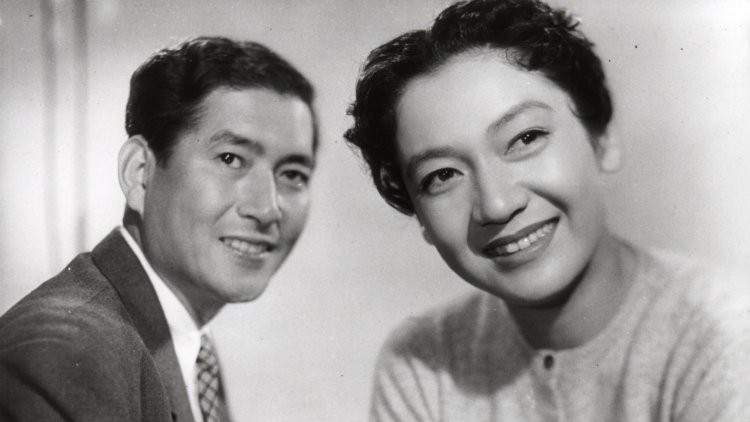
It is Sunday on the outskirts of Tokyo and married couple Fumiko (Hara Setsuko, "Late Spring") and Ryôtarô (Sano Shûji) cannot agree on what to do. When she suggests conversation, he retorts she talks while he is trying to read the paper, then complains when she takes up her knitting when he does so. Their disgruntlement is echoed both by Fumiko's niece Ayako (Kagawa Kyôko, "High and Low," "Tokyo Story"), upset by the behavior of her new husband on the honeymoon she's just returned from, and by new neighbors Hinako (Negishi Akemi, "Red Beard") and Imasato Nenkichi (Kobayashi Keiju, "Sanjuro") in "Sudden Rain."
Laura's Review: B+
Prolific Japanese director Mikio Naruse made this film the year after what many consider his masterpiece, 1955's "Floating Clouds," and they couldn't be more different in style and tone. While the former is a tragic romance set in post WWII Japan filmed in far reaching locations, this is much more limited in set and scope with Ichirô Saito's ("The Life of Oharu") almost childlike piano score telling us this is a comedy even before we begin to chuckle.
Taking place almost entirely in a suburban machiya, the traditional wooden townhouses attached in a row, with brief forays into a shopping area and the train station which transports workers into downtown Tokyo, we observe the deep patriarchal traditions of 1950's Japan in Ryôtarô condescension towards his wife and her niece. After listening to Ayako's complaints about her husband staying out all night drinking, Ryôtarô rationalizes the man's actions into a face saving episode meant to protect his wife. When an awful neighbor, Rin Ameyama (Haruko Tôgô, "Dreams"), comes to charge Fumiko with every crime imaginable after the stray dog she feeds took off with her husband's shoe, Ayako is stunned when her uncle declares finding it 'women's work' and not something he should be bothered with on a Sunday. Fumiko portrays nothing but extravagant politeness, apologizing profusely about the creature she has declared 'better than a man' and which, notably, she continues to feed. When it begins to rain, it Fumiko's neighbor, Imasato, who helps her bring in her laundry.
After Ryôtarô has admired pretty Hinako doing stretching exercises outside, he will meet up with her husband Imasato as they both brush their teeth at the ends of their yards. Imasato opines that he maybe shouldn't have married such a young woman and whan a smiling Ryôtarô notes her charm and beauty, Imasato notes Fumiko's gentle nature. Later, when Fumiko finds a felt hat that has been chewed on by 'her' dog, Imasato claims it, noting that it is no longer in fashion and 'not the dog's fault.' In addition to a clear 'grass is greener scenario going on here, it is clear who the man with more modern sensibilities is.
As in his prior film, Naruse also observes how money impacts relationships, Fumiko, so careful with the household budget called a fool when a pickpocket gets her wallet, then told to pay a ridiculous sum for an old chicken purportedly bitten by 'her' dog. But when Ryôtarô must weigh a buy out deal at the cosmetics firm he works for, he is adamant that Fumiko not work despite her desire to do so. Ironically, when his colleagues in the same boat suggest pooling funds to open a yakitori shop, it is Fumiko they nominate to run the front of house and Setsuko navigates the scene beautifully, her physicality illustrating humility while pleasure and pride shine through her expression.
She's a wonderful actress and the heart of this film, remaining optimistic while her character's good nature is assaulted, hurt only evident when the perpetrator is Ryôtarô. While Shûji's character is less likable, the actor shades his temperament with the insecurities and jealousies that fuel his behavior. Naruse and his supporting cast creates a community of female gossip and male commiseration, but if Fumiko has been the target of the first and often the dark horse of the second, the filmmaker finally gives her her due, the woman standing up for herself against her husband. The couple will surprise everyone with an outdoor contest that turns into play, Naruse sending his "Sudden Rain" out with a burst of sunshine and ray of hope.
Robin's Review: B+
Fumiko (Setsuko Hara) and Ryotaro (Shuji Sano) have been married for years and their life is in a rut. He likes movies, she does not. She likes to stay at home, he does not. When a pretty young neighbor and her new husband move in next door, Ryotaro makes it obvious he is attracted to her in “Sudden Rain.”
This 1956 film by Mikio Naruse is an almost humorous look at a 1950s marriage in contemporary (at the time) Japan. The couple has been “married a long time” according to him – it has been four years. They have become set in their ways with him burying his face in the newspaper and she pays attention only to her knitting.
One day, Fumiko’s newly-married niece, Ayako (Kyoko Kagawa), drops buy to tell her auntie that she is getting a divorce. She says that her husband is an ill-mannered lout who just wants to sleep or stay out with friends until dawn. Auntie consoles the young woman. Then, Ryotaro comes home from work and, of course, mansplains to the young woman how her husband’s behavior is easily explained and is harmless.
This sets the stage showing the conflict in the older couple’s marriage as they go their separate ways in their day to day life. He, a salesman, is facing a company merger and the threat of layoffs. She sort of adopts a stray dog who roams freely and causes trouble – which she is blamed for. Then, there are the new neighbors.
Ryotaro loves going to the movies and their very pretty young neighbor, Hinako (Akemi Negishi), does too. They make a date and we come to find out that he has a wandering eye and his wife knows it. But, the merger looms large and he is told to take a severance deal or it is just bye-bye from his employer.
This leads to an interlude where his friends and colleagues propose opening a classy restaurant. Ryotaro just needs to invest in the venture. Then, one of the men suggests that Fumiko would be perfect to become the front of house hostess. He reacts as if he was slapped in the face and is adamantly against the idea. She, though, is flattered.
Naruse gives us a unique look at married life in post-war Japan that is serous and, at times, whimsical with subtle humor. I particularly like the character arc Setsuko Hara gives Fumiko. In a society that was highly patriarchal – in other words, it is a man’s world – she proves to be his equal, standing up for herself and her feelings. He, on the other hand, is a misogynist (as the culture dictated at the time) and pretty much stays the same – until the mirthful ending.
It is nice to go back in film history and culture and get a view into another world very different from our own. I think that is one reason, in many, why I love movies. “Sudden Rain” is a good example of that view.
A retrospective of the cinema of Mikio Naruse co-organized by New York's Japan Foundation is traveling through North Ameria with screenings at the Japan Society in New York, the Harvard Film Archive, BAMPFA, TIFF Cinematheque and Vancouver Cinematheque. Click here for information about the HFA's Floating Clouds...The Cinema of Naruse Mikio and here for specific information on "Sudden Rain."

