Floating Clouds
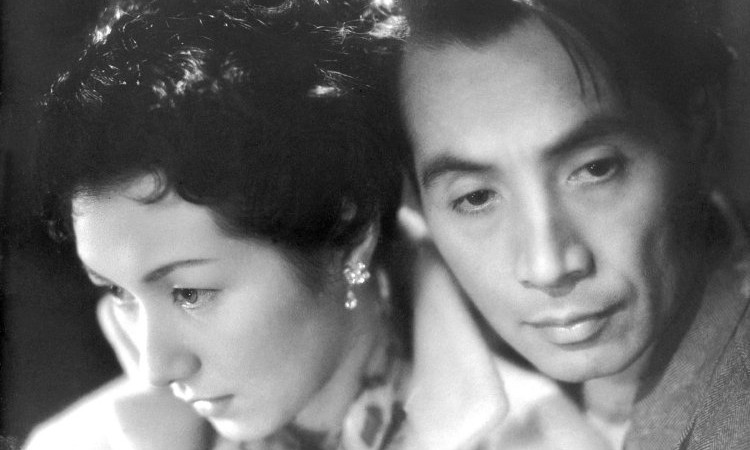
A young woman arrives at a home in post-war Tokyo, asking if a Mr. Tomioka is in. The older woman who answers leaves and a younger woman returns, asking for the visitor's name. Instead Yukiko Koda (Naruse favorite Takamine Hideko) says she is from the Forestry Ministry and has a message. When Kengo Tomioka (Mori Masayuki, "Rashomon") appears, he hustles her out onto the street where we learn they had had an affair in Indochina during the war and that he had promised to divorce his wife and marry her, but while Tomioka reneges on that promise, these two lovers keep reconnecting over the years like "Floating Clouds."
Laura's Review: A-
This 1955 film from director Mikio Naruse is a study on the economic hardships faced in post-war Japan through the lens of a tragic romance. Stunningly shot in black and white boxy Academy ratio by cinematographer Masao Tamai (1954's "Godzilla") on location from Vietnam to Tokyo to the remote, rainy Yakushima Island, unusual for its time and Naruse, "Floating Clouds" is an intimate epic with a devastating finale.
Shortly after walking Yukiko down the street, Tomioka asks her to wait so he can return to his house and get dressed, leaving her to reminisce, the first of many flashbacks Naruse employs. In stark contrast to the gloom of post-war Tokyo, the screen suddenly fills with light as she recalls herself as a 22 year-old typist, radiant in white, arriving at Japan's foreign Forest Ministry office where she immediately takes note of the handsome Tomioka (while the servant bringing tea eyes both, a telling foreshadowing). Noting his sharp tongue after he teases her, his colleague will assure her that he is 'nice,' writes to his wife every three days and has a strong sense of responsibility.' Walking in the forest the next day, Yukiko will tell Kengo she couldn't sleep because Mr. Kano got drunk and came into her room (later we will see a flashback of a similar episode, the one which caused Yukiko to seek out this distant post, another foreshadowing). Their first kiss then dissolves into the kiss they share back in Tokyo, but Tomioka feels duty bound to the woman who kept his home and his mother in Tokyo during the war. Yukiko lashes out, disparaging his wife Kuniko's (Chieko Nakakita, "Early Spring") age and appearance. This relationship would appear over, but these two cannot quit each other even as they lob accusations.
Yukiko will rely on other men to survive, including the brother-in-law, Iba (Isao Yamagata, "Seven Samurai"), who raped her years earlier, and an American GI (Roy James), but an embittered Tomioka will show up, telling her he is sending his wife and mother to the countryside and selling his house to prop up his struggling lumber business. Yukiko kicks him out when he suggests spending the night, but later agrees to go on a little trip into the mountains with him, where he talks about dying together, a romantic notion she rejects. Instead, a New Year's celebration will inspire his wandering eye towards the innkeeper's young wife Osei (Mariko Okada), whose reciprocation is obvious to all but her husband. When Yukiko discovers she is pregnant and goes to find him in Tokyo, it will be Osei who opens the door. Later, recovering from an abortion, Yukiko sees a headline about an innkeeper killing his wife in a jealous rage, Tomioka named as her lover. After his hypocritical words about 'not chasing after something that doesn't belong to you,' it will be the innkeepers' of 'you can't fight fate' that will be proven true, Yôko Mizuki's ("Kwaidan") adaptation of Fumiko Hayashi's novel 'Ukigumo' ending with another foreshadowed event, the light of Indochina and shadows of Tokyo combined via one of Naruse's most poignant flashbacks, now given additional meaning.
There is far more to this tragic tale of passion, its demise, then return as something deeper, all while its protagonists' economic situations take precarious twists and turns in their uncertain world. Takamine Hideko keeps us off balance, her youthful disregard for morality gradually revealed more as survival instinct, her emotions running deep. Mori Masayuki evolves more slowly, his final realization arriving too late. Both seem to age during the course of the film, Tamai returning Yukiko to the glories of her youth in her final closeup. Ichirô Saito's ("Ugetsu") score often sounds like snake charming music accented with a snare drum during the duo's more spitefully provocative Tokyo days, becoming more melodramatic as our protagonists' fortunes wane.
"Floating Clouds" is a tale of two people buffeted by the winds of fate in a post-war world. It is a one tragic tale woven through the tapestry of many that comprised a defeated nation struggling to find its feet, men feeling the burden of familial responsibility, women finding little recourse without them.
Robin's Review: B
A retrospective of the cinema of Mikio Naruse co-organized by New York's Japan Foundation is traveling through North Ameria with screenings at the Japan Society in New York, the Harvard Film Archive, BAMPFA, TIFF Cinematheque and Vancouver Cinematheque. Click here for information about the HFA's Floating Clouds...The Cinema of Naruse Mikio and here for specific information on its "Floating Clouds" screenings.

