Wicker
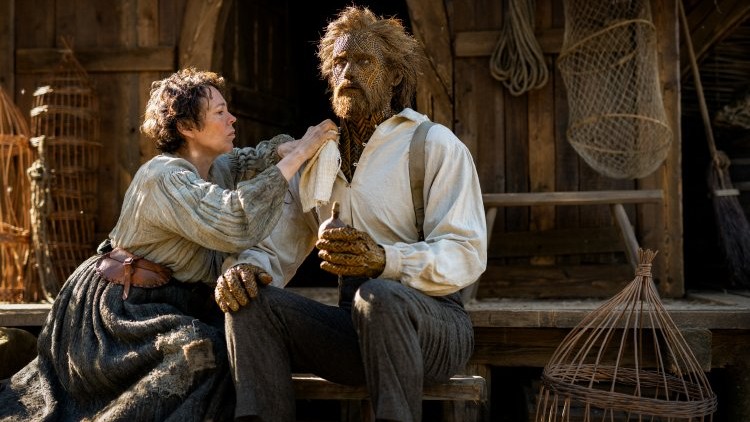
Long ago in a European village a middle-aged Fisherwoman (Olivia Colman), orphaned at a young age, had grown used to living alone. After catching and gutting her fish, she sold them in the village, mostly ignoring the remarks about her looks and smell. Everything would change when a shaken egg at the Bottlewasher's wedding indicates she will be the next to wed, but after turning down a proposal from the town drunk and ignoring Mrs. Tailor's (Elizabeth Debicki) veiled remarks, the Fisherwoman hires the Basketmaker (Peter Dinklage) to fashion her a husband made of "Wicker."
Laura's Review: B+
Married writer/directors Alex Huston Fischer and Eleanor Wilson ("Save Yourselves!"), whose first film envisioned a married couple facing an alien invasion, turn to Ursula Wills' short story to illustrate how one unconventional marriage upends an entire village. The film is a social satire cast as fairy tale, featuring a feisty Olivia Colman ('lick my worm') and courtly Alexander Skarsgård, amazingly still recognizable encased in wicker. It also teems with the type of cheeky humor which suggests an erection via sound effect.
The Basketmaker's creation heads to the village, first knocking on the Tailor's door. 'Lend me a suit because I am getting married in the morning and cannot go naked,' he requests, followed by a trip to the Shoemaker and the local inn for an evening's rest. If the Fisherwoman is, at first, somewhat awed by the figure who greets her at the altar, she is cackling in delight after a boisterous wedding night, one so energetic her bed is broken. But no fear! The Wicker Husband is handy around the house and not only is the bed repaired (for the first time), but soon her old home becomes the envy of the village. But it is not just her house that gains attention, the wives of the village swooning at her wicker man's romantic, caring words and chivalrous nature, not to mention the couple's steamy dance at the next local wedding. The men of the village are not amused when their wives begin to notice their inadequacies compared to the Fisherwoman's husband. That includes the Bottlemaker's new bride (Marli Siu), who must resort to visiting the Basketmaker in order to have a child, the second momentous event to shake up the village when rumors about its parentage begin to swirl. And Mrs. Tailor, the village matriarch who is seeing her influence slip away, isn't inclined to set matters straight.
The film has numerous things to say, beginning with the metal 'wedding collar' which equates a woman with chattel, something the Fisherwoman easily dispenses with in her evenly balanced marriage. The Wicker Husband attributes his good fortune to his wife, telling her that 'without you I'd have never seen the sun and the ocean or the clouds in the sky' and 'you are the reason I live and breathe,' neither sentiment supplied by the Basketmaker but sprung from true love. This is a true marriage of equals where the wife earns the living while the husband makes the home, although the old saying 'happy wife, happy life' also comes to mind. But "Wicker" also illustrates how darker emotions like jealousy (Mrs. Tailor) and mistrust (the Fisherwoman) can quickly bring devastation. Fortunately, there is also redemption through forgiveness.
Colman is delightful as the Fisherwoman, her bawdy bark of a laugh suggesting both happy surprise and earthy desire. Skarsgård expresses as much through his eyes as his hesitant speech, his sex appeal even encased in wicker as undeniable as his and Coleman's mutual attraction. Dinklage's philosophical soliloquies about his creations have a grandeur that elevates the Basketmaker's position within the village to almost god-like status as opposed to Richard E. Grant, who will have you laughing out loud in his brief role as the incompetent village doctor.
The production is beautifully crafted, first and foremost Wētā Workshop's prosthetic makeup designer Joe Dunckley and lead makeup effects makeup artist Sarah Rubano's astounding work rendering Skarsgård in wicker yet retaining his facial expressions and allowing movement. Production designer Renátó Cseh has created a period village defined by its craftspeople and farmers yet with its own culture. Cinematographer Lol Crawley gives the film the look of folk art, at one point employing Sam Raimi's rushing "Evil Dead" shot to highlight Mrs. Tailor's malignant influence. Composer Anna Meredith's score utilizing strings and the recorder is as idiosyncratic as its subject.
Not since "Little Otik" has a botanical creation made such a cinematic impact, but "Wicker" has a far more human heart.
Black Bear releases "Wicker" in theaters on 10/23/26.

