Magellan
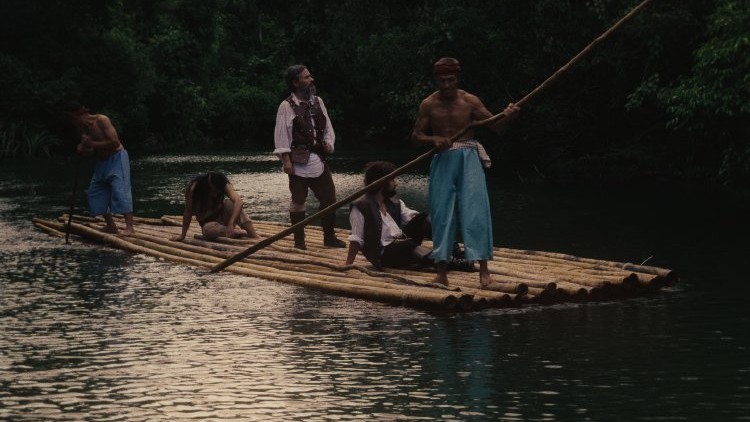
After sailing to and then assisting in the conquest of Malacca in Malaysia for King Manual of Portugal, the Portuguese seafaring explorer was convinced he could find a new route to the Spice Islands. When Manuel not only denied him repeatedly, but belittled him, the man turned to King Carlos of Spain (Victor Chesnais) who agreed to the expedition, gave him command of the Armada of Molucca and made him Commander of the Order of Santiago. He set sail again in 1519, eventually discovering a path around the southern tip of South America into the ocean he named Pacific. His name was "Magellan."
Laura's Review: B+
Filipino 'slow cinema' writer/director Lav Diaz ("Norte, the End of History") illuminates the greed, cruelty and colonialism behind what is historically cited as the greatest achievement of the Age of Exploration, Magellan's (Gael García Bernal) first circumnavigation of the globe. If you are unfamiliar with the historical details of Magellan's life preceding his historic voyage, Diaz's in media res approach, beginning with a massacre in Malacca, requires patience, as eventually the details pull together and the epic tale achieves a rhythm.
Sharing cinematography and editing duties with Albert Serra's "Pacifiction" and "Afternoons of Solitude" cinematographer Artur Tort, painterly long and two shots reveal indigenous peoples praising their Water God while Magellan triages the massacre, dragging a friend for help. In voice over narration, Bernal tells us that after this conquest and that of Cochin and Goa, next up will be Aden. Afonso de Albuquerque (Roger Alan Koza) holds court on the steps of a thatched dwelling, talking about how Islam will be wiped off the face of the earth for Christianity to rise and prepare for the Second Coming. Magellan purchases a slave, Enrique of Malacca (Amado Arjay Babon, "Phantosmia"), who will witness the rest of his life. This first act of the film, with its conquistadors clashing with indigenous peoples is highly reminiscent of Werner Herzog's "Aguirre: The Wrath of God," if less accessible in its storytelling.
Magellan comes ashore back in Lisbon to deliver news to one woman as others gathered on the beach begin wailing, recognizing their widowhood. A fifteen year-old beauty, Beatriz Barbosa (Ângela Azevedo), will treat the gangrene in his leg, later becoming his wife and bearing him two children, neither of which will survive (she will visit Ferdinand in his dreams during his voyage, Tort casting her in a ghostly white glow, like the dead woman in Manoel de Oliveira's "The Strange Case of Angelica"). Magellan's good friend, Francisco Serrão (Tomás Alves), tries to get an audience with the King for Magellan's expedition, but is also disturbed by all the greed and killings, the two breaking into a scuffle.
It is just after the film's one hour mark that Magellan sets sail for Spain's crown. He faces one scandalous ordeal after another. When captain Antonio Salomon (Paco Clares) is caught buggering a cabin boy, Magellan orders his execution, receiving pushback from Father Dela Reina (Baptiste Pinteaux, "Pacifiction"), who will later be abandoned on a remote shore with a mutineer and rations. Magellan battles with Juan de Cartegna (Max Grosse Majench) over who has overall command of the expedition. He is fired on by one of his own ships in a mutiny attempt. Finally, after a year and a half at sea and the discovery of the passage that will bear his name, he will reach his destination, the King of Cebu (Ronnie Lazaro and especially his Queen (Hazel Orencio, "Phantosmia") embracing the Child Jesus the explorer presents to them, promising he will save their son. But it will be this King's demand that Magellan conquer his enemy, Datu Lapulapu, that will bring about his downfall, the man last seen lying on a beach amidst massacred bodies.
Diaz resets the historical perception of Ferdinand Magellan as, yes, an impressive explorer but also a greedy opportunist and colonialist who spouts Christianity while neglecting to follow its tenets, a familiar picture to those in the U.S. who have rejected the celebration of Columbus for Indigenous People's Day. The production is impressive, the filmmakers shooting on open seas with replica ships and exquisite attention to period detail. It may take a while to get into "Magellan's" rhythms, but once you do the film is breathtaking in both beauty and scope.
Robin's Review: B+
Ferdinand Magellan (Gael Garcia Bernal) offered King Manuel I of Portugal his services to circumnavigate the globe – and is turned down. He then makes the offer to the opposition, the king of Spain, and strikes a deal. In 1519, he begins the journey that is based on greed, power, religion and conquering lands and people in “Magellan.”
Director Laz Diaz brings us a piece of history that, up to now, has been ignored as a subject for a film. That lack has been corrected with Gael Garcia Bernal in the title role – though, with the way “Magellan” is shot, far away from the subjects, it is hard to distinguish faces. These shots also linger for long times with little action.
But, the languid scenes and distant images do contain the story of the man who, almost, orbited the earth in wooden ships. It is no secret to anyone with a passing interest with world history that Ferdinand, with his zeal to spread the word of Christ, picked a fight with a Philippine warlord – and lost his life and those of many of his men.
Director-writer Diaz takes his time telling the explorer’s story, beginning with his 1511 foray to the Far East and Malacca in Malaysia. There, he purchased a slave, Enrique (Amado Arjay Babon), who would also accompany his master on his world tour. We get the nuts and bolts of Magellan’s planned expedition, going hat-in-hand to King Manuel, then to Charles I of Spain, who eventually footed the bill.
Magellan is fleshed out as a person through his relationship and marriage to Maria Caldera Beatriz Barbosa (Angela Azevedo), who helps humanize the ambitious and focused explorer. Once he is made human by her, the film turns to the preparation and the start of the journey. Look it up, it is one heck of a story.
We get a concise depiction of the expedition, with its violence – on several levels – generally shown in aftermath, like the battle that done him in. At two hours 40 minutes runtime, the viewer must be patient as the filmmaker takes plenty of time – usually in long, languid shots – to let the story play out,
Of course, after watching “Magellan,” I had to check the accuracy of the telling and, sure enough, Lev Diaz dotted his i’s and crossed his t’s and got all of the details – chronology, set design, costume – are accurate and true to ”history.”
Acting, with the way most of the film is shot, is secondary to the history lesson which does a good job documenting Magellan and his crews’ trials and tribulation – of the 240 who set out, only 18 or 19 completed the journey. It also shows, well, the effect that forced religion has on the people – those that embrace Christianity and those that, vehemently, do not. To force a warrior people to destroy their traditional religious icons and replace them with those of the invader, that may not bode well. I think Ferdinand might agree with me.
Janus Films released "Magellan" in select theaters on 1/9/26, expanding in subsequent weeks. Click here for theaters and showtimes.

