You Can See Everything
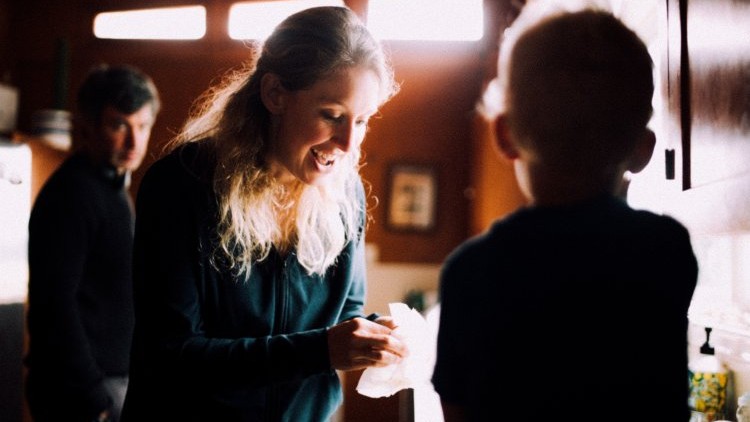
When documentarians Nathan Fielder (TV's 'The Rehearsal,' 'The Curse') and Lance Oppenheim ("Some Kind of Heaven," "Primetime") decide to bunk in with Theranos' Elizabeth Holmes and her partner Billy Evans in the days before she will report to prison for fraud, they're surprised that "You Can See Everything."
Laura's Review: A
Well, one could insert one's tongue in cheek and say that title referred to Billy Evans' shower scene, but it actually is misleading - this mind blowing exploration of just who Elizabeth Holmes is, something she herself claims to want to put out there, induces whiplash with our perception of the truth, Fielder himself apparently succumbing. This is bound to be one of the most discussed movies of the year. It is also one of 2026's best.
Throughout his career, Nathan Fielder has challenged the truth of things by acting out various scenarios, but this film finds him challenging his subjects, the socially awkward filmmaker more direct and confident than we've seen him in the past and he is front and center throughout the film's 175 minute running time, 'directing' his subjects through conversation and observation while Oppenheim apparently handles things behind the scenes (cinematographer David Bolen gets in so close, you can his subjects' pupils dilate, thought to be a sign of lying). For those who may not know, Elizabeth Holmes became the first self-made female entrepreneur worth a billion with her company Theranos, but was later convicted of fraud and bilking investors for over a half billion on a product which never could run the myriad of tests with a drop of blood she claimed it could, exposition provided briefly here with a '60 Minutes' piece Fielder watches on his laptop. The first part of this film takes place during the thirty-four days before Holmes must report to Texas for her eleven year prison sentence.
The first glimpse we get inside Holmes' San Diego beach rental is of her partner Billy on the phone explaining what's going on in the household. He gets up to reveal Liz, as she will be called here, sitting on the floor nursing one of their two children. She'll spend a lot of time looking directly into Fielder's eyes (amusingly, she will later admit that is how she flirts), her wide blue eyes a presence unto themselves, especially in profile, two transparent orbs. And she will tell him that she's never cared about money, is now deeply in debt, and has no idea why she was convicted of a crime. When Fielder pushes back, saying he's seen evidence which supports her verdict, she replies that all she has is 'her truth.' One small part of that is she and Billy's conviction that a NYT reporter's recent article quotes something Liz never said, that the media reported on a 'character she created.' They are adamant that they have audio recordings of all the interviews and that Liz never said that. The NYT stands by its reporting (later in the film's second half Billy backtracks, stating that they hadn't gotten through all their material. Billy backtracks a lot). Fielder begins to note Billy's controlling nature when he takes the bowl Liz is beating eggs in away from her, finishing the job himself. Billy begins to object to filming at certain times, but always acts like he's being accommodating.
Fielder has a forehead slapping exchange with Liz going over her actual Theranos components, Holmes explaining that the machine did work. But she's using logic recently exposed by Alex Gibney in "Musk" of an 'inventor' who makes product claims about future hoped for developments. Billy will support Fielder when he shows Liz the 'Who's on first' comedy routine ('What's the name of the player on first?' Fielder asks when it's over. Liz, who claims to have found it funny replies 'I don't know.') and proposes that Liz just thinks differently than most other people, something he ties to that earlier conversation. 'It's an apt analogy,' says Billy, clearly grabbing onto it, but he'll become jumpy again when Liz's dad appears and begins to talk to Fielder about her rape and the influence of former boyfriend Sunny Balwani, especially when Fielder asks the man if it isn't troublesome that she appears to be going into business again with a romantic partner. 'That's a good question,' Liz's dad replies.
All this is quite fascinating, but after Fielder, along with a horde of reporters, watches Liz enter a Texas prison ('you got this,' are her parting words to him), the film goes into its second, even more fascinating phase. Fielder and Oppenheim employ a bit of trickery by revealing information they've had all along that begins to cast everything in a new light. Billy is far more complicit and manipulative than we've even seen so far, which also makes us reconsider what Liz has said - or does it. Every time we think we've landed on a truth, it is again cast into doubt, and when Fielder pulls in actress Amanda Seyfried, who portrayed Liz in Hulu's 'The Dropout,' things get even more intriguing, Seyfried providing yet another perspective, including a particuarly astute closing one. What began as a month long dive into discovering just who Elizabeth Holmes is turns into a three year project, one in which Seyfried plays Liz when she or her voice are legally withheld by the prison system. Nathan Fielder has never been more compelling than he is here and he and Oppenheim, along with their cinematographer, editor Adam Locke-Norton and composer Ari Balouzian have created a unique piece of investigative work in their search for an elusive truth. And the film's closing imagery suggests Seyfried's last suggestion is uncomfortably close to it.
A24 releases "You Can See Everything" in theaters on 10/16/26.

