Victorian Psycho
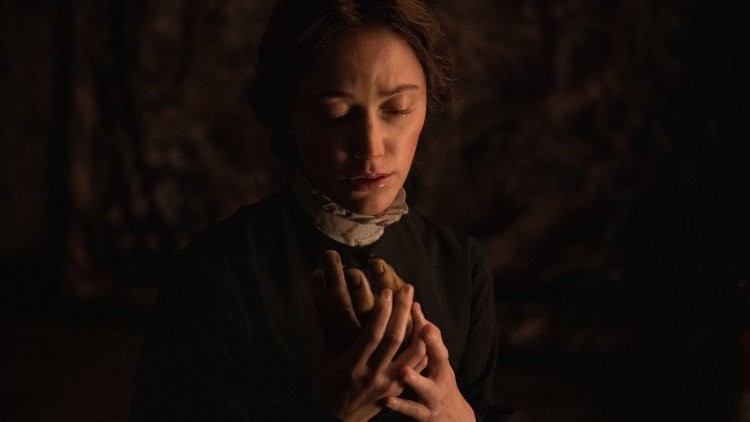
In 1858, Mr. and Mrs. Pounds (Jason Isaacs, TV's 'The White Lotus;' Ruth Wilson, TV's 'The Affair') of Ensor House hire a new governess, Winifred Notty (Maika Monroe, "It Follows," "Longlegs"), to teach their children Andrew ("Hamnet's" Jacobi Jupe) and Drusilla (Evie Templeton, TV's 'Wednesday') family history and table manners, but when other members of their staff begin to go missing, they wonder if they have hired a "Victorian Psycho."
Laura's Review: B+
From its very first frame, "Victorian Psycho" suggest both dark comedy and madness, cinematographer Nico Aguilar ("The Monkey") capturing Maika Monroe in the back of a horse drawn carriage looking like her head is about to fall off. It's a disconcerting image and the camera work in the film will continue to be a major asset, accentuating both comedy and horror with whip pans and canted angles while centered establishing character shots recall early American naive portraiture.
Winifred boldly knocks at the estate's front door only to be told to go to the servant's entrance, an action that becomes more meaningful later. She's led to her room by housekeeper Mrs. Prim (Dagmar Döring), who tells her when she's expected at dinner and that she should wash up as she smells. At dinner, as if Miss Notty's (it's pronounced 'naughty') behavior isn't already somewhat odd, several red flags are raised when she reveals that her mother died ten months ago and that she's from a small village where murdered babies had been found, but while Mrs. Pounds expresses shock at the latter, she mostly sympathizes, expressing the importance of a mother's presence, something Mr. Pounds notes is the reason they have retained a governess. Returning to her room to continue unpacking, Winifred spies a human ear on the floor and kicks it under her bed, later, shot from that ear's POV, reaching out for it and consuming it.
Winifred's relationship with the children begins rockily, at least with the precocious Andrew who immediately begins to question her (and rightfully so, the governess easily admitting that her last charges, twins, disappeared, and the little boy before that drowned). Notably neither parent seems to have anywhere near as much interest in Drucilla's education, at least until some shocking misbehavior is discovered when they host a country weekend. Then there is the gardener, who dares to appear in Winifred's room, saying his cousin worked with her and he knows her history, demanding 50 Pounds be delivered that evening for his silence. It is little surprise what will happen to him (although Aguilar and editors Dustin Chow and Lance Edmands nonetheless make the moment shocking) and Winifred is forced to make up a story when she runs into Miss Lamb, the nurse (Thomasin McKenzie, "The Uprising," swapping her usual hair color with Monroe), on her way back to her bedroom when Miss Lamb notes she saw her outside with the man. Terrified by Winifred's report of a ghoul outside the privy, Miss Lamb wishes to stay in Winifred's room, but although the governess pushes her out, a friendship of sorts has begun.
Director Zachary Wigon ("Sanctuary") and screenwriter Virginia Feito, adapting her novel, lay down breadcrumbs for a third act reveal that I, for one, still failed to see coming, and rather than being a gimmicky twist, instead comments on societal norms among the wealthy. Wigon has also fashioned the film as a portrait of madness, Monroe really stretching in a reversal of her usual final girl roles, fake teeth, an auburn wig and disembodied voices accessorizing her bizarre tics, crazy eyes and idiosyncratic way of speaking. As her 'maternal counterpart,' Ruth Wilson is vain and entitled, an amusing performance. Jason Isaacs is the epitome of the Peter Principle, believing his inherited wealth has made him the better of others, a man described by his own daughter as having 'limited mental capacity.' McKenzie digs into her "Fackam Hall" performance while flipping stations, her giggly, trusting servant no match for the conniving governess. Jacobi Jupe is once again excellent, the young actor wise and intuitive beyond his years.
As Winifred slides further into madness and the film's tone becomes increasingly darker, Ariel Marx's score ("Sanctuary"), which begins with shrill violins, becomes increasing discordant. "Victorian Psycho" is a slasher film with a lot more on its mind than mayhem.
Bleecker St. releases "Victorian Psycho" in theaters on 11/13/26.

