The Odyssey
When Agamemnon, king of Mycenae (Benny Safdie), gathers an army to invade Troy and retrieve Helen (Lupita Nyong'o), the kidnapped wife of his brother Menelaus, king of Sparta (Jon Bernthal), Odysseus (Matt Damon), the king of Ithaca, believes his infant son Telemachus would pay the price if he did not go, accepting that this war would likely have him away for years. But after his Trojan Horse gambit wins the war for Agamemnon ten years later, Odysseus decides to take a different route home, one whose trials ends up adding another ten years while back home his wife Penelope (Anne Hathaway) tries to stall the dozens of suitors jockeying to take his place in "The Odyssey."
Laura's Review: B
In the third hour of his Homeric IMAX spectacle, writer/director Christopher Nolan ("Dunkirk," "Oppenheimer") delivers a homecoming full of feeling, intrigue and action, but, ironically, his odyssey itself, while featuring standout moments, often fails to engage emotionally. The film has been under attack for months for its casting, Elon Musk, in particular, ranting about Nyong'o playing Helen, but the only casting that seemed odd is Safdie, who we never actually see without his helmet except from behind and whose voice, when finally heard, doesn't match the imposing presence Nolan and his cinematographer give the war mongering king.
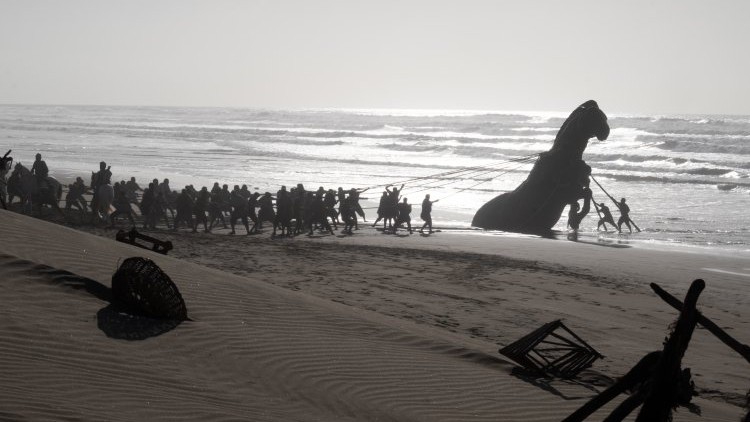
Just like Homer's epic poem, Nolan flits around the story's timeline, beginning with an out of sequence montage of Penelope's suitors, Odysseus explaining years earlier why he has to leave, then quickly trotting out his version of the Trojan Horse, here a thirty-five foot rearing animal sinking into the sands on a beach, the Greek soldier left to explain it, Sinon (Elliot Page), shot with arrows by approaching Trojans before he describes it as a gift for Athena with his last breaths. But essentially, also like the poem, we follow two stories - Odysseus' participation in the battle of Troy and long journey home and life back in Ithaca in his absence, where his now grown son (Tom Holland) tries to convince his mother to let him take the throne while the villainous Antinous (Robert Pattinson), who promised to care for them both, plots to remove the son and take the wife. Both highlight the laws of Zeus, which decreed that any visitor, even if he looked like a beggar, be treated as if he were a god in disguise, a timely theme that equates the weakening of laws with the collapse of civilization.
Nolan, who both sourced and built period ships for Odysseus' troops, makes us feel the intense labor and fear of sailing on one on open water, actually done for the film. The first of Odysseus' ordeals is one of the most exciting, their run in with the sheep herding Cyclops (Bill Irwin), which eats several of Odysseus' men and whose blinding they believe turns Cyclops' father, the god of the seas Poseidon, against them. Sure enough, their ships are battered by ferocious storms. In their quest for supplies, the men will encounter the Laestrygonians, armored giants wielding deadly swords who break apart two of their ships, then the witch Circe (Samantha Morton), who entices them with food before turning them into pigs, Odysseus convincing her to turn them back (oddly scenes like this and others, like the sacking of Troy, feel like Nolan's taken shortcuts, using close ups to suggest rather than to show) while also getting advice that sends him to Hades where the blind prophet Tiresias (James Remar) will instruct him how to get home (and also tell him he will not like what he encounters). Here is one of the few places we feel some emotional pull as Odysseus is confronted by the dead including Sinon, dismayed that Odysseus used him as a naive dupe. Tiresias gives Odysseus two choices, one which will ensure all their deaths, the other six of his men, but when Odysseus makes the latter choice, he faces a revolt that worsens when they land on an island where the sun god keeps his cattle, the killing of which promises certain death. His men, including second in command Eurylochus (Hamish Patel), eventually give in to their hunger and after they are shipwrecked, Odysseus is saved by the immortal nymph Calypso (Charlize Theron) who makes him forget his quest for seven years by feeding him white lotus. While the now aged and hirsute Damon conveys his confusion well, these scenes, in particular, feel inert, despite Calypso's professed love for Odysseus.
But things are about to pick up as Odysseus heads for home, learning that Antinous has set a trap for Telemachus, who, in defiance of his mother, has set off to try and find his father. Telemachus will visit Menelaus, who describes the Trojan Horse plot, but also cautions that homecomings can be fraught, citing Agamemnon's murder by his wife, Helen's twin sister Clytemnestra (Lupita Nyong'o), for the horrific sacrifice he made before his war. Dressed as a beggar, Odysseus saves his son and concocts a daring plot to retake his kingdom.
The most moving moment of the film arrives when Telemachus realizes who this beggar is, something any animal lover will respond to. Damon gives Odysseus gravitas, his voice low and raspy, as well as regret, his deceitful role in Troy a lesson for a future king. Holland is fine as the son in over his head, but heart in the right place. Hathaway conveys strength holding down the fort, despite the betrayal of her servant Melantho (Mia Goth). But the biggest surprise is an almost unrecognizable John Leguizamo as Odysseus' blind, loyal servant, a champion of all that is right and good. The film also stars Mrs. Holland, Zendaya, portraying the goddess Athena as Odysseus' sounding board and conscience.
Nolan, of course, hasn't included everything in Homer's tale and yet his film seems to run long. There are times, especially in the beginning, when clarity is lacking, more time spent on the reason for Agamemnon's eventual murder than his reason for waging war. Some characters, like Eurylochus and Calypso, are underwritten. Director of photography Hoyte Van Hoytema ("Oppenheimer") shot this entirely in IMAX in six different countries (Morocco, Greece, Italy, Iceland, Scotland and the U.S.), but unfortunately Universal screened this for us in Boston in a non-IMAX theater and the projection was less than ideal. Still, the epic nature of many scenes shone through, like the Greeks emerging from the Trojan Horse to open the gates of Troy to Agamemnon's army or the dead emerging from the black sands of Hades. Ludwig Goransson's score isn't so much melodic as atmospheric, utilizing ancient instruments and human voices to mythical effect.
Nolan sends his "The Odyssey" out on a high note, but the journey to get there can be bumpy.
Universal Pictures releases "The Odyssey" in theaters on 7/17/26.

