Ken Russell’s The Devils (4K Director’s Cut)
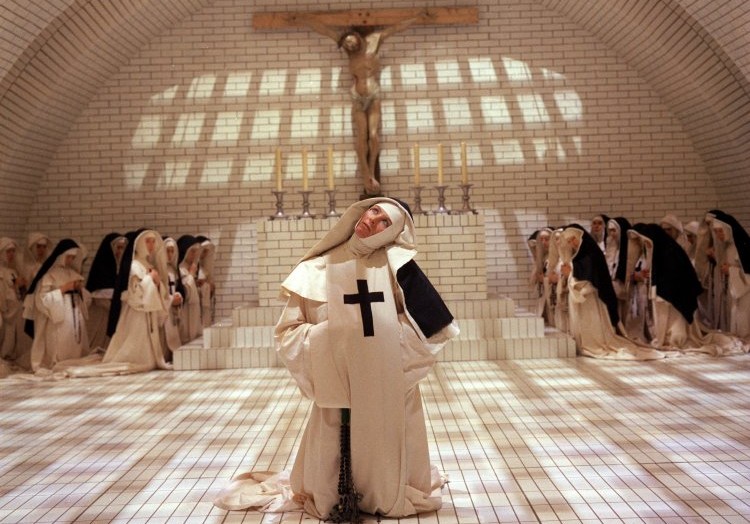
In 1643, Cardinal Richelieu (Christopher Logue), in a bid for his own power, urged Louis XIII (Graham Armitage, "The Boy Friend") to destroy the fortifications of French towns to keep Protestants from uprising. Louis agreed except for the town of Loudon because of a promise he'd made to its recently deceased governor. Richelieu's power grab was bolstered when the hunchbacked Mother Superior of Loudon's Ursuline convent, Sister Jeanne (Vanessa Redgrave), made wild accusations against the town's acting governor, Father Grandier (Oliver Reed), a man she was sexually obsessed with, in Ken Russell's notorious 1971 film "The Devils."
Laura's Review: A
The following review was originally published in 2015 based on the 109 minute version. An addendum below addresses the new 114 minute 4K Director's Cut.
The Harvard Film Archive's Furious Cinema '70-'77 series is an outstanding program of 35 mm prints of some of the most searing films of that era, including a rare showing of the restored version of "The Devils," a film that its distributor, Warner Brothers, has made difficult to see. The film, which features torture, Sister Jeanne's blasphemous fantasies and nude nuns engaged in an orgy culminating with their rape of a giant statue of Christ crucified (a sequence cut from the original U.S. release of the film) has been surrounded by controversy even before it was even released. Decades later, Russell's film is rightly considered a masterpiece.
Adapted from Aldous Huxley's nonfiction work 'The Devils of Loudon,' Russell's ("Women in Love," "The Lair of the White Worm") movie is full of the over the top, sexually explicit type of imagery the filmmaker is well known for but it is very clear that his intent was an indictment of religious hysteria and fascism. Russell uses lots of cross cutting here - Sister Jeanne flagellating herself as Grandier weds himself to Madeleine De Brou ("Bridget Jones's mum, Gemma Jones), Grandier performing Mass by the side of the road as the nuns cavort - to contrast depravity with spirituality.
Grandier himself was a controversial figure, a vain man who took lovers, but his fight to save Loudon was his redemption. Reed is fabulous here, preening and erotic, but also spiritually resolved when the tide turns against him, refusing to confess to the charges brought by the King's emissary, Baron De Laubardemont (Dudley Sutton, "Orlando"), and his witchhunter Father Barre (Michael Gothard, "For Your Eyes Only"). He endured unimaginable torture and, eventually, was burned alive in Loudon's town square.
Redgrave gives a tortured, somewhat mad performance (that unhinged laugh!) as the disfigured but beautiful woman banished to a life of rigid ritual. As Jeanne herself notes in the film, most women who became nuns did so because they were unmarriageable, making a convent full of sexually repressed women ripe for the sort of political maneuvering that goes on here. When Jeanne requests Grandier as the convent's confessor and he instead sends Father Mignon (Murray Melvin, "Barry Lyndon"), she lashes out, calling him an incubus who steals into her room at night to ravish her. A horrific exorcism, attended by tourists from all around, proves nothing, even though the King himself unveils the entire charade for laughs.
Russell's filmmaking team included future director Derek Jarman ("Caravaggio," "Edward II"), whose production design looks like a Kubrickian reimagining of the 17th century with white tiles and black columns. It is further brought to life by Russell with its plague ridden denizens and the corrupt surgeon and chemist who profit with their horrific 'treatments' (Grandier throws them out of a sick room like Christ banishing the money lenders). Modern experimental classical composer Sir Peter Maxwell Davies created a cacophonous score that sounds like an orchestra tuning up before evolving into something darker and more disturbing, perfectly accentuating the horrors we see on screen.
"The Devils" concludes with a brilliantly conceived, devastating final image. As Grandier's ashes are swept from the town square, it's fortifications crumbled all around it, Grandier's innocent wife climbs over the broken down wall towards a road heading off into the horizon, studded as far as the eye can see with mounted breaking wheels. Bruegel couldn't have captured the insanity better.
The 2026, 4K restoration from Warner Brothers' new Clockwork label:
Wow. Just wow. Comparing the 109 minute cut to this new 114 minute one is like seeing the film in color for the first time. While the 109 minute cut did include the infamous crucifixion orgy, where naked nuns penetrate themselves with various parts of the Christ statue while another twirls about with her legs spread on a fabric loop like a stripper, the sequence has been extended and flows more smoothly, as do other points in the film where the prior version featured some abrupt cuts. Everything is so vibrant, the colors incredibly rich, the blue of Oliver Reeds' eyes much more prominent. In addition to the film being restored from the original camera negative, the film's sound was also restored from the 35mm magnetic film.
In addition to my earlier review of the 109 minute cut, I would note that the confession scene in St. Peter's, where Grandier first listens to a rejected, pregnant lover, then to Madeleine's confession of love for him before ending with a flirtatious 'regular,' one of the many Loudon women lusting for the man, is one of the film's many brilliantly written sequences, this one representing multiple aspects of the flawed priest - cold-hearted entitlement, true spiritual love and impatience with fawning subjects. Russell also cast his film extraordinarily well, the faces of Redgrave, Reed, Armitage, Sutton, Melvin and Judith Paris as Sister Agnes all distinctive (one shot of Paris spying on Sister Jeanne masturbating is highly reminiscent of Shelly Duvall in "The Shining" while a stacked profile shot of a reclining Reed and Jones calls to mind "2001"). If there is a niggle to be made, it is that Michael Gothard's exorcist Father Barre has too modern an appearance, the actor looking like he just walked off Carnaby Street, but that is a minor complaint in what is otherwise a masterpiece. I gave the earlier version of this film an A-, but this new restoration receives an unqualified A.
Robin's Review: A
Note: Robin's review is based on the 109 minute cut of the film.
In 1634 France, powerful Catholic priest Urbain Grandier (Oliver Reed) flexed his personal power in defiance of King's favorite, Cardinal Richelieu (Christopher Logue). He resists his power-hungry superior, but is brought down by the mad abbess, Sister Jeanne (Vanessa Redgrave), of the local nunnery in "The Devils."
Way back in 1971, the movie world, and a few others, must have had its mind blown when director Ken Russell adapted Aldous Huxley's non-fiction novel The Devils of Loudon. I saw Russell's film some year ago and I thought it was like a psychedelic trip. Watching it again in anticipation of the restored release in 4K, it is still trippy as heck.
Huxley's work, well-adapted to the big screen, is a narrative of mysterious events that took place in the small town of Loudon in France. The story is about demonic possession, the fanaticism of the Catholic religion, sexual repression and mass hysteria in the nunnery. Russell packs this all in a stunningly graphic and artistic representation of the Inquisition that gripped Europe in the 17th century.
As I watched "The Devils" again, I was struck by the modernity of the filmmaking. Ken Russell could have made this now and I believe it would have the same impact today as it did over a half century ago. It is a pleasure to watch a masterpiece by a master filmmaker.
There is so much controversial material in "The Devils" that I can understand the brouhaha it stirred back in 1971. I think it will raise a few hackles up, even now.
Warner Brothers' Clockwork label is releasing the 4K Director's Cut of "The Devils" for one week only on 10/16/26.

