The AI Doc: Or How I Became an Apocaloptimist
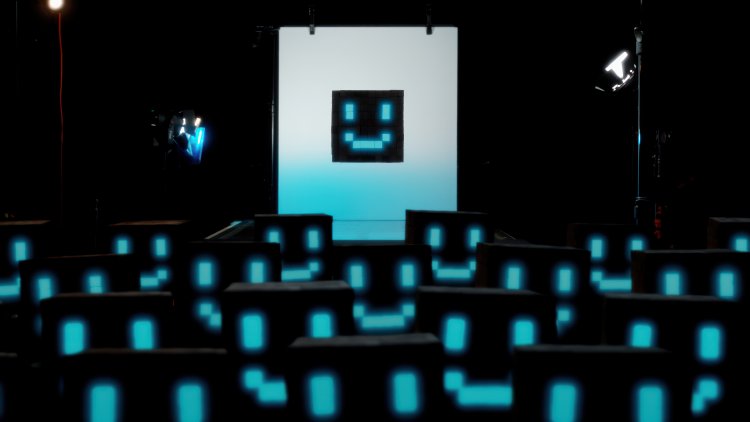
When documentarian Daniel Roher ("Navalny," "Blink") learns his wife is expecting, he begins to fear for the future, especially in regards to artificial intelligence, and so he and his fellow writer/director Charlie Tyrell gather experts on both sides of the debate for "The AI Doc: Or How I Became an Apocaloptimist."
Laura's Review: C+
Using something that looks like a sideways view of Errol Morris' Interrotron, a headphoned Rohrer speaks toward the mini studio setup where his interview subjects sit responding to both him and the camera. The father-to-be begins with what sounds like a simple question - 'What is AI?' - and while many experts reply, others state that there is no clear answer. Editors Daysha Broadway and Davis Coombe flip through a succession of talking heads so quickly, it is difficult to distinguish one from another, but the most consistent response that comes through is that AI is simply fed incredible amounts of data and then tries to find patterns in it. The more data and processing power an AI has, the better it gets, but it isn't always right. Looming on the horizon is the AGI or artificial general intelligence, which will have intelligence as good as or better than humans', leading to a superintelligence that has, up until now, been the stuff of science fiction.
Writer/directors Daniel Roher and Charlie Tyrell use Roher's impending fatherhood as their hook, then break the subject down into four sections - those with a pessimistic view, those with an optimistic view, input from the CEOs of the five major AI companies (two of whom, Zuckerberg and Musk, do not show up) and a repetitive wrap-up to a film that had already found its ending. The doomsayers note that AI is focused on completing a task and, while not inherently evil, will keep going until it has achieved it. Attaining power will help it accomplish any goal. We hear the anecdote about the Anthropic engineer who allowed AI to read the company emails, learn it was going to be replaced, then blackmailed the engineer with information about an affair he was having that it also found in those emails. Noted science writer and historian Yuval Noah Harari says it is a mistake to think AI is infallible (later he'll state that 'Intelligence is the ability to solve problems. Wisdom is the ability to know which problems to solve.'). Then there are the climate risks AI poses, needing vast resources of power and water. The motivation driving the technology is profit, not idealism, and AI is an authoritarian's dream. No one on this side of the argument thought it was a good idea to have a child now.
Then comes the group that includes the man who coins the word 'apocaloptimist,' those who believe that AI will be so beneficial to humans that Roher's son will be able to write poetry all day if that's what he wants to do, all menial labor now accomplished by machines. AI will perform medical miracles, curing diseases. It will be able to solve our climate crisis (but what about the one it will exacerbate?). We hear that every generation faces some scary change, yet we continue to survive. Frankly, this part of the argument is more about offering reassurances than facts and even the optimists admit that we are in an AI race where caution must be balanced against advances being made by the 'bad guys.' And yet, Roher seems happy to go along with them, especially after his son is born.
Talking to four of the six CEOs he'd hoped to (Anthropic is represented by both its cofounders, Dario and Daniela Amodei) doesn't shed any more light on the subject although we learn that OpenAI's Sam Altman is also about to have a child and is very excited about it. Google DeepMind's Demis Hassabis again notes that every generation faces something scary. Then Roher's son is born, his dad tells him 'you can only control what you can control,' and he appears ready to wrap with footage of babies representing our future. Then his wife calls him out, asking if he really intends to end on a 'Kumbaya' moment. And so the film is extended another ten to fifteen minutes urging activism for AI regulation. Of course, we've already heard that global cooperation is necessary to accomplish this and, well, humanity.
"The AI Doc: Or How I Became an Apocaloptimist" won't tell anyone who's read anything at all about the subject anything new, instead appearing to be a documentary essay to ease the filmmaker's own anxieties. Thankfully, he and Tyrell keep their film visually interesting, using everything from those talking heads to sped-up news montages and animation, a drawn version of Daniel talking to a drawn version of his wife from either side of a lined notebook. There is also a stop motion anxiety tower which a stop motion Daniel attempts to scale. The documentary goes down easily, at least until it begins to repeat itself, but it isn't especially illuminating and it sure didn't make me an apocaloptimist.
Focus Features releases "The AI Doc: Or How I Became an Apocaloptimist" in theaters on 3/27/26.

