Sirât
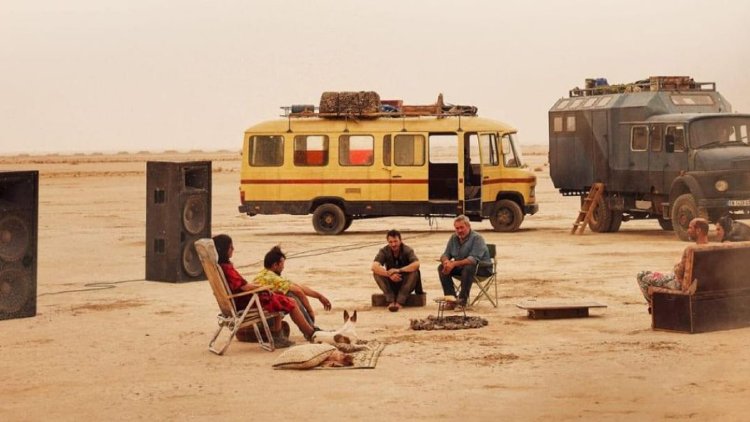
In an indeterminate future, Luis (Sergi López, "With a Friend Like Harry...") and his young son Esteban (Bruno Núñez Arjona) search for his older daughter Mar amid a nomadic rave scene in a Northern African desert as the threat of WWIII looms on the horizon. No one recognizes the girl in the picture he passes around, but when the military comes in and one of the ravers they'd talked to, Jade (Jade Oukid), stands up to a young soldier then flees in an RV and truck with her friends, Esteban demands his father step on the gas and follow them in "Sirât."
Laura's Review: A
Cowriter (with Santiago Fillol)/director Oliver Laxe's devastating film takes its title from the Islamic belief in the Sirât bridge which must be crossed on Judgment Day in order to reach Paradise. It is 'narrower than a hair,' 'sharper than a sword' and crosses over hellfire, an apt description of the latter half of Laxes's film, which, at times, recalls the more harrowing parts of "Wages of Fear." But Spain's submission for the International Oscar is very much an original, a film about connection, inconceivable loss and a dark future, all set to composer Kangding Ray's infectious dance beats.
The middle aged dad wearing a backpack looks out of place wandering through crowds of pulsing bodies, but the mostly younger, definitely hipper ravers take the time to try and help, Jade's group suggesting his daughter may show up at a subsequent rave they may or may not be attending. When Luis follows them the next day, they eventually stop to ask if he is doing just that, warning that his minivan is not up to the roads their vehicles are equipped for. But Luis tells them he has no other choice and when the group finds they do not have enough cash for all the precious gasoline they need and he bails them out, trust and camaraderie begin to build, Estaban already enchanted with Jade, Bigui (Richard Bellamy 'Bigui'), Tonin (Tonin Janvier), Steff (Stefania Gadda) and Josh (Joshua Liam Herderson).
Gradually we, along with Luis, get to know this group, Jade of the dramatic eye makeup, shaved head and forelocks inviting him in for a chat as she recycles a broken speaker, explaining, when Luis says the music isn't his style that it isn't for listening but dancing. Tonin will make a puppet out of his peg leg, amusing all. Steff gives Estaban a fade while Bigui generally clowns around, the LSD-laced excrement he failed to bury causing Estaban's little dog Pipa to become ill, something Jade quickly acts to remedy.
But when the group observes a military convoy snaking along their route, Tonin makes the decision to reroute over precarious mountain roads, signaling a major shift in the group's mood and the film's tone, the score's beats morphing into a drone. When their RV gets stuck, they stop to dislodge it, Steff at the wheel, and something so unthinkable happens it will evoke gasps. The travelers end up in need of help, but a local shepherd runs from them. Camping in an open expanse, they will try to lift their spirits, setting up two amps like monoliths in the desert, but when two begin to dance they will find to their horror that they are in the midst of a minefield. The group diminishes one by one until only three are left, traveling in a sea of refugees atop a train enroute to who knows where.
Laxe's futuristic look at migration is an astonishing work, one which is sure to leave you shaken. He's directed his nonprofessional actors, his ravers having been sourced from the streets, into a tangible community, Jade and Tonin especially charismatic. As the only professional, López carries a lot of emotional weight while representing a contrasting demographic. That these two groups bond so well is the film's most hopeful element.
Cinematographer Mauro Herce ("Samsara") makes great use of the landscape, beginning with opening shots of a wall of speakers being erected in front of a desert escarpment. Drone shots accentuate the three vehicles' isolation, especially in a night shot, their headlights slowly progressing on the side of a mountain. And while "Sirât" has been nominated for the International and Sound Oscars, the failure to recognize Kangding Ray's score is a head scratcher, so integral is it to the success of the film.
Robin's Review: A-
World War III looms on the horizon and people flock to organized raves in the middle of the Moroccan desert to ease their coming pain. Luis and his son Esteban are searching for their daughter/sister who joined the exodus five months before. They meet the kindness of strangers as they set out on their quest in “Sirat.”
What starts off as a dad searching for his teenage daughter, Mar, becomes, in the hands of director-writer Oliver Laxe, an epic story of enlightenment, despair and tragedy. The things that transpire in this father-son road trip take the tiny family through treacherous and deadly terrain.
Their story begins at a desert rave and Luis wanders through the crowd showing Mar’s photo. No one recognizes the girl. However, he does meet a oddball group of ravers – Stef, Jade, Tonin, Biguil and Josh – who tell him that they are heading to another rave being held deeper in the desert where she might be. Then, the army arrives and begin an emergency evacuation all of the Europeans.
Their newfound friends, in their sturdy all-terrain vehicles, escape the soldiers and begin their treacherous journey across the desert mountains to the new rave location. Against their dire warnings, Luis and Esteban follow in their little minivan. The journey they take is fraught with danger and becomes a bridge too far when disaster strikes and Luis is left without a family. And, things will get worse.
Director Laxe takes the simple concept of a road movie and, carefully, turns it into an odyssey of a man determined to find his daughter in a world that seems to be fast approaching the apocalypse. For the people attending the rave it is the apparent accepted of their coming fate. They seem determined to “live fast, die young and leave a pretty corpse.”
Luis’s steadily building anxiety to find his daughter, risking his and Estaban’s life to find Mar, is palpably portrayed by Sergi Lopez. His search is a constant part of his and his son’s life and, when befriended by the five ravers, he enlists them in the hunt. This is the first half of the story.
Once they break away from the pack and head deeper into the Moroccan desert, the story takes a very different direction and is best left to be viewed afresh. Let us just say that things do not go in expected directions.
Sergi Lopez is the name actor in the film. The rest are non-actors playing people who accept their upcoming fate. As such, they are believable characters who lend their kindness to the strangers, Luis and Estaban. They give the film an organic, real feel as they party hardy and dance away their fears of the future.
“Sirat” will evoke a lot of sympathy for the dad in search of his daughter, especially with its backdrop of the looming apocalypse. I can make an educated guess that you will not see the ending coming.
Neon released "Sirât" in N.Y. and L.A. on 2/6/26, expanding in subsequent weeks. Neon is also kicking off a six city tour featuring Q&A's with director Oliver Laxe on 3/2 in N.Y., 3/3-4 in D.C., 3/5 in Boston, 3/6 in Chicago, 3/7 in Austin and 3/8 in Nashville.

