Shin Godzilla
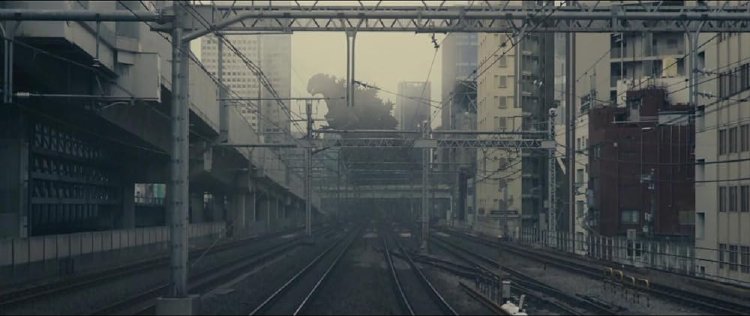
In Tokyo Bay, the Coast Guard boards an abandoned pleasure craft. A huge geyser of water spouts upward and the Aqua-Line Tunnel ruptures and floods. While Prime Minister of Japan Seiji Okochi (Ren Ôsugi) urges public calm as his government scrambles, only one man, Rando Yaguchi (Hiroki Hasegawa), shuns the volcanic theory, suggesting a giant sea creature may be responsible. He'll be proven partially correct after bringing in wildlife specialist Hiromi Ogashira (Mikako Ichikawa), but it isn't until the U.S. sends the daughter of a U.S. Senator, Kayoko Ann Patterson (Satomi Ishihara), with a classified folder that his worst fears are realized in "Shin Godzilla."
Laura's Review: B+
This 2016 Toho film from writer/director Hideaki Anno (with codirector Shinji Higuchi) is getting a well deserved rerelease from GKIDS in a new 4K subtitled version, the first time the complete Japanese version will be seen in U.S. cinemas. If you were a fan of 2023's "Godzilla Minus One," this modern kaiju story is perhaps its equal, its political satire as involving as its evolving monster. (If you are wondering what the 'Shin' stands for, it could mean new, true or god and has been left intentionally ambiguous as every interpretation works.)
As bureaucrats sit debating courses of action, Yaguchi's opinion ignored, a gigantic tail appears in the waters of Tokyo Bay in news coverage playing on a conference room television. Suddenly, everyone jumps into action, even if those actions have not yet been defined, but the subcommittees formed to react are all quickly named, none more hilariously than the 'Giant Unidentified Creature Special Response Task Force.' As the powers that be try to figure out what to do, they do all agree that they are, indeed, dealing with a sea creature and a massive press conference is called for an official to announce that there is no danger of it coming onto land - just in time for an aide to whisper in his ear that it has just done exactly that.
Do not despair at your first sight of Godzilla, which looks like it is made of some natural fiber with gills and first makes landfall wriggling on its belly with giant googly eyes which, unfortunately, do not google. It is a bit silly looking, its body like a mutant Chinese dragon, but capable of massive destruction nonetheless. Thankfully, this creature evolves and when we next see it, it will be twice the size and resemble the more familiar looking kaiju we all know and love and we will learn from those U.S. files that a disgraced Japanese biology professor predicted the emergence of Gojira, a creature that fed on nuclear waste at the bottom of the ocean. The only problem is now analysts are left to figure out Professor Maki's complex diagrams (some origami(!) will do the trick).
This leads to a debate on whether to preserve the creature for study or try to eliminate it, the latter plan quickly decided on leading to more debate as machine gun fire may allow radiation leakage, the creature already having contaminated the areas it has passed through. Logistics teams, firefighters, evacuation committees and more all scramble amidst Godzilla's chaos. After an evacuation, the Prime Minister is missing, leaving the Minister of Agriculture (Sei Hiraizumi) to step into his shoes. Then Godzilla begins to propagate and the U.N. steps in. The movie, which has been fast-paced throughout featuring machine-gun fire dialogue delivery, acquires a ticking clock as Japanese scientists rush to stop the kaiju by freezing its blood before the United States drops a thermonuclear bomb on Tokyo. And yes, parallels to WWII are quite obvious, the only other team of scientists represented speaking German while it is France who mediates, adding one more day to the timeline.
Editors Atsuki Sato and Hideaki Anno keep crack comic timing on the political front, cinematographer Kosuke Yamada having tons of fun with bizarre points of view, like a phone cradle anticipating the receiver about to be slammed down on it. Both are equally adept with action scenes, which involve aerial attacks, train bombings and timed detonations. Shiro Sagisu's score folds in the classic 1950's Godzilla theme at critical moments. And on top of all this, a romance blossoms, Yaguchi and Patterson's attraction apparent, their mutual ambitions suggesting a sequel. If "Godzilla Minus One" revived the popularity of the Toho Godzilla franchise, "Shin Godzilla" proves there is still an appetite for more.
Robin's Review: B
A giant creature emerges from Tokyo Bay and wreaks havoc across the country. The radioactive beast, after the destruction, must return to the water to cool down and replenish its deadly energy. The government, though, is confused about which department is responsible for dealing with “Shin Godzilla.”
I hearken back to another age, in the 1950s, when a monster, awakened and mutated by the hydrogen bomb testing, attacked Tokyo and the government and military worked together to stop the beast. Well, in 2016, when “Shin Godzilla” was released, the world has changed and bureaucratic red tape replaces thought and reason.
This time around, there is giant steam plume in the middle of Tokyo Bay. Then, someone captures on video what looks like a giant reptilian tale. Before those in charge can figure out what is happening, a giant creature, 100 feet tall, lumbers onto land and leaves a swath of destruction, then retires back to the bay.
The “Giant Unidentified Life Form” makes another appearance and is bigger, badder and more destructive than the first iteration. And, it is seething radioactivity. When it overheats during its path of death it must, again, return to the water to cool off and replenish its power.
While Godzilla wreaks havoc and gets bigger and more powerful, the government, first, points fingers with one department after another refusing to take responsibility. When it finally does, it is confused and ineffective. This is where “Shin Godzilla” diverges from its predecessors. Here, America sticks its nose in and threatens to nuke Tokyo. To say the least, this is a controversial idea.
This is not a rehash of the original – which was titled “Gojira” in Japan. Those were simpler times when the public, not politics, was the focus of the government response to the crisis. Here, the response to the crisis is erratic, at best, much as our own government responds to things, of late.
The cast of characters in this play is vast as. When the government finally responds to the monstrous crisis, the rebels of all walks of life are brought in to brainstorm how to stop Godzilla. Of course, the American option – use nukes – is the last resort and a third nuclear bomb on Japan is not an option as they revert to Plan B.
One of the many good things about the 1954 original is its brevity at 96 minutes. This one, though, is a full two hours and the repetitive attacks by Godzilla on Tokyo develop a sameness. The filmmakers try to justify the repetition by having Godzilla mutate – which only works sometimes – and changing Godzilla’s mode of attack, He has nuclear rays emanating from his enormous body or radioactive blasts from mouth and tail.
Gone are the days when Tonka Toys were used for the vehicles in the movie. We have evolved, I guess, to where the simpler ways are just forgotten. Kudos, though, to the filmmakers who pointedly use the original music from the best Godzilla ever!
GKIDS releases a new, 4K subtitled restoration of "Shin Godzilla" in theaters on 8/15/25.

