Pressure
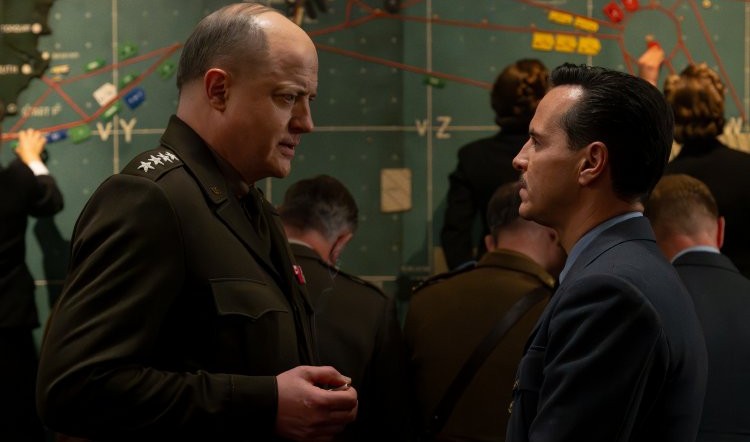
Six weeks after the disastrous dress rehearsal for D-Day known as Operation Tiger resulted in the deaths of almost 800 American soldiers, Dwight D. Eisenhower (Brendan Fraser, "The Whale") is facing the final 72 hours before the actual event and is getting conflicting weather information from his own guy, Colonel Irving Krick (Chris Messina, "Air"), who insists the weather will be fine, and his Chief Meteorological Officer, Dr. James Stagg (Andrew Scott, "Blue Moon"), the 'genius' recommended by Churchill who predicts a catastrophic storm on June 5th in "Pressure."
Laura's Review: B+
This must be the most exciting movie ever made about a weather report. Adapted by the play's author, David Haig, with director Anthony Maras ("Hotel Mumbai"), "Pressure's" title describes not only a threatening weather front, but what the men sequestered at Allied headquarters in Southwick House were feeling with literally millions of lives and the trajectory of history weighing on their heads. And while there have been many films about D-Day from "The Longest Day" to Steven Spielberg's indelible portrayal of the event in "Saving Private Ryan," this focus on what led up to it is a little known piece of history that required different, but very real bravery.
After witnessing Dr. Stagg tenderly take leave of his heavily pregnant wife Liz (Tamsin Topolski), we see his socially awkward side when he arrives at Southwick, his abrasive behavior at stark odds with his chummier American counterparts and fellow Brit Kay Summersby (Kerry Condon, "The Banshees of Inisherin," F1: The Movie"), the aide to Eisenhower who will ironically be the one to recognize his worth and procure her boss's ear. The focused Scot, however, makes his first impression with Summersby by asking why she's in his office and demanding that she leave, nothing on his mind but rolling up his sleeves and diving into the task at hand. He'll meet Krick grabbing her for a dance as the Americans jam around a piano that Stagg immediately orders removed.
What the Allies must have for a successful D-Day invasion is the element of surprise, the light of a full moon and waves under six feet. It is Friday, June 2 and Eisenhower has set Monday, June 5 as D-Day and he is now requiring his Chief Meteorological Officer to do what Stagg tells him is impossible - predicting weather more than 24-48 hours in advance - especially given Northern Europe's erratic weather systems. But Stagg gathers data from a 2,000 mile radius around the Allies' target and concludes a major storm will come in with waves as high as 10 feet and significantly reduced visibility that would stymie air cover. When Krick insists on beautiful weather by relying on past forecasts to predict the future, Stagg deems the method moronic and denies him access to Eisenhower's go/no go meeting. Neither Eisenhower nor Bernard 'Monty' Montgomery (a deliciously amusing Damian Lewis, PBS's 'Wolf Hall,' "Fackham Hall") are happy to hear Stagg's report, especially as their next window would be June 18, an impossibly long time to keep the plans secret and so when Krick goes crying to his boss about Stagg, Eisenhower is perhaps too eager to hear a dissenting opinion. With everyone on edge, Stagg gets a phone call that his wife was admitted to St. Mary's Hospital in London, but it was subsequently bombed and his wife's whereabouts are unknown.
Maras and Haig shrewdly parallel American/British friction, Eisenhower and Stagg, the two men in charge, continually interrupted by Montgomery and Krick, their brash, more flamboyant underlings. Fraser, his head shaved for the role, does a lot of bellowing, but also exhibits the weight of history on his shoulders, the man still grieving the loss of so many due his insistence on using live ammunition during a training exercise also botched by a communications breakdown. Lewis brings a puckishness to Monty's infamous ego while Messina exudes American can-do confidence with an underlying lack of seriousness that Scott brings in spades. His is the subtlest performance, unwavering in his opinion, fiery just once, when Eisenhower finally asks him just why Krick is wrong. Yet despite his early abrasiveness, it is Stagg who quietly and diplomatically brings a subdued Krick back into the fold to find a surprise solution once Stagg's forecast is proven right. Condon is invaluable support as the woman who helps bridge divides, her Summersby softening towards Stagg when she witnesses his anticipatory grief, then appealing to Eisenhower to bring him around.
If the film has a flaw, it is the resolution to Stagg's personal anguish, a situation that provides him empathy but one mostly forgotten until the film's final, not quite believable moments. But Maras has kept the action - men in rooms with maps occasionally intercut with brief snippets of battle - intense until that point. Production designer Daniel Taylor ("Mr. Turner") went to incredible lengths to ensure period realism, right down to the paper stocks and inks used to recreate weather maps. Cinematographer Jamie Ramsay ("All of Us Strangers") captures the weather in all its variations, dark paneled interior scenes just as dynamic in composition as soldiers fighting surf heading towards a beach, victory signaled with a long shot of one man cresting a cliff beside a German entrenchment.
Focus Features releases "Pressure" in theaters on 5/29/26.

