Possible Love
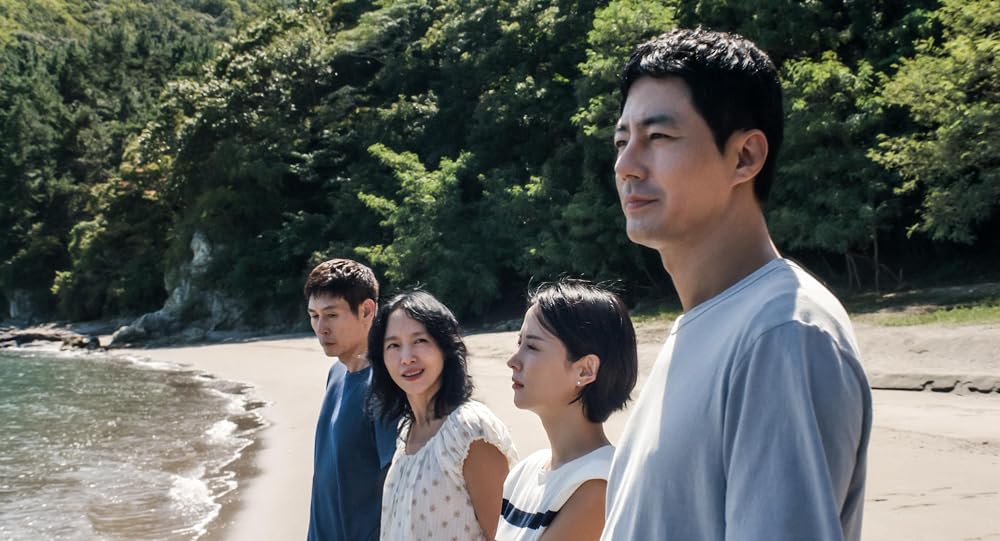
Two years after her husband Ho-seok (Sul Kyung-gu, "Oasis") was badly beaten during a strike against SP Heavy Industries over a 40% reduction in staff, Mi-ok (Jeon Do-yeon, "Secret Sunshine") agrees to be part of a documentary about corporate restructuring that will focus on his former company. Soon she and 'director Lee,' who insists Mi-ok call her Ye-ji (Cho Yeo-jeong, "Parasite"), have become fast friends, but Mi-ok is obviously crushing on Ye-ji's wealthy husband Sang-woo (Zo In-sung, "Hope") while Ho-seok opens up to Ye-ji but not Mi-ok in "Possible Love."
Laura's Review: A
Originally part of a project to remake the ten episodes of Krzysztof Kieślowski's "Dekalog," cowriter (with Jungmi Oh, "Burning")/director Lee Chang-dong's ("Oasis," "Poetry") latest became a standalone film but is still tied to the original project by its opening title card, 'Thou shalt not covet,' and its dedication to the memory of Dekalog: Ten and Kieślowski’s longtime collaborator, Krzysztof Piesiewicz. It also marks the second year in a row that South Korea has submitted a film for the International Oscar dealing with post-layoff trauma after Park Chan-wook's "No Other Choice" last year, although Lee's film primarily explores martial bonds and class differences.
As they drive to a funeral, we can see Ho-seok cares about his wife by the way he massages her neck, but we also see things are not right when he at first refuses to go in, then does so and begins to drink soju, Mi-ok objecting that he'd promised to only drink at home, Ho-seok having a history of getting into fights in public. Shaken, Mi-ok goes outside for a smoke, loses her wedding ring and begins to look for it around a pricy sports car which turns out to belong to Song-woo, who finds her ring just as his wife joins him. A short time after that chance meeting, Ye-ji will be picking Mi-ok up at work in order to meet Ho-seok for an interview, but she's so taken listening to Mi-ok talk about an incident in her childhood she films Mi-ok. Mi-ok takes the opportunity to clandestinely take a picture of Ye-ji's handbag in order to price it, shocked at its cost. But Ho-seok ducks the interview, then walks out of a planned meeting with the director of a therapy group for laid off workers ('the dead,' Mi-ok says they're called, the colleagues who survived the lay-off called 'the living'). When he ends up following one of 'the living' from a bakery to a restaurant after buying his son Cheol (Jung Seol) a birthday cake, he realizes therapy may be what he needs. He'll have another incident with a former colleague, though, when Ye-ji convinces Song-woo to take the Choi family out to dinner, a dinner where Mi-ok says Song-woo looks like Steve Jobs who she clearly admires.
The two women, who got tipsy at that dinner, continue to work together, Mi-ok's recollections leading into flashbacks of both her relationship with Ho-seok and the early days of the strike. She'll also confront Ye-ji about her expensive wardrobe, noting it may not be the most suitable for interviewing laid off workers (embarrassed, Ye-ji next appears in a t-shirt similar to what Mi-ok wears). Song-woo will also suggest Ye-ji is 'method acting,' making friends with folks that are not like her, but Ye-ji insists she loves these people as a documentarian must love her subject. Then she invites the Choi family to vacation with them at Song-woo's family estate overlooking the ocean and all the simmering tensions will come to a head.
Lee and Oh's subtle, complex writing gives Lee and his troupe a multi-layered adult drama which gives its audience the breadcrumbs to arrive at many truths. While Le-ji is fascinated by and sympathetic towards the trials experienced by blue collar workers, getting Ho-seok to open up on camera about his repressed trauma, Mi-ok, who has been dealing with her husband's closed off depression, is impressed by the wealth Le-ji takes for granted as well as her handsome husband. But when Mi-ok appears to be on the verge of fulfilling her desire skinny dipping with Song-woo on his beach, she suddenly sees the man for the first time and the filmmakers have worked in a shattering implication about Song-woo's potential complicity in the Chois' troubles. They've also artfully echoed that earlier childhood memory of Mi-ok's with her son and Song-woo's 'house fairy' Min-sok (Kang Chang-gwon), the earlier implication that Mi-ok's mother wished to shield her from a blue collar career now compounded as evidence that class barriers cannot be crossed.
Min-sok also watches events unfolding in and around the estate on security cameras, paralleling Ye-ji's intrusive filmmaking.
Each actor adds just what the film needs, creating an impressive ensemble of which Sul Kyung-gu is the standout, her conflicted yearnings laid bare. Sul Kyung-gu conveys a deeply troubled soul whose emotions eventually erupt, his flashback to the strike far more brutal than his wife's recollections. Cho Yeo-jeong presents a perfect exterior, revealed, in the end, to maybe not be as happy as Je-yi would like to project because while Zo In-sung radiates a cool as Song woo, what's underneath may not be as appealing. One of these couples is left in a far better place than the other. The production is beautiful, cinematographer Kim Ji-yong capturing beauty at a car wash or in the moon as easily as the savagery of a beating or the comedy of a drunk man urinating. The whole rides upon composer Jung Jae-il's gentle piano score, although it may just be the sound of birdsong one recalls more vividly.
Netflix releases "Possible Love" in theaters on 10/23/26. It begins streaming on 11/06/26.

