Nuremberg
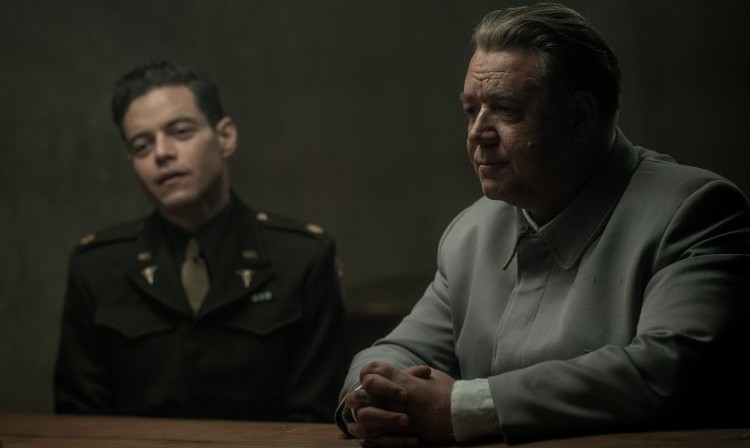
After WWII had ended, Supreme Court Justice Robert H. Jackson (Michael Shannon) was intent on putting the Nazi brass responsible for the Holocaust on trial, fearing straightforward executions would lead to historical revisions if their crimes were not aired publicly. The first of its kind tribunal formed with the United States, Great Britain, France and Russia, hired psychiatrist Douglas Kelley (Rami Malek) to ensure the men were fit for trial, but Kelley would become obsessed with cracking what made men evil while meeting with the highest ranking Nazi still alive, Hitler's second in command, Reichsmarschall Hermann Göring (Russell Crowe) in "Nuremberg."
Laura's Review: B+
Writer/director James Vanderbilt ("Truth") reveals some of the lesser known aspects of the Nuremberg trials while pointedly highlighting historical lessons relevant to today. Not only do we learn about just how extraordinarily novel these trials were at the time, but get an in-depth look
at the wily Göring and the psychiatrist who crossed ethical boundaries on both sides of the line.
Vanderbilt's adaptation of Jack El-Hai's 'The Nazi and the Psychiatrist' focuses on this relationship, Kelley seeing a golden opportunity for fame and fortune by writing a book about the roots of evil, something Göring quickly sniffs out. Kelley's something like a forerunner of the F.B.I. serial killer profilers who rose in the early 1970's. The film begins with Jackson, though, who, while an excellent lawyer, doesn't quite know what a minefield he's about to step into putting Göring on the stand, something which Kelley will reluctantly help him with, breaking professional client privilege. We also learn about Sgt. Howie Triest (Leo Woodall), the translator assigned to Kelley who, we will learn, is actually a German Jew whose parents immigrated to the United States in time to avoid tragedy.
When Kelley's lips get loose trying to impress a pretty female journalist, the base's furious Colonel Burton C. Andrus (John Slattery) brings in second man, Dr. Gustav Gilbert (Colin Hanks), and the two clash immediately. Kelley is eventually decommissioned when it is discovered he's been secretly visiting Göring's wife relaying letters between the two, but stays to witness the trial, a tense affair, Jackson walking right into the trap Kelley had predicted, only to be rescued by his British counterpart Sir David Maxwell-Fyfe (Richard E. Grant).
Malek is fine as the very flawed Kelley, and Shannon exudes the gravitas of the situation while also having some fun blackmailing the Pope in exchange for his support, but the film belongs to Crowe, who hasn't been this intriguing in a movie in some time, the actor packaging sly manipulation with charismatic charm.
Robin's Review: B+
In 1946, the famous Nuremberg trial of the top Nazi leaders was in session. A US Army psychiatrist (Douglas Kelly (Rami Malek), is given the commission to examine these high-ranking defendants for competency, especially the star prisoner, Hermann Goering (Russell Crowe), in “Nuremberg.”
The Nuremberg trials, the decisions, the preparation and the judgment itself are the backdrop for director James Vanderbilt’s interpretation of the trial of the century. The story, though, focuses on the relationship between military shrink, Kelly, and the former second-in-command of the Third Reich.
What starts out as a straightforward psychological mission for the army analyst becomes an obsession as he delves into the life and mind of his favorite Nazi subject. It is a cat and mouse game where the roles reverse several times as Kelly and Goering lock horns, with each vying for the upper hand. And, Kelly crosses ethical boundaries in a couple of ways in the course of his analysis and evaluation.
The trial part of the story centers on Justice Robert Jackson (Michael Shannon), the barrister personally selected by FDR to lead the prosecution of the top 22 Nazi officials, civilian and military. The entire trial – charging the defendants with war crimes and crimes against humanity – had no precedent and the International Military Tribunal was born. The members of the four powers (AKA the winners) – the US, the USSR, Britain and France – decided against a show trial or summary executions. Thus, the Nuremberg trials were held with all the trappings of a legitimate court. (The defendants may have differed with that analysis.)
The procedural of the trial is handled in a matter of fact way – we know exactly how things will turn out, at least I did – with all of the players presented. But, of course, the main prisoner, Goering, is the star of the lot and Russell Crowe plays up the prima donna that the #2 Nazi in the Reich was.
The meat of the film is the interaction between Kelly and his “patient” as they play verbal chess – Kelly asking pressing questions and Hermann doing his best to avoid answering them. Malek gives dimension to his performance but Russell Crowe provides his best acting in years and dominates when on screen.
For a history student, the characters presented are a who’s who in the Nazi hierarchy, like Rudolph Hess (Andreas Pietschamm), Karl Donitz (Peter Jordan) and Julius Streicher (Dieter Riesle) and more. The attention to the details of the trial – down to showing the footage from the liberated concentration camps – fits the somber tone the film conveys.
James Vanderbilt, in his second time at the helm, adapts the source material, Jack El-Hai’s book, The Nazi and the Psychiatrist; Hermann Goering, Dr. Douglas Kelly, and a Fatal Meeting of Minds at the End of WWII. There is a nice balance between the Kelly-Goring story and the trial of worst men on earth. With the horrors of war still raging in parts of the world, we might be establishing a new level of war criminal. Let us hope they come to justice, too.
Sony Pictures Classics releases "Nuremberg" in theaters on 11/7/25.

