My Father’s Shadow
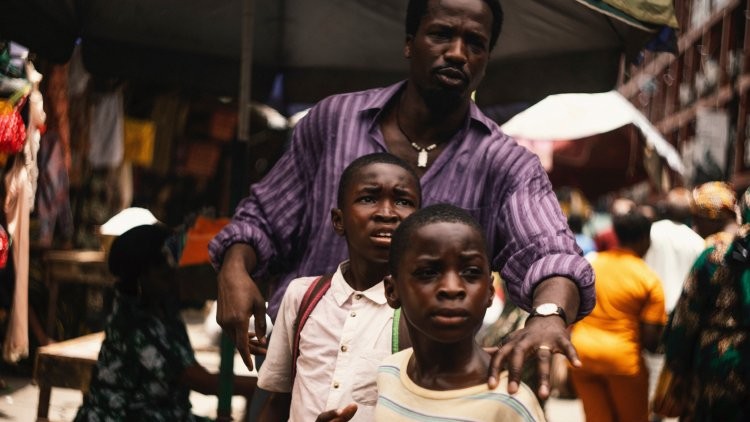
Eleven year-old Remi (Chibuike Marvellous Egbo) and his eight year-old brother Akin (Godwin Egbo) are waiting for their mother to return from the village when they realize their father, Folarin (Sopé Dìrísù, "His House," TV's 'Gangs of London'), who they rarely see, is home unexpectedly from his job in the city. Unable to wait for his wife to return in order to conduct important business that day, Folarin delights his sons by taking them along into Lagos where citizens are anticipating celebrating the results of their 1993 election. While Folarin faces obstacles trying to secure his past six months pay, he ensures his sons have a day to remember, but the soldiers always glancing his way suggest other business afoot in "My Father's Shadow."
Laura's Review: A
Britain's submission for the 2026 International Oscar is the incredibly moving feature debut of filmmaking brothers cowriter/director Akinola Davies Jr. and cowriter/producer Wale Davies. As two wide-eyed little boys experience both the hustle and bustle of Lagos and a side of their father they've never seen for the first time, we are given hints about Folarin's political activity as newscasts and headlines proclaim the Bonny Camp massacre has been denied by the military, something he debates with other passengers on a crowded bus.
That bus will run out of gas, the first of many instances that will find Fola finding alternative means of transportation, taxis now charging exorbitant rates due to fuel shortages. But hope is in the air, pro-democracy presidential candidate Moshood Abiola, known as MKO, ensured a landslide victory. And the first person the boys see their father interact with, Corridor (Olarotimi Fakunle), is the first of many to hail him as 'Kapo,' a term signifying leadership and respect. The boys are astonished to see their dad slip him some cash. Fola will be greeted the same way by Emeka (Gregory Ojefua), who tells him he just missed the supervisor, but the man will return for the night shift. After telling Fola he successfully got his own back pay by having his wife sit outside the man's office with his newborn twins, he encourages Fola to show his boys the sights and return.
Cinematographer Jermaine Edwards ("Bronson," "Pride") counterintuitively uses a lot of tight close-ups over the course of the day, emphasizing both the crowded nature of Lagos as the boys experience it and the tight bond being forged between father and sons. One of the boys will periodically see a woman watching them, who will turn out to be their mother, Bola (Efòn Wini), an imagined presence completing the family, but one will also be the first to spot Aunty Seyi (Tosin Adeyemi), an unexpected and joyful family reunion between his father and father's sister. They'll then all board a motorbike for a surprise visit, Fola pointing out the drama theater their mother spent much of her college years at along the way. On their arrival, an old caretaker, Baba (Ayo Lijadu), will take a minute to recognize the man he probably hasn't seen since those days, inviting the boys to ride anything they want in the amusement part beyond the gates. But the film's most moving scene happens afterwards, Fola taking them to a beach and into the ocean, telling them (and us) that 'family is everything,' but also that 'everything is sacrifice - you just have to be careful not to sacrifice the wrong thing,' the man recognizing the importance of spending time with his family in addition to providing for them. Then, sitting on the beach with Remi, he'll give the boy the necklace we saw him don that morning, explaining that it belonged to his brother, who was afraid he would not be remembered, the reason Remi is his namesake. (Something else from the morning, a piece of folded fabric Fola takes from a bag, will have momentous significance in the film's last scene.)
Back in the city, things will take a downturn. Fola's boss has not returned as Emeka had expected and the man pushes his friend to join him for a toast to his twins. Facial expressions reveal that there is something going on between Fola and the waitress, Abike (Uzoamaka Power) who takes his and his boys' order, something Remi will be shocked to confirm when he pays a trip to the men's. Then their entire day and attempt to return home will be thrown into chaos when the military government announces on television that the election results are being annulled because of 'irregularities,' a gut punch to Nigerians hoping for democracy.
The Davies brothers sprinkle their film with allusions to Fola in the form of street preachers, their film's title perhaps a reference to St. Peter's Shadow, and they'll utilize a bit of magical realism in their penultimate scene that suggests the man will always be watching over his sons and Remi has taken his father's tale about his brother to heart. Sopé Dìrísù rises to the immense challenge of portraying this man determined to right his own father's wrongs, an imperfect man who nonetheless loves his wife and boys above everything. His is an indelible performance, buoyed by the natural instincts of the squabbling Egbo brothers, who, amazingly, were cast before the filmmakers knew they were actually brothers and who are both combative with and supportive of each other, different yet inextricably connected. "My Father's Shadow" is an emotional knockout.
Robin's Review: A-
11-year old Rami (Chibuike Marvellous Egbo) and his 8-year old brother Akin (Godwin Egbo) unexpectedly run into their father, Folarin (Sope Dirisu), back from his job in far off Lagos. Akin begs his dad to spend more time with them. So, on a whim, and with mom away, he decides to take the boys with him back to his job, but things do not go as planned in "My Father's Shadow."
Set in 1993, during the election for a democratic government, Nigeria is in the throes of an economic crisis, with gasoline in short supply and military presence all pervasive. Travel is difficult with public transport running out of gas and everyone scrambling to find any transportation. At more than one point the father and his boys hitch a ride on a motorcycle!
Sope Dirisu gives a powerful performance as a man torn between the need to work and earn money and the needs of his family, especial his youngest son, Akin. He is a prisoner of a bad economy, a political system in upheaval and a military wielding an iron fist on the country's citizens.
Director Akinola Davies, with co-writer Wale Davies and his star Dirisu, create a character study and a political period piece that shows the struggles of a father trying to care for his family, financially, and spending his scant time to make it up to them. There is often heaviness in his heart as he tries to get the six months back pay he is owed and attempt to be the father he often cannot be.
The Egbo boys do a fine job being kids and brothers. There is a bond between the boys and their dad that is palpable and real. He is protective of them but helpless, too, in the face of no pay and a suspicious military ever present.
Davies puts us into the political turmoil gripping Nigeria as a backdrop to Fola's personal story. You get to know the man, as when the boys realize that the waitress at a Lagos café, Abike (Uzoamaka Power), is more than that to their dad. This prompts Akin to ask his father the question, "Do you love mommy?"
This is more than a mere road trip by a father and his sons. It is an adventure in many ways for the kids who see things they have never seen before. And, they get to spend time with their dad.
Mubi released "My Father's Shadow" in select theaters on 2/6/26, expanding in subsequent weeks. It is having a limited run at Cambridge's Brattle Theater on 4/16/26. It will also begin streaming on Mubi on 4/10/26.

