Living the Land
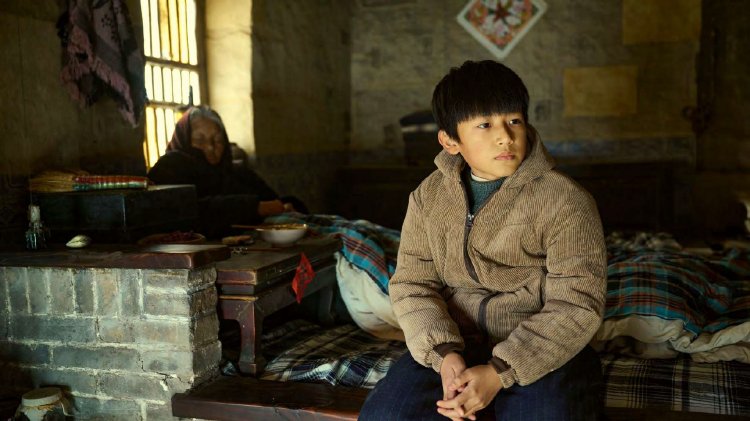
In 1991, 10-year-old Xu Chuang (Shang Wang) is the third child of Xiuli and Xinmin during the time of China's one child policy. While his parents and two older siblings have moved to the Southern city of Shenzhen for work, they have hidden him with his Uncle Tuanjie (Zhong Wan) and Aunt Guifang (Cao Lingzhi), rural wheat farmers in Xiuli's home village of Bawangtai in the Henan province where he will experience "Living the Land."
Laura's Review: A-
Writer/director Meng Huo's ode to a disappearing way of life, one he knew as a child himself, was filmed over the course of a year so he and cinematographer Daming Guo could take advantage of seasonal changes, documenting the extended, communal families of one village as they harvest wheat by hand, turn cotton into quilts, bake bricks and till the soil for new crops. Huo also frames his narrative within a country undergoing profound change, industrialization causing vast migration by people held in check by a government that regulates their very bodies as well as their productivity, demanding grain fees for their children's education and 'tributes' to local party reps. This unhurried but thoroughly absorbing film, only Huo's second, won the Silver Bear winner for Best Director at the 2025 Berlin Film Festival.
Huo immerses us in Chuang's world as his parents arrive for the funeral of a family matriarch, an elaborate ritual complicated by the decision to find, unearth and rebury her bandit son, Li Bao's, bones alongside her. Chuang's beloved 23 year-old aunt Xiuying (Chuwen Zhang) ensures everyone has the appropriate mourning hats and walks alongside her older sister, Chuang's mother, as Xiuli wails loudly in a show of grief, stopping to have a regular conversation before loudly lamenting again. Huo steps back, allowing Guo's painterly, floating pans to take in the long, snaking line of mourners as they parade through verdant fields. Bowing rituals are upheld as graves are dug and once coffins have been buried, the elaborate wooden coffin carrier is set afire.
After Chuang's parents have again left for the city, we'll learn that Xiuying will take the place of her heavily pregnant sister-in-law for the enforced pregnancy tests women are subjected to by the state. An official, Gongchang (Mao Fuchang), will note Chuang calling her 'aunty' and Xiuying, expecting to only have her belly prodded, is subjected to a far more invasive exam. Worse, her brother will take his wife to a hospital to deliver their child, resulting in its official documentation, and the family's subterfuge will have horrific implications for Xiuying later.
In addition to the forced sterilizations of the one-child policy, Huo illustrates the fate of the mentally disabled with Chuang's twenty year old cousin Jihua (Zhou Haotian), who is mercilessly teased by the other boys and beaten by his father when a neighbor complains that he has destroyed her cotton plants (notably, this same neighbor will defend the boy once she witnesses his punishment). Only Chuang, Jihua's hard-working mother Guifang and Chuang's Great-grandmother (Zhang Yanrong) care for the boy, who eventually suffers a horrible and cruel fate, seemingly left to die rather than be attended to after an 'accident.' Jihua's younger brother Laidan (Jiang Yien) will be humiliated when his mother sends him to school with wheat for his fee which has already sprouted, the struggling farmers attempting to get away with anything they can, but she will give Chuang the three yuan necessary to secure Laidan's place.
A wedding, Xiuying's forced one to Gongchang to ensure the state does not charge the family for its extra children, produces a beautiful bride, but one who looks like she is heading for an execution. Notably, she sends Chuang off in the night to deliver a letter to the local teacher, Guo. Guifang stands crying as her daughter leaves on a bus only to be manhandled during her wedding and not to be seen again until the New Year celebration which ends the film (and where Xiuying will tell Xiuli she wants a divorce). In her absence, Chuang grows ever closer to his great grandmother, ensuring that the woman who once slipped him candy now gets a share of his own. During a local census, we learn she does not know her name and so is registered as Mrs. Li-Wang 3. The older women share stories that echo Xiuying's situation, theirs with even less agency. Soon after Chuang asks her if she is 'afraid of cremation,' he will be responsible for the urn holding her ashes, inadvertently letting it fall when their wagon becomes mired in mud, the ashes strewn on the ground and lifted by the wind towards the river, just as she had prophesied.
Throughout all this hard work and toil, there are moments of great joy, popsicles shared during a rest from farm work, the family gathering around platters of food to celebrate holidays, the boys playing in the river. With "Living the Land," Huo memorializes a past way of life, extended families toiling for the common good. A small tractor is introduced at film's end, the male farmers talking about the comparative wonders of American farming machines. The film is melancholy and beautiful, like a pastoral landscape animated with living characters Huo makes us care about.
Robin's Review: B+
1991, China. In Bawangtai village, the farm community bustles with life. For 10-year old Chuang, it is a time of both tradition and impending change. The country has been living under a restrictive one child policy for over a decade and the economy is beckoning the younger workers from the country to the city in "Living the Land."
I expected this to be a treatise on China's long term restriction on births to bring down the population numbers. It worked, but not in the way that the Communist government anticipated and resulted in a mass migration to the cities.
The rural world is shown through the boy's eyes as the adults in the village cope with the all-controlling hand of the government bureaucracy intruding into their lives – especially for the women, who are ordered to be examined to make sure the laws are enforced.
This, though, leads the people to do what they can when extra, unexpected births take place – like enlisting grandma and granddad to claim the child as their own, Writer-director Meng Huo does not dwell on the one-child policy, though. Instead he gives us a slice of rural Chinese life during the transitional 1990s.
The two plus hour film does take its time telling its slice-of-life tale. While Chuang is the ostensible focus, the vast cast of characters, all related or inter-related in some way makes for a huge extended family sage. The remarkable thing is the filmmaker lets us keep everyone straight in our head.
I may have been challenged by the huge cast and varied stories that intertwine, but the main story has a positive arc and flow through a boy's eyes.
Film Movement released "Living the Land" in select theaters on 4/3/26. It is available for home viewing on 7/3 and upcoming theatrical engagements can be found here.

