Life of a Shock Force Worker
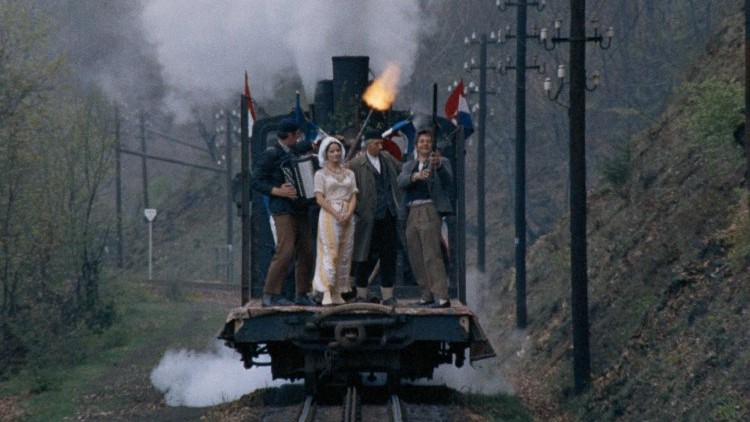
In Yugoslavia, Bosnian coal miner Adem (Adem Cejvan) is championed by Stalin and Tito for his labors, but after decades of towing the party line he is left questioning the "Life of a Shock Force Worker."
Laura's Review: B+
This 1972 Yugoslavian film of the Black Wave from cowriter (with Branko Vucicevic)/director Bahrudin “Bato” Čengić satirically explores how the communist lionization of a 'shock force worker' affects his life from 1947 to 1972. The film was recently restored under the supervision of cinematographer Karpo Godina and featured in the 'Venice Classics' section of the 2023 Venice Film Festival and this restoration highlights the vivid colors of his unique use of tableau vivant in telling the tale, the clarity of his work showcasing miners working underground particularly astounding.
Godina's style is notable from opening frames, a centered shot in blocky Academy ratio of Adem's wedding party on an approaching train's platform. The pretty bride smiles as one of Adem's fellow miners fires off a shotgun and men run down to jump aboard bearing gifts of lavishly decorated tree branches and hunted rabbits. The train passes beneath a tunnel emblazoned with a portrait of Stalin and when it emerges, the brides face is smeared with soot. When they gather to celebrate at Adem's house, Godina's composition resembles naive folk art.
We'll descend into the mines with Adem and his team, who strip to the waist as they work with little light, drilling and digging, their soot streaked bodies glistening. Later, a scene of an opera will be revealed as these miners and mores' entertainment, one that is interrupted by an announcement that due to a severe coal shortage which is causing railway lines to be shut down in Belgrade, a competition will be held to increase production. Adem's team will win by short-changing safety and working double shifts and be greeting above ground by a marching band and feted with the gift of a new drill ('It's like a girl! I want to kiss it!') and small triangular banner. But on the homefront, Adem's wife, who now suddenly has five young children and an infant, is finding life difficult with her husband hardly ever home. With her husband away in the mines, we'll see the Muslim woman led away by several men, protesting.
Adem's team continues to win competing against teams from Serbia, Crotia and Montenegro. He is declared a shock worker twenty-seven times and brings a new wife, comrade and fellow shock worker Stefka (Stevka Ddroljceva), home to mother his children, riding his latest gift, a white horse. But locals will warn Adem he's spending too much time with the commies, yet while he is in Moscow, which Čengić illustrates with red tinted archival footage of a Red Square military parade, he writes home about standing two meters away from Stalin, reporting that he's joined the party. He returns to find 'Death to Adem' painted in red above his door, Stefka murder by Chetniks, his children indoctrinated into communism in foster care.
1972 finds Adem still working at the mine, but aboveground in the fresh air, a reward after surviving a mining accident. Now the man who lost two wives and labored all his life for a portrait, bronze bust, some furniture and electricity is telling his team about his closeness to Tito. "Life of a Shock Force Worker" is often funny even as it paints a portrait of a man getting little for putting his and his family's life on the line. Godina gifts us with a colorful window through which to observe their history.
Robin's Review: B
For information about the Harvard Film Archive's Karpo Gordina - Frames for Living program, click here.
For specific information about "Life of a Shock Force Worker," click here.

