Kokuho
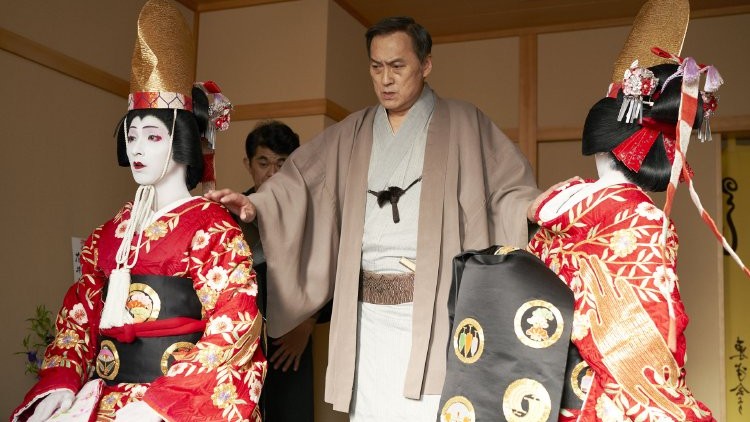
In the 17th century, Japan's Shogunate, fearing a decline in morals, forbade women from performing, so men took over their roles in kabuki. In 1964, Hanjiro Hanai (Ken Watanabe), Osaka's leading kabuki actor, is so impressed with the talents of the son of the yakuza boss hosting him for the New Year, that when a rival gang causes mayhem during the celebration, slaughtering the boss in front of his son, Hanjiro takes the teenaged Kikuo Tachibana (Ryo Yoshizawa) under his wing and into his family, setting up a rivalry with his own son Shunsuke Ogaki (Ryusei Yokohama), as both vie to become a national treasure, a "Kokuho."
Laura's Review: A
Working with an adaptation of Shûichi Yoshida's two part novel by Satoko Okudera ("The Girl Who Leapt Through Time"), director Sang-il Lee ("Hula Girls," TV's 'Pachinko') has crafted a cinematic epic, a sweeping saga that pits innate talent against traditional hereditary birthright throughout decades. Each of the two men will take something from the other and each will experience highs and lows, forever bound by the kabuki master who gave one an opportunity and the other life. One of Sang-il's greatest achievements here is his elucidation and celebration of the kabuki art form, his film having reignited interest in his home country.
Kikuo, now orphaned as his mother died of 'A-bomb disease,' isn't exactly embraced by Hanjiro's wife, Sachiko (Shinobu Terajima), who wishes to see her own son given preference as tradition demands, kabuki houses sustained via bloodlines. But Kikuo's beauty is undeniable and paired with Shunsuke's vulnerability, the two form a team to be reckoned with, drawing the attention of a businessman who offers them a theater in Osaka where their performances become popular. Then Hanjiro is injured in an accident and instead of choosing his own son, picks Kikuo to replace him in an upcoming performance. Kikuo's long time girlfriend, Harue Fukada (Mitsuki Takahata, "Monster"), who has refused his offer of marriage so as to not impede his career, comes to see the performance but ends up comforting the devastated Shunsuke. Kikuo will eventually claim Shunsuke's kabuki inheritance, offered to him against Sachiko's wishes by Hanjiro, but the ceremony passing on the title is marred by Hanjiro's debilitating diabetes, the man calling out for his son after vomiting blood. Kikuo, who has had an illegitimate daughter with a geisha, Fujikoma (Ai Mikami), he and Shunsuke met in their youth, loses public favor when his scandalous past, including his yakuza father, comes to light. Shunsuke, who has married Harue and had a son, reappears on the scene and as his star rises again, public sympathy his, Kikuo's falls, the former star reduced to performing for private events in rural clubs (after one such event, Kikuo is beaten and drunkenly dances on a rooftop, a riveting scene). It will be Mangiku Onogawa (Min Tanaka, "The Twilight Samurai," "Perfect Days"), the legendary elder onnagata (female kabuki performer) considered the greatest of his era, who will reunite the two, but after having attained prominence once more paired together, Shunsuke will be doomed by a legacy of a different nature from his father.
The contrast between these two, Kikuo cold, beautiful and completely dedicated to his art and Shunsuke warm, far less serious and more laid back, is perfectly portrayed by the two actors. Both spent almost two years training in the art of kabuki for this film and while their characters are different off stage, they are perfectly in sync on it, their performances mesmerizing. Tanaka, a dancer as well as an actor, is also spellbinding to watch, the picture of grace and beauty in movement, while veteran actor Watanabe creates a dominant character whose presence is felt even after his death, his unorthodox decision driving the narrative. The film ends fifty years after it began, Kikuo, having achieved Kokoho status, being interviewed before a performance by a surprising person from his past. His coldness has crystalized, his appreciation of beauty still all consuming as he stares in wonder at falling snow.
The end recalls that opening scene, where the kabuki star holds back the teenaged boy as his father is slain in the snow, and if it has a familiar visual flair, it might be because the stage was set by "Kill Bill, Vol. 1" production designer Yohei Taneda. He and cinematographer Sofian El Fani ("Blue Is the Warmest Color") work together with subtle color shifts representing different periods. The film was Japan's submission for the International Oscar but while it made the shortlist, it received a nomination in another category, Hair & Makeup, reflecting the meticulous theatricality - and beauty - of men portraying women in kabuki theater. Do not let the film's three hour runtime deter you, as Sang-il Lee's classical work is thoroughly absorbing from start to finish. "Kokuho" is one of 2025's very best.
GKIDS qualified "Kokuho" for awards consideration in October, 2025, and released the film is select theaters on 2/6/2026, expanding on 2/20/2026.

