I Play Rocky
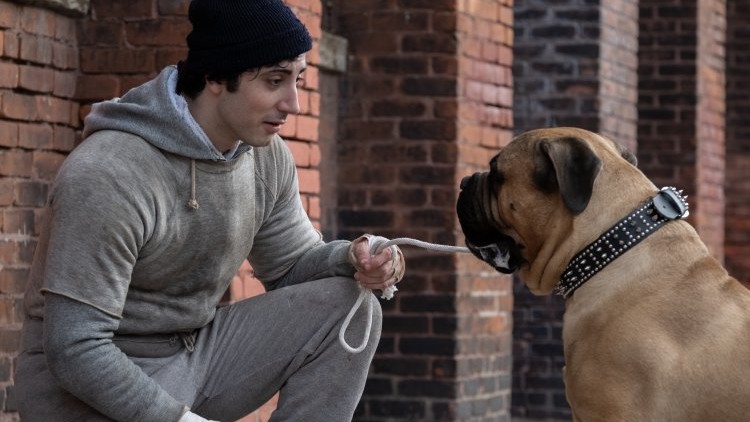
In the early 1970's a struggling actor who auditioned under the name Mike (Anthony Ippolito, "Pixels," "Purple Hearts") was so broke he had to take a job in a soft core porn film and sleep on the street with his dog Butkus. Then he met and married Sasha (AnnaSophia Robb, "Bridge to Terabithia," "Rebel Ridge") who encouraged him to use his real name, Sylvester, and write a role for himself. He did, exciting producers Irwin Winkler (P.J. Byrne, "The Wolf of Wall Street," "Babylon") and Robert Chartoff (Toby Kebbell, "Control," "War for the Planet of the Apes"), but even after they'd gotten United Artists' Sandy Maddox (Tracy Letts, "The Lovers," "The Woman in the Window") up from a $20K script fee to $360K, he wanted a star while Stallone kept insisting "I Play Rocky."
Laura's Review: A-
There's an interesting bit of archival footage from the Johnny Carson show after the credits run where Carson tells the audience 'if they made a movie about the making of the movie, you wouldn't believe it,' before introducing Sylvester Stallone as the writer and star of "Rocky." This is that movie, and the movie about the making of "Rocky" parallels Rocky Balboa's own underdog tale. Screenwriter Peter Gamble had no need to embellish this incredible story and he and director Peter Farrelly ("Green Book") found the perfect star in Anthony Ippolito ("Pixels," "Purple Hearts"), who recently played another iconic Italian American actor, Al Pacino, in the television mini series about the making of "The Godfather," 'The Offer.' At times you won't believe you're not watching Stallone on the screen.
Ippolito's uncanny resemblance to Stallone is initially hidden by cinematographer Sean Porter ("Green Room," "Green Book") who backlights the actor as he auditions for 'thug #2,' that unmistakable voice trying to overcome the speech impediment caused by a delivery doctor's misuse of forceps. We'll watch Stallone retreat to the dump of a room he can't afford in a Hell's Kitchen hotel with an entrance lit by a neon 'Jesus Saves' sign where he will elocute into a reel to reel tape recorder in an effort to train his speaking voice. That recorder will be turned in for back rent before he takes to the streets, but after he meets Sacha, an aspiring photographer, he'll find the encouragement he never got from his dad Frank (Matt Dillon, "Drugstore Cowboy"). A year and a half later the couple are married and living in Los Angeles, still struggling, Stallone working as valet and so broke he reluctantly sells Butkus when he cannot afford to buy dog food (not to worry - he manages to buy him back for a considerably higher price).
Then someone he regularly parks for gets him that fortuitous connection. The first screenplay he turns in is for "Paradise Alley," enough to get Winkler and Chartoff's attention, but not enough for them to bite. Yet they clearly like this self-effacing guy who's smarter than initial impressions might suggest. Stallone learns the art of dealing making, every offer he turns down returning with more incentive, yet he reaches a possible point of no return. Dad Frank tells him he's foolish not to take it while Sasha insists the decision is his alone to make and the final deal offered gives him the starring role, his original $20K script fee, $250 a week to star, an almost impossibly small budget and the studio the right to fire him should there be delays. Stallone and his producers roll the dice.
With John Avildsen (Jay Duplass, TV's 'Dying for Sex,' "Other Mommy") on board, a director known for working fast and cheap, the first major setback arrives when Stallone butts heads with Hollywood's foremost fight choreographer. Then he and Carl Weathers (Stephan James, "Selma's" John Lewis) have to not only learn to box, which they do at Pete's (Erik Palladino) Gym, but to choreograph their own fight scenes. The production has the incredible luck of locating a guy who works for 'Sesame Street,' Garret Brown (Michael Fuchs), who'd just invented the lightweight Steadicam, allowing them to shoot faster (and attain that iconic shot of Stallone running up the steps of the Philadelphia Art Museum). The entire cast and crew would go into hiding when Union guy Sal (Saul Stein) comes looking to make trouble, held at bay by Winkler and Chartoff, who would both also mortgage their own homes in order to procure the skating rink for Rocky's wooing of Adrian. Stallone incurred injuries to both his tendons, running 15-20 miles in one day (Ippolito gives Tom Cruise a run for his money, his speed astonishing), and his knuckles, punching sides of beef they didn't expect to be frozen solid.
Most will know how everything worked out, Farrelly wrapping with a fictional look at "Rocky's" first, triumphant public screening, then cutting to archival footage of the real Winkler, Chartoff and Stallone accepting the Best Picture Oscar. But even if you know a lot about "Rocky's" production history, you'll come away with a whole new appreciation, especially for the producers who so believed in this guy, they put their own sanity and assets on the line. Ippilito is uncanny as Stallone, but Byrne and Kebbell are also exceptional, Byrne making Winkler the more cautious one while Kebbell gives Chartoff more daring. Tracy Letts is hilarious as their fictionalized composite foe and Robb will have folks wondering whatever happened to Stallone's first wife. Robert Morgan and Scot Teller mostly provide lookalikes for Burgess Meredith and Burt Young while Kiki Seto's Talia Shire is largely indistinguishable from Adrian.
Like the controversial Best Picture winner ("Rocky" won over such highly regarded films as "Taxi Driver" and "Network"), "I Play Rocky" may not please an art house audience, but that would be their loss. It might end a bit abruptly (the film feels like it was shortened for time), but this is a real crowd pleaser.
Amazon/MGM releases "I Play Rocky" in select theaters on 11/6/26, opening wide on 11/13/26.

