Highest 2 Lowest
Just as music mogul David King (Denzel Washington) is ready to bet all his assets to maintain control of his label Stackin’ Hits Records, his bid is endangered by the $17.5 million ransom demanded when his son Trey (Aubrey Joseph) is kidnapped. But when he and his wife Pam (Ilfenesh Hadera) learn that the kidnapper mistakenly took Trey's friend Kyle (Elijah Wright), the son of David's driver (Jeffrey Wright), instead, he is faced with an agonizing moral dilemma in writer/director Spike Lee's reimagining of Akira Kurosawa's "High and Low," Highest 2 Lowest."
Laura's Review: B
In Kurosawa's version (both were adapted by Evan Hunter from Ed McBain's novel 'King's Ransom'), the film is split into the protagonist's business dealings before turning into a police procedural. Spike's version struggles with the business machinations, his first act almost inert. Even King's reaction to the kidnapper's call feels enervated. But once King boards the NYC transit system to deliver a backpack stuffed with Swiss Francs, Lee's movie sparks to life in a suspenseful sequence enlivened with the dual beats of chanting NY Yankees fans and a Puerto Rican street festival featuring the Eddie Palmieri Salsa Orchestra.
Lee kicks off the film tipping his hat to another filmmaker, his drone shots of King's Brooklyn penthouse overlooking the bridge and Manhattan beyond it set to Gordon McRae's 'Oh, What a Beautiful Mornin'' from "Oklahoma!" reminiscent of Woody Allen's "Manhattan." It's corny, but it works, although scenes shot on the Kings' balcony feel artificial, as if shot against a green screen. After asking is wife to hold back on her annual $500K charity check with no explanation, he and his driver Paul take their sons to their high school basketball practice, where their coach is played by former Boston Celtic and L.A. Laker Rick Fox, the first of Lee's many references to NY/Boston sports rivalries. At Stackin' Hits, David's colleague Patrick (Michael Potts) is happy about their imminent sale to Stray Dog, but David convinces him to sell him his shares to maintain control of the label which made him famous. At home, Pam isn't happy about the enormous financial risk he's about to take, especially because he's no longer inspired by the music itself, as he was in the early days. Then that phone call which will upend everything arrives.
Unlike Kurosawa's film, where the kidnapper warns against calling the police, this one does no such thing and so that is the first thing King does and an entire troop of police led by Detectives Earl Bridges (John Douglas Thompson), Bell (LaChanze) and Higgins (Dean Winters) arrive and set up shop in the Kings' dining room. Paul, who we will learn is an ex-convict, is treated with suspicion, Higgins, the only white man of the three, quite rude to the man, even after Trey is found and everyone realizes Paul's son Kyle was taken by mistake. And rather than becoming a police procedural, after David wrestles with the financial obligations, with Patrick pointing out that the moral ramifications will also impact his industry standing, David and Paul will take the law into their own hands.
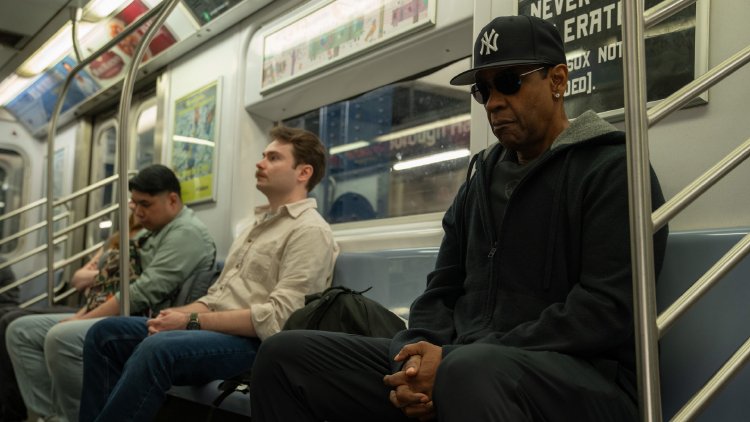
That will happen after a stunning action sequence, one where David sits on a train crowded with Yankee fans heading towards a game against the Red Sox awaiting texted instructions from the kidnapper (he even sits beneath subway PSA bashing the team and one fan turns directly to the camera to shout 'Red Sox suck! Red Sox suck!'). As the Yankee fans chant in unison, the el passes over a street festival several blocks wide and in a moment of great sound mixing, its orchestra and the fans harmonize to the same beat. King is instructed to get between two train cars, which he does after questioning he's understood correctly, and the backpack is dropped, where it is scooped up and handed to a black helmeted moped driver. Detective Higgins gives chase through the streets of the city as the bag is passed from one driver to another, finally cornering one only to empty a backpack filled with...something other than those Swiss Francs.
Although all that money is still out there, they do get Kyle back, beaten but alive, and one thing he remembers is some words to a song that was played repeatedly that he did not recognize. King happens to locate it on one of Trey's mix tapes and immediately recognizes the voice of the kidnapper and when the cops don't immediately follow his lead, he and Paul trace the rapper down (he lives in apartment A24!). There will be gunfire and if you've been waiting for Lee's signature double dolly shot, Matthew Libatique sneaks a subtle one in focusing on Wright. (Speaking of Wright, Lee must be a big fan of "Sing Sing" as his Muslim ex-con always calls King 'beloved.')
This leads to the movie's other exciting scenes as Denzel goes head to head with A$AP Rocky as Jung Felon. This is also where the film's expected hip hop influence kicks in, the film's music up until now more old school, Howard Drossin's ("25th Hour") score verging from orchestral to piano to Irish jig. But there is also some distraction with continuity issues, a Cartier bracelet David gave Pam as a fifteenth anniversary gift demanded as part of the ransom still appearing on her wrist, not just in one sot, but two. Lee's film isn't as good as Kurosawa's, but his finale is a double-barreled return to King's business dealings, one which finds him in a better place than Kurosawa's shoe executive, but also one which feels like Lee indulging himself again, this time with an intimate Aiyana-Lee performance. "Highest 2 Lowest" works in fits and starts, but it gains momentum as it progresses and Washington's scenes with A$AP Rocky elevate his game, even coaxing the legendary star into a rap battle.
Apple releases "Highest 2 Lowest" in theaters on 8/15/25 before it begins streaming on their platform on 9/5/25.

