Happyend
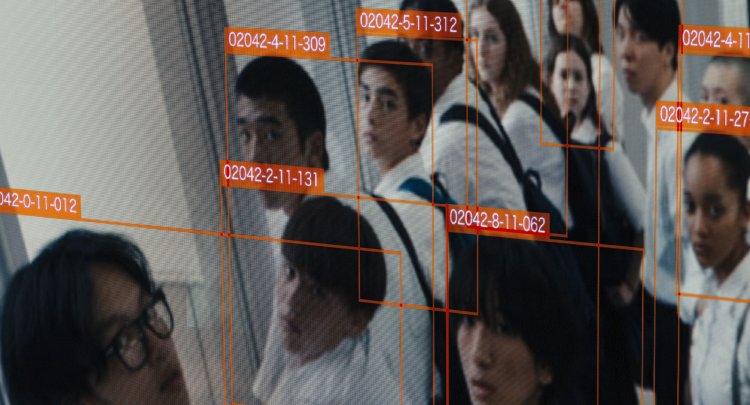
Yuta (Hayato Kurihara) and Kou (Yukito Hidaka) have been friends since they were little kids, but after pulling a prank on their Principal (Shiro Sano) that causes him to install an oppressive security system, Kou's political awakening begins to distance him from his more happy-go-lucky pal in "Happyend."
Laura's Review: B+
Writer/director Neo Sora ("Ryuichi Sakamoto: Opus") seamlessly blends multiple genres - coming-of-age, high school rebellion and science fiction - in his futuristic look at how one group of friends in Tokyo react to both local and national oppression. Cinematographer Bill Kirstein uses Kobe locations featuring narrow streets amid towering buildings to heighten the sense of tyranny, figures dwarfed in a gray landscape. Costumer Shigeo Ômori clads the kids in white shirts with navy blue skirts and trousers, the only real pops of color in the film afforded by the Principal's bright yellow sports car and the red headlines and advertising that is broadcast against the skyline.
Sora presents five friends - Kou, Yuta, Ming (Shina Peng), Ata-chan, (Yuta Hayashi) and Tomu (ARAZI) - trying and failing to get into a nightclub, something which the first two work around by posing as delivery boys at a back door. Their joy listening to a DJ (Yousuke Yukimatsu) roll out techno beats is evident, but shortly after they've taken their place, police raid the club. While one urges the other to leave, the boys are astonished when the DJ presses a small drive into their hands and when they rejoin their friends we discover the five have set up a secret music studio within their high school, a hangout space they call The Music Research Club. They access it that night by getting the school's security guard to search for a cat, one of the boy's playing 'meow' sounds on his phone.
But when that room is discovered, the kids are ordered to clean it out and told the equipment may still be used, but only during school hours. They decide to steal it instead and Kou and Yota retaliate by standing the Principal's beloved car on end, a sight that fascinates all the next morning. Given that a further sense of doom hangs over them all because of frequent earthquake warnings, the Prime Minister having warned that the biggest in one hundred years is expected, the Principal's car is in a very precarious position. The student body will arrive to see a surveillance system being put in place, one which announces points deducted for various infractions. Ata-chan quickly racks up ten points by giving it the finger in various poses, his fashionably pleated palazoo pants also receiving a demerit, causing his parents to be notified. A sympathetic teacher, Mr. Okada (Ayumu Nakajima) is let go while parents, including Kou's mom Fukuko (Pushim), only show deference to authorities.
Each of the kids are distinct, most of the group somewhat ostracized by their non Japanese or mixed racial status. Kou is Korean, Ming at least half Chinese, Tomu half black. Although Japanese, Yotu has a contentious relationship with his mother, who, observing him asleep on the couch on her return from a business trip, looks down and mutters 'brat.' Kou will begin pulling away from Yotu after becoming attracted to student activist Fumi (Kilala Inori), who also is tagged by surveillance when she joins those ordered out of class for a Japanese Defense talk, standing up for Kou, Ming and others. She'll organize a sit-in in the Principal's office to disband the system and be the first to reject the fancy sushi he has delivered, instead accepting the kimbap Kou delivers from his mother's shop.
Sora and Kirstein frequently picture their protagonists indoors as protests, riots and police crackdowns rage outside, a frequent cause of delays, like Yotu's first day working at a music store. While Kou worries about the state of the world, Yotu continues their music focus, objecting that they should be having fun. Sora's tale builds to graduation day, each of the five given his or her own sendoff, Ata-chan memorably using his style sense in hilarious fashion, the city's architecture once again used to symbolize Kou and Yota's future.
Robin's Review: B
In a near, dystopian future, a group of high school students pull an elaborate prank on the principal and his beloved car. Outraged by their disrespect, he orders surveillance cameras placed everywhere. And, a hundred year earthquake is predicted, threatening great devastation in “Happyend.”
The small group of high school students/rebels, led by Yuta (Hayato Kurihara) and Kou (Yukito Hidaka), are a mix of native Japans and Korean – leading to a societal prejudice against outsiders. This, though, does not include the small band of brothers and sisters who, to each other, are family.
It is a turbulent time in the country, not just the high school, with the Prime Minister threatening to crack down on immigrants and restricting people’s movement in country. This gives the school principal reason to punish all for the actions of a few with intrusive surveillance cameras watching the many. When his threat to install surveillance cameras everywhere in school becomes reality, the pranksters set out to circumvent the system whenever possible.
It is the rebels’ graduation year and some of the group just want to enjoy their life before becoming an adult. Others, though, want to continue the radicalism and rebellion against authority. Soon, their promises to stick together after graduation grow less as each will go in a different direction.
There is a lot to unpack here as we deal with student rebellion, increasingly restrictive rules, in school and out, prejudice and just plain growing up. The society is moving to authoritarian rule but, to the kids, they are not there yet.
While Yuta and Kou are the nominal “stars” of the film, it is really an ensemble with the two as first among equals. And these kids seem a bit more mature than I would expect for a Japanese high school student, though that comes from my dealings with American high school kids.
DIrector/writer Neo Sora does not do a “dystopian future” the way we do in the US. Here, it is a lot less a “bad” future than, say, our recent “The Long Walk” where volunteers walk or die. In either case, authoritarian government is authoritarian government.
Film Movement released "Happyend" in select theaters on 9/12/25, expanding in subsequent weeks. Click here for theaters and play dates.

