Fjord
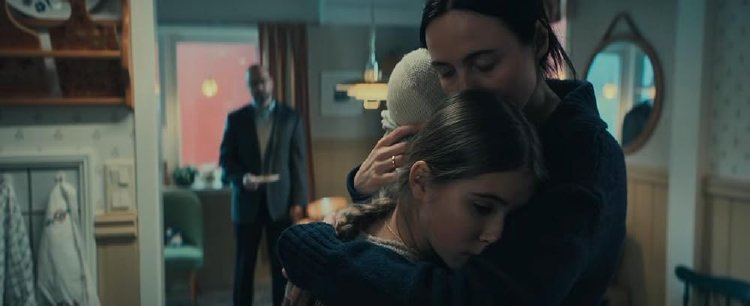
After the death of his parents, Mihai Gheorghiu (Sebastian Stan, "Captain America: The Winter Soldier," "The Apprentice") moves his wife and five children from Bucharest to Norway to be close to his wife Lisbet's (Renate Reinsve, "Armand," "Sentimental Value") family. Initially, the conservatively religious family is welcomed by the small town, Mihai going to work for his new neighbor Mats (Markus Scarth Tønseth) at the school his children will attend. Lisbet, a nurse, begins to help with Mats' father Åke (Øyvind Venstad Kjeksrud) as well, wheelchair bound and non-verbal after a stroke. But when a teacher, Frida (Lisa Loven Kongsli, "Force Majeure"), notices bruises on their eldest daughter Elia (Vanessa Ceban), sentiments begin to change in the "Fjord."
Laura's Review: A-
Since its unveiling at the 2026 Cannes Film Festival where it won the prestigious Palme d'Or, writer/director Cristian Mungiu's ("4 Months, 3 Weeks and 2 Days," "R.M.N.") latest film has attracted controversy, labelled by many as a MAGA movie because of its harsh depiction of the citizens of a progressive nation. But what Mungiu is doing here is inviting thought and discussion about any group blinkered by its own self righteousness. That said, the film is so unbalanced in its depiction, some formerly friendly and welcoming Norwegians becoming downright malicious against other people's beliefs amidst unproven accusations, it will be difficult for many to consider. (Note that while the behavior of the townspeople seems extreme, the behavior of Norway's protective child services has repeatedly come under fire by human rights organizations for the very reasons depicted here and the film is based on a notorious true life case).
That imbalance extends to Elia's bruises. The teenager, who has been quickly befriended by Mats and Mia's (Lisa Carlehed) rebellious daughter Noora (Henrikke Lund Olsen), is seen wrestling with the girl in gym class (one of several instances hinting at a lesbian relationship) and jumping off of an upstairs window to join her friend, both possible explanations for the mark on her face and bruise on her back. While the Gheorghius talk about disciplining their children, we only witness it take the form of denying Elia and next eldest Emmanuel's (Jonathan Ciprian Breazu) attendance at Noora's birthday party, yet Noora reacts with self harm, cutting her wrist, something which goes largely unremarked upon. When they are questioned by authorities, Mihai describes 'hitting' as a 'slap on the butt years ago,' something which is exaggerated in the report he is blackmailed into signing. The Gheorghius never appear to be anything other than unassuming, yet even their custom of daily prayer is called into question. Near the film's conclusion, Mihai will make one veiled remark about Elia perhaps being *too* close to Noora, something that would be accepted in the community but rejected by evangelical Christian fundamentalists.
After a welcoming that includes baked apple cakes, singing and invitations, we see cracks beginning to form when Mats responds to Elia's playing of a church hymn on a school piano by forbidding her from 'evangelizing at school.' 'But I'm not singing the lyrics,' Elia reasonably responds. Once Frida reports her concerns to Child Services, Mihai will be visited by local police at work while she and Gunda (Ellen Dorrit Petersen, "Armand") arrive at the Gheorghiu home to inform Lisbet her children will be taken into custody, a Norwegian flag prominently fluttering outside the living room window. 'We don't need your permission,' the astonished woman is told. Lisbet is horrified, of course, and particularly objects to having the baby who she is breastfeeding removed from her care.
The Gheorghiu are alternately shunned and sympathized with in early goings. Noora is bullied at school for 'missing her little nun.' The family loses its first, female lawyer when she objects to an objection made by Mihai after they're informed a pediatrician has determined their newborn has Shaken Baby Syndrome. Mat's wife Mia steps into the void and helps the couple get their children returned, but there will be a second, criminal trial and she refuses to continue to represent them, a decision that appears to come out of the blue. It is noted that the family 'still thinks they are the victims' and that they have refused to accept the community's values.
If all this really happened to the Bodnariu family, it is utterly deplorable, a real life witch hunt based as much on the family's religious beliefs as Elia's bruises, but for international audiences who may be unaware of just how unrelenting Norway's protective child services is, it can appear incredible. Yet both the right and the left have been accused of governmental overreach into people's health and private life and this is a particularly potent example that happens to have taken place in a progressive country.
Mungui's production revels in the beauty of the Norwegian fjord contrasted by warm, homey interiors, a snowy 'Silent Night' scene breathtaking, and the acting is fine across the board, especially from "A Different Man" costars Stan, using his native Romanian tongue for the first time in a film, and Reinsve, whose maternal warmth is turned into palpable separation anguish. Loven Kongsli's stridency as Frida can be put down to bureaucratic militancy, although Carlehed's character's abandonment of a woman so supportive of her elderly father-in-law is more difficult to fathom, especially after she pushes back against others' prejudices. And speaking of Åke, Mungui uses his character very symbolically as another victim of isolation, ironically saved by Lisbet.
"Fjord" is the Romanian submission for the 2027 International Oscar, but note that while the film includes passages in both Romanian and Norwegian, the film is largely in English, the language used to bridge between the different native speakers.
Neon releases "Fjord" in theaters on 10/16/26.

