Fatherland
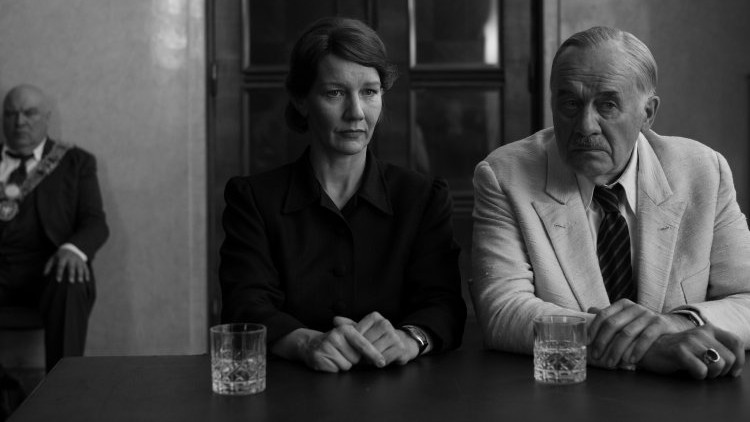
In 1949, exiled German Nobel Laureate novelist Thomas Mann (Hanns Zischler, "Munich," "Clouds of Sils Maria"), the author of 'Buddenbrooks,' 'Doctor Faustus' and 'Death in Venice,' returned to Germany, first to be feted in the American Occupation Zone of Frankfurt, then to Russian controlled Weimar to accept the Goethe prize. He was driven around the county in an imposing black Buick by his daughter Erika (Sandra Hüller, "The Zone of Interest," "Project Hail Mary"), also a novelist and rally driver, her facility with languages coming in handy for translation at his press conferences. Mann, who was vehemently anti-Nazi, gave speeches throughout the trip in an effort to reunite the "Fatherland."
Laura's Review: B+
Cowriter (with "Goodbye Lenin!'s Henk Handloegten)/director Pawel Pawlikowski ("Ida," "Cold War") completes his European post WWII period trilogy with a fictionalized account of Mann's 1949 trip that explores the fractured political landscape through fractured family dynamics. Returning cinematographer Łukasz Żal once again shoots in black & white with the boxy Academy ratio, beginning with a long take of Mann's son Klaus (August Diehl, "The Counterfeitors," "Inglourious Basterds") sitting on the floor of a Cannes hotel room talking on the phone with Erika as a man in his bed rises, dresses and leaves. Erika is trying to convince her 'spiritual twin' (both were gay, as, it has been claimed, was their father) to join the trip, but although he says he 'doesn't believe in anything anymore,' he agrees.
Żal's camera then introduces us to a country in ruins through the windshield of that Buick in a police motorcade which ends with a celebratory greeting by Frankfurt's mayor (Waldemar Kobus) which Erika will later describe as 'like a state visit.' Erika will hand a letter threatening her father, one of many, to the C.I.A.'s Arthur Quint (David Menkin) before the duo fields questions from international press. When asked where his home is, Mann replies that while he lives in California and is now a U.S. citizen, if asked where his Heimat is the answer might be different. At the cocktail party which follows, music lover Mann refuses to condemn Wagner's to his grandsons Wieland and Wolfgang Wagner (Enno and Theo Trebs, "The White Ribbon"), but sharply observes that their Beyreuth Opera should be shut down and their mother jailed. (Earlier when Erika tells her father that Klaus only listens to Bach now, the composer almost making him believe in God, Thomas replies that actually he believes Nietzsche said that about Beethoven, a telling remark about the family's intellectual pursuits and its divisions.) Meanwhile Erika banters with her former lover, AP reporter Betty Knox (Anna Madeley, "In Bruges"), who tells her the U.S. Government is unlikely to be happy about she and her father being feted by Russians, then has a heated run-in with her ex-husband, actor Gustaf Gründgens (Joachim Meyerhoff), she accusing him of selling his soul to the Nazis while he points out that her life has been afforded by nepotism. Erika hauls off and slaps him.
All the while, Erika has been checking with the front desk about her brother's arrival (Gründgens asks for Klaus, expressing affection. Erika retorts that he had Klaus's novel 'Mephisto,' reportedly based on him, suppressed). That evening, Thomas will come to Erika's room to inform her that Klaus is dead, and, to her surprise, that they should leave immediately the next morning for Weimar. Thomas has no sympathetic words for his eldest son, calling him a drug addict and a spoiled child whose suicide was inconsiderate of his mother. A younger brother, Michael, will be taking care of the funeral arrangements. Erika is devastated, but after exorcising her emotions in her room that night by screaming at drunk Nazis from her bedroom window, the two are back on the road the next day.
Pawlikowski illustrates the marked difference between West Germany and East, Erika having to show papers at a checkpoint, using the invite of Red Army propagandist Colonel Tiulpanow (Daniel Wagner) as influence. Where Frankfurt's hotel still held grandeur, father and daughter are asked to wait for Johannes Becher (Devid Striesow, "The Counterfeitors") in a restaurant that doesn't even seem operational. The music which greets them is sung by military men instead of children. An audience listens to Thomas's speech in stone-faced silence, then applauds. With Klaus's death weighing heavily, Erika finally erupts at her father, accusing him of 'cold-hearted narcissism' whose speeches will make no difference to a Germany now controlled by the U.S. and Russia. As Thomas is shuttled about the next day, visiting Goethe's death bed and providing photo ops, he notices her absence, yet Pawlikowski will bring the two back together in a moving conclusion that includes a spiritual third, a real emotional masterstroke in a film whose characters usually withhold feelings.
At a very economical 82 minutes, the filmmaker has encapsulated the shifting societies of post WWII Germany and the differing generational philosophies within a famous literary family (Pawlikowski shared 2026's Cannes Best Director prize with "La Bola Negra's" co-directors). From the family dynamics of post WWII Poland in "Ida" which also featured the loss of a sibling, to the conflicted lovers of "Cold War" and now "Fatherland," Pawlikowski has created a triptych of historical divisions in post WWII Europe. He also has a good luck charm in Joanna Kulig, who appears as a professional singer in the first and third, while starring as an amateur in the second.
Mubi releases "Fatherland" in select theaters on 10/23/26, expanding in subsequent weeks.

