Exit 8
A young man (Kazunari Ninomiya, "Letters from Iwo Jima") listening to classical music on a crowded rush hour train in Tokyo observes a salaryman screaming at a woman because her baby is crying, but, like every other passenger, does nothing to stand up for her. Then he'll get a phone call from the woman he's recently broken up with (Nana Komatsu, "After the Rain"), telling him she's at the hospital where she has just learned she is pregnant. The man says he will come and meet her there, but the decision she has yet to make throws him into a tailspin of doubt and anxiety, reflected by in the underground subway corridors that deny him "Exit 8."
Laura's Review: B-
Cowriter (with Hirase Kentaro)/director Genki Kawamura's addition of a psychological basis for the lost man's plunge into an endless loop of an underground subway corridor isn't integrated into his adaptation of the video game well enough to make its rules representative of the man's conundrum and is only applied to two of its four navigators, leaving the other two with no reason for being there. Unlike David Lynch's "Eraserhead," the looming prospect of fatherhood actually dilutes the film's horror, which may have been far more effective left as a nightmarish puzzle game.
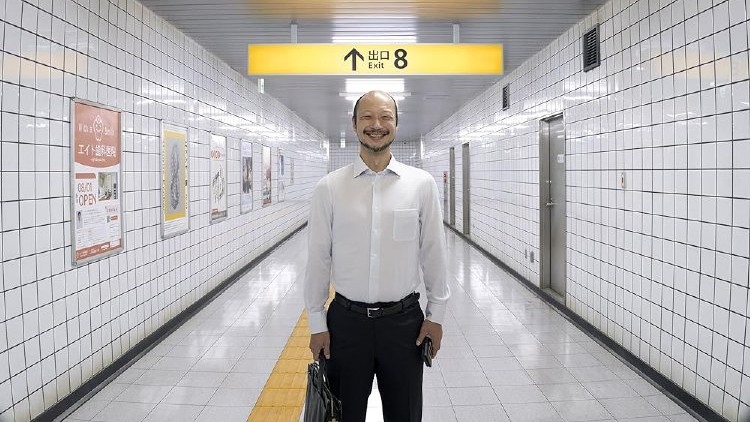
After the initial setup, Kawamura breaks his film into three sections, the first, titled 'The Lost Man,' centering on our protagonist as he exits the train to head for the hospital via Exit 8. He'll walk beneath a yellow, overhead sign indicating Exit 8 into a white tiled corridor with several advertising posters (one for an Escher exhibit features the inverted '8' of the film's one sheet) hung along the left wall, an internal fire hydrant, doors and vents on the right. A salaryman (Yamato Kôchi) with a man bun in a white shirt and tie carrying a phone in one hand and briefcast in the other crosses at the end of the hall and begins marching towards him without acknowledging him, his dress shoes loudly tapping on the floor like a metronome. Our man turns a corner, passes a group of lockers and a photo booth with some trash lying in between them, then finds himself back where he started, the same salaryman appearing at the same time, but it won't be until his third pass that he begins to really sense that something isn't right. It is then that he will read the Information placard posted on the wall which tells him 'do not overlook anything out of the ordinary. If you discover an anomaly, turn back immediately. If you don’t, carry on. Then leave from Exit 8.' He immediately inventories the hallway. His next pass lists Exit 0, then Exit 1, then 2, progress being made, but then things begin to get weird. Every time he turns around that salaryman is right behind him grinning a maniacal grin. As he passes the lockers, he'll hear a baby crying, then a crescendo of them as all the locker lights change from green to red. The eyes on those posters begin to follow him. Then the salaryman appears with a little boy (Naru Asanuma) with a vivid red scrape on his cheek, another anomaly? After having gotten all the way up to Exit 5, the Lost Man finds his exit has been reset to 0 and he collapses on the ground, vomiting and weeping.
This shifts us to the middle segment, The Walking Man, which gives us that salaryman's point of view, but he's only ever so loosely connected to the Lost Man and we are left to guess what his psychological issue is. Could it be a prurient connection to the high school student (Kotone Hanase) who approaches him the way he approaches the Lost Man? Eventually she'll stop and ask him if he thinks they're dead or if they are in purgatory, before shutting down bizarrely, like a malfunctioning robot. We'll see this man take that little boy by the hand and see how the child got that scrape on his cheek, before we segue into the third chapter, The Boy, where The Lost Man will take the boy by the hand and reckon with his ex-girlfriend's pregnancy, including a futuristic reverie on the beach. The film ends on a very ambiguous note, the Lost Man back where he started on that train, Kawamura, who so strongly implied the man's feelings in the prior scene, now waffling on closure.
The film apparently had all the right elements in place to begin with, but the filmmakers' additional flourishes detract rather than add. The production design is perfect, as is the sound design which rachets up the tension with The Walking Man's echoing footsteps and the type of recurrent ding dong chime one used to hear in department stores, complemented by composers Shouhei Amimori and Yasutaka Nakata's unsettling score. Special effects are also good, coming into play in that final chapter where horrific things suggested by The Lost Man's earlier scrolling emerge from those vents and the subway is flooded. Ninomiya becomes more and more sympathetic as the film goes on and Kôchi's two facial expressions, a deadpan gaze and malevolent grin, are very effective.
"Exit 8" begins with a solid concept, but the repetitive nature of its construct begins to affect pacing and its sentimental third act ends up being an unsatisfying bait and switch tactic. The film has loads of atmosphere, but its narrative never fully connects.
Neon releases "Exit 8" in theaters on 4/10/26.

