Don’t Let’s Go to the Dogs Tonight
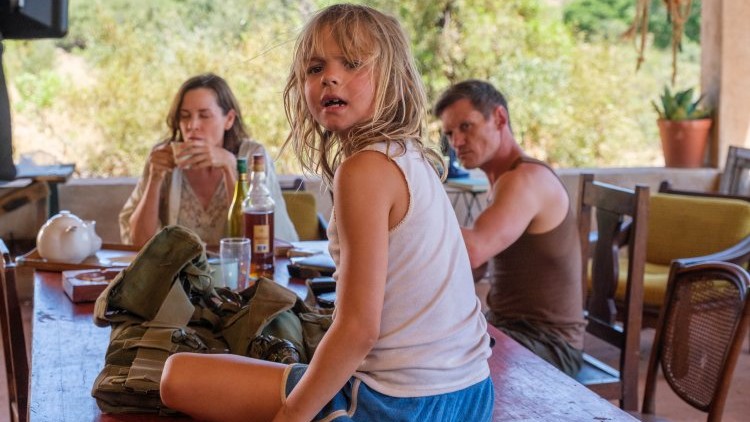
In 1980 Rhodesia the Zimbabwean War for independence was coming to a head with an election that pitted Robert Mugabe against incumbent Bishop Muzorewa, the former supported by the black populace while the latter was championed by whites like Nicola Fuller (Embeth Davidtz, "Schindler’s List"), who is trying to hang onto her family farm during times of racial tension and violence. Caught between conflicting sides, 7 year-old Bobo (Lexi Venter) adores the family servant, Sarah (Zikhona Bali), while also mimicking the more questionable behavior of her parents in "Don't Let's Go to the Dogs Tonight."
Laura's Review: B
Writer/director Embeth Davidtz adapts Alexandra Fuller's book for her filmmaking debut, her own experiences as a 7 year-old in South Africa guiding her to tell the story from Bobo's point of view and she's found a real firecracker in newcomer Venter. Davidtz appears a natural born filmmaker and her coming of age tale has echoes of Claire Denis' debut, "Chocolat," another tale of racial tensions in colonialist Africa seen through the eyes of a young girl, but here the threat of violence instead of sexual tension pervades the air.
Venter narrates much of the film, telling us at the onset that her thirteen year-old sister Vanessa (Anina Hope Reed) used to accompany her when she needed to go to the bathroom in the middle of the night, but now she hesitantly goes herself, advising that it is terrorists one needs to look out for. Later, looking out from the back seat of her parents' car, Bobo will inform us that any African just might be a terrorist.
Funnily enough, Sarah's partner Jacob (Fumani N Shilubana) appears to take the same view of Bobo, warning Sarah that being seen with the child could be dangerous, Bobo dropping by their home as if she belongs there. Sarah is much more of a mother to Bobo than Nicola is, brushing her hair, playing with her and agonizing over the undisciplined little girl's outrageous behavior, like smoking cigarettes she steals from her dad (Rob van Vuuren). At her own home, her mother is either drinking, recovering from drinking, sleeping with a shotgun or patrolling her farm with it while her father is frequently away because of the war. She and her sister are largely ignored like the three dogs which roam around the house.
When Nicola must go into the town to work as a police officer, they require a police escort to watch for ambushes and landmines. Stopping in at her grandmother's (Judy Ditchfield) house, Bobo will ask such blunt questions as 'Are we racists?,' receiving defensive replies which lack conviction, Nicola harshly condemning Mugabe. Bobo boldly asks her grandmother if she can have a paperweight she admires. 'No,' replies the bitter old woman, prompting Bobo to request it after she dies. She is informed that the Fullers have 'breeding,' which is better than money, but Nicola's subsequent behavior at a local bar suggests otherwise and when family 'friend' 'Uncle' Anton (Albert Pretorius) sexually assaults Vanessa by forcing his thumb into her mouth, Nicola refuses to believe Bobo when she tells her. Bobo herself draws Sarah's attention outside by commanding two young black boys to do her bidding. 'You're too young to be bossing,' a clearly shaken Sarah admonishes her. (We'll also remember that breeding remark with a smile as the whole family enthusiastically sings 'For Patricia Is the Best Stripper in Town,' none more gleefully than Bobo.)
Davidtz never lets us forget about the natural beauty surrounding all this man made ugliness. We see the world as a giant playground full of living creatures through Bobo's eyes, the filmmaker using Malickesque cutaways to draw our attention to the wonders - and the dangers - inherent in the landscape. Symbolism indicates racial strife - Bobo innocently 'writing' her name on Sarah's thigh - and harmony - Sarah creating a queen's headdress for Bobo, one which Bobo will later 'see' on Sarah in a revelatory bit of magical realism. But the movie's climax brings harsh realities, one foreseen, another during one of Bobo's dreaded late night trips to the bathroom. And while Nicola Fuller's dreams are dashed, the family admitting defeat after Mugabe's victory, Bobo receives a touching farewell, a tribute from a most unexpected place.
Robin's Review: B+
It is 1980 Rhodesia and independence is dawning in the country. For 8-year old Alexandra “Bobo” Fuller (Lexi Venter) life is a daily wonder of discovery. Her mom, Nicola (Embeth Davidtz), though, is worried that the coming political changes will endanger her farm and livestock in “Don’t Let’s Go to the Dogs Tonight.”
Actress Embeth Davidtz puts on the director’s cap for the first time AND adapts the memoir of the same name by Alexandra Fuller. The story is told through the eyes of young Bobo, a free spirited little girl to whom the world is an oyster. She runs the countryside on her dirt bike and is constantly in need of a bath.
She makes her rounds of the neighbors and, especially, Sarah (Zikhona Bali), the African woman who works for Bobo’s mom and dad. The woman honestly cares for the girl, oftentimes giving Bobo the motherly attention that her own mom does not – who is too busy running the farm and cares more for her cattle and dogs.
The idyllic life that Bobo leads is juxtaposed with the events that are enveloping Rhodesia. Independence is inevitable and the coming election will decide between leftist Robert Mugabe and centrist Joshua Nkomo. For the conservative, white Fuller family, the election holds a store of change – good if Nkomo wins, not so good if Mugabe does.
Director Davidtz deftly combines the personal story of little Bobo and her comings and goings and the backdrop of a country on the verge of throwing of the repressive cloak of white colonialism. The blissful child’s life is the opposite of her mom’s, whose existence is entirely focused on saving her farm in the face of the incredible odds of the coming change.
The political lesson that “Let’s Don’t…” gives us is an unexpected bonus while watching this finely-hued debut work. I remember the transition from Rhodesia to Zimbabwe, the election and how it all turned out. Here, we get that history in a very personal way from the Fuller family viewpoint – and each is different.
The amazing Lexi Venter centers the story as we watch the kid grow up, a little bit, before our eyes. She holds every scene as her own in a wonderfully natural way, making my inner child happy. Then there is mom and dad’s world that is about to be torn apart, The steadfast Nicola refuses to give up the farm and will fight for it if necessary – this while the Bush War for black rule rages before the elections.
Mom, because of the threat to her farm because of the coming changes, teaches Bobo to distrust any Africans. The girl maintains a strong relationship with Sarah, despite the warnings by her husband, Jacob (Fumani N. Shilubana). To him, their relationship with the white family could cause problems, bad problems, in the future.
There is a lot to unpack in a film that runs a scant 98 minutes and Embeth Davidtz creates a real world and tells us about a country’s rise against colonialism, mainly through the eyes of a little girl. That is some good prestidigitation.
Sony Pictures Classics releases "Don't Let's Go to the Dogs Tonight" in select theaters on 7/11/25, expanding on 7/18/25.

