Dead Man’s Wire
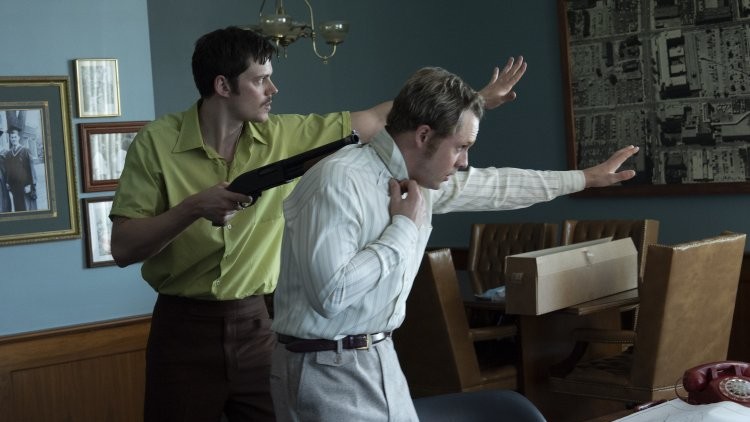
Tony Kiritsis (Bill Skarsgård) was ready to ride the wave of shopping mall development, having procured an ideal piece of property with a loan from Indianapolis's Meridian Mortgage. He had a buyer attached when he discovered the financial company's owner, M.L. Hall (Al Pacino), had hijacked his deal, shopping other properties to his client. Outraged, he marched into Meridian's offices on February 8, 1977, and, discovering M.L. was in Florida, took a meeting with his son Richard 'Dick' Hall (Dacre Montgomery, Netflix's 'Stranger Things') instead, kidnapping the man by attaching a rifle to the back of his head with a "Dead Man's Wire."
Laura's Review: B
After a couple of forays into television, director Gus Van Sant ("My Own Private Idaho," "Elephant") returns to feature filmmaking after seven years with a script by newcomer Austin Kolodney based on a true story from almost fifty years ago that couldn't be more relevant today, a little guy trying to get ahead who is taken advantage of by someone who wields money as power. The film has a second draw in the complex Stockholm Syndrome situation that develops between Dick and Tony, Dick empathizing with his kidnapper not just as a method of dealing with trauma but because of parallels in his own relationship with his father.
DJ Fred Temple (Colman Domingo) introduces us to a new day, his warm, soothing voice promising uneventful calm, but Van Sant will cut to an anxious looking Tony, his arm in a sling to help disguise the rifle he is carrying in an Indianapolis business district. After accepting that he will have to bargain with the son and not the father, securing Dick with his terrifying set-up, Tony calls 911 to report the situation, wanting all the media attention he can get. That is supplied in the form of fictional reporter Linda Page (Myha'la, HBO's 'Industry'), the rare black female field reporter who sees an opportunity to step into the spotlight and who will provide the media perspective throughout the rest of the film. But the first person to arrive on the scene is Detective Michael Grable (an unrecognizable Cary Elwes) who is shocked when he realizes he knows the perpetrator as Tony is a regular at the local cop bar. 'I know this guy, he's a friend of mine,' Tony whispers to Dick, as if Dick should feel threated by the cop and not the man holding a gun to his head.
Tony will make his way back to his apartment with Dick in two, the entire city now watching his exploits live on their local news station. Tony's demand is a public apology from Meridian Mortgage, but he isn't satisfied when Clifford Chapman, a company employee, makes one on TV. Tony wants to hear from M.L. and when he and Dick call the man, we are astonished by his calculated coldness. After being holed up in Tony's apartment for three days, much of which is spent in friendly conversation, Tony realizes he's been backed into a corner, and so demands prosecutorial immunity and $5 million dollars to release his hostage.
Sarsgaard plays Tony with a combination of twitchiness and genuine hospitality towards the man he's taken hostage, creating an endearing anti-hero any 99 percenter should relate to. Dacre Montgomery is his equal here, the actor creating a decent family man whose outward success in a family business is revealed to be a burden, the man unable to reason with a father who views him as a bargaining chip. We feel for both of them. Domingo is perfectly cast as the smooth talking DJ who ends up inadvertent negotiator at Tony's request. Cinematographer Arnaud Potier's ("Aggro Dr1ft") handheld camerawork keeps us right inside the action.
This is the rare film that deserves its double ending, the film's climax a gut punch of betrayal only to be reversed with an unexpected coda. "Dead Man's Wire" is a rage against the machine.
Robin's Review: B
In 1977, Tony Kiritsis (Bill Skarsgard) took Richard Hall (Dacre Montgomery) hostage. He claimed that Hall and his father (Al Pacino), holders of his mortgage, bilked him of his property for missing a payment. He attaches a sawed-off shotgun to the back of the man’s head that will go off if anyone disturbs the “Dear Man’s Wire.”
Tony is none too bright and, when he loses everything because of foreclosure on his property, turns to desperate measures to get back what is his. He devises a plan, which he documents well, of building a dead man switch attached to the shotgun. He takes his device to the Hall mortgage company and asks to see the president – Richard. Things escalate out of control.
Very quickly, the media gets hold of the story and, suddenly, it is big news. So big that local radio personality, Fred Temple (Coleman Domingo), gives live coverage to what becomes a hostage situation, bringing detective Michal Grable (Cary Elwes) in as negotiator. The bulk of the rest of the story is about the negotiations and the final outcome of the crisis.
As I watched Gus Van Sant’s latest opus – and wondering where this once wunderkind has been – a couple of films from the 70s come to mind. One, also being a true crime story, is Sidney Lumet’s terrific “Dog Day Afternoon (1975)” with its live coverage of a bank robbery in progress. The other, more obscure, is “Vanishing Point” from 1971, about the multi-state police chase of a stolen car driver. That film, like “Dead Man’s Wire,” had a DJ (Cleavon Little) narrating the crime on radio to the public.
Bill Skarsgard does a first rate job in giving depth to a very troubled young man pushed to the brink by others’ greed. All he wants from Hall is an apology from his cruel-minded father and his property back but the demand changes to immunity from prosecution and five million bucks. The end, surprisingly, is not a surprise but consistent with Tony. You hope he will be well, but you know…
Row K releases "Dead Man's Wire" in theaters on 1/9/2026.

