Chronovisor
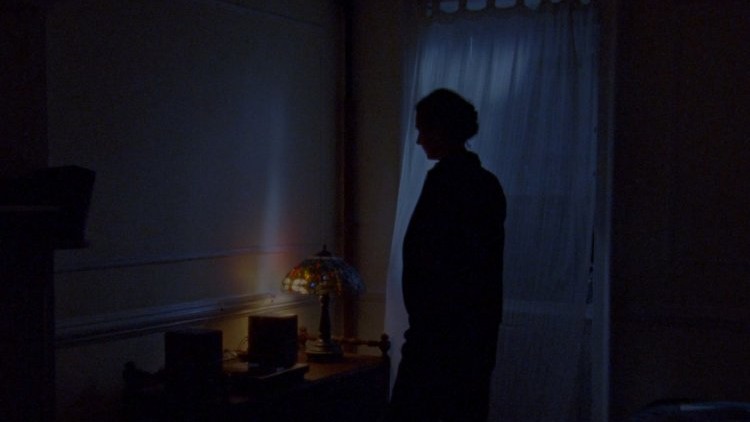
In NYC, French philosophy and neurology professor Béatrice Courte (Anne Laure Sellier, Professor of Behavioral Sciences at HEC Paris) lectures at Columbia University on the Jacobean understanding of dualism, the concept accepted by most civilizations throughout time that the mind and body are fundamentally different. While continuing her research on the subject, Béatrice comes across a recording of a lecture which reveals the existence of a device which could capture imagery via 'waves in the ether' throughout time, reportedly having broadcast both the crucifixion of Christ and the first performance of Sophocles' Antigone in 440 B.C., and her focus becomes entirely hijacked by the "Chronovisor."
Laura's Review: B+
This is a very special film for a very particular audience who will be rewarded by writer/director/editors Jack Auen and Kevin Walker's unique approach, one which focuses on the written word. Fear not, though, because while the film largely takes place in hushed library settings shrouded in darkness except for the golden pools of light cast by green shaded lamps, there is nothing fusty about it as it delves into spatial time travel, Vatican secrecy and madness. The fact that Auen and Walker based their film on a real Benedictine monk, philosopher and musicologist Father Pellegrino Ernetti, and that almost all of the research media shown is real just adds another jaw-dropping element to this mystery thriller with elements of horror.
It was a smart move casting an actual academic whose comfort with esoteric terminology and multiple languages adds to the film's reality. Using the boxy academy ratio, cinematographer Leo Zhang keeps us tightly focused on both Béatrice, introduced from the point of view of academic dinner companions at a cozy restaurant, and her research, which we literally share as Zhang closes in on a paragraph in a book, newspaper or magazine, the filmmakers highlighting (and frequently translating) phrases with ghostly illumination. Shooting in 16 mm makes those dusty old pages come alive, those old VHS tapes show their age and the filmmakers pull us right onto the trail Béatrice follows with expert pacing. Gustav Holst's orchestral music adds to the drama as she closes in, recordings of Gregorian chants lending Gothic mood.
The professor manages to speak to one of Ernetti's biographers, Father François Brune, who dismisses the debunking of Ernetti's photo of Christ as a journalist's error and says Pope Pius XII covered the entire story up, afraid the chronovisor would be used for nefarious purposes. The machine Ernetti built, he says, was disassembled and stored in a secret place within the Vatican and then Ernetti's body mysteriously appeared in his childhood home, a funeral held in Venice. As Ernetti continues to elude her grasp, Courte begins to use slightly unethical means in her pursuit, calling publishers and lawyers as an academic wishing to bestow an honor on the man. This pays off in a box of the man's belongings arriving at her apartment, including a videotape whose casing has been horizontally cut in half, its tape dumped in a plastic bag. Beatrice carefully puts it back together (and this is most likely the media fabricated by the filmmakers) and discovers her quest's endgame. But her research had also warned that the chronovisor had different effects on people, their memories merging with those from the past causing some religious enlightenment, others madness.
After almost 130 years of cinema, Auen and Walker have come up with an entirely original way of telling a story, their filmmaking only becoming slightly conventional in its last act (but certainly not its very last scene). "Chronovisor" explores a lot of lofty ideas, but its central mystery is the stuff of conspiracy theories, a cinematic rabbit hole for the adventurous.
Robin's Review: B+
Grasshopper Films released "Chronovisor" in L.A. on 8/30/26. Click here for theaters and play dates.

