Changing Lanes
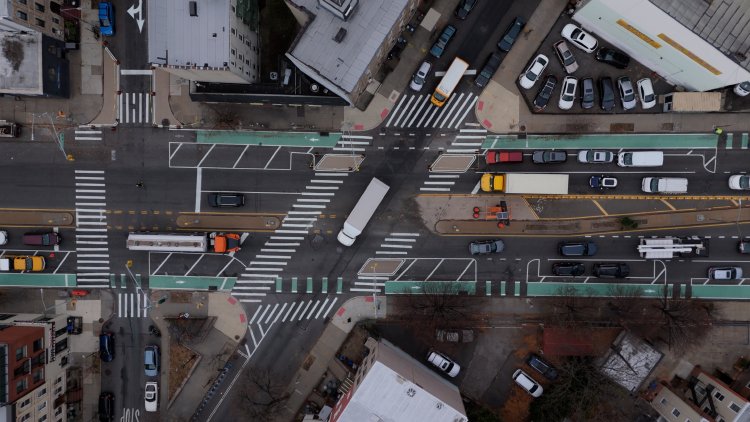
He was far from the first bicyclist to be hit by a vehicle on McGuinness Blvd. in Brooklyn's Greenpoint neighborhood, but when beloved teacher Matthew Jensen was struck and killed, a grassroots bicycle safety movement began to swell, demanding New York's Department of Transportation create a redesign plan by "Changing Lanes."
Laura's Review: B+
Producer/director/cinematographer Ben Wolf ("Obit" cinematographer) makes his documentary directorial debut supporting the movement with a pledge to film only with equipment transported via non-motorized vehicles, in other words, his bicycle. While focusing on one major NYC street, he's made a very engaging film about an issue dogging many American cities featuring everything from century-spanning archival footage to talking heads and spatially illustrative real life examples using high overhead shots. Wolf was also on the street as local big money influence clashed with safety minded protestors, his project kicking off from his having filmed a public meeting on the subject which the public was largely locked out of.
If you mostly commute by car and have ever been annoyed by the introduction of bike lanes, this film could very well change your mind (it already has resulted in action, after years of trying, by NYC's new Mayor Mamdani, whose administration is finally completing the redesign). If you are a biking enthusiast, the documentary will give you hope, as well as ideas for initiating grass roots change in your own community.
Wolf begins with a bit of razzle dazzle, profiling one of NYC's more famous cyclists, Talking Heads' David Byrne, both on his bike out on the street and within his home. Byrne talks about his early days in the city living in the Lower East Side and Soho and how it was no problem to bike around back then, but that things have degraded. He'll return to talk about taking folding bikes along on tours and having much more positive experiences biking around places like Istanbul, Rome and Copenhagen, the latter city, he reminds us, having been taking over by cars before returning to the pro-cyclist city it is today.
We also get a history of New York City's streets, once owned by pedestrians as evinced by the actual parks and benches that used to be centered right within the aptly named Park Avenue. Kids could play in these streets before the automotive industry turned pedestrians into 'violators' of space it now claimed as its own, criminalizing them as jaywalkers. The powerful urban development planner, Robert Moses, transformed the city, knocking down neighborhoods (including houses on what became McGuinness Blvd.) to build thoroughfares and transform many which once allowed pedestrians and bicycles into automobile only transportation routes. Although Moses was New York based, his influence was felt across the country. More history goes back through New York's governors, some, like Rudy Guiliani, being against bicyclists, others, like Koch putting in bike lanes after an eye-opening trip to Beijing and a transit strike only to remove them under public pressure. Dinkins, DiBlasio and Adams are heard from as well. All this is, of course, preceded by shocking statistics comparing NYC traffic fatalities to those of other cities. We are also told that half of these fatalities occur on only 7% of NYC's streets, the problem clearly concentrated in areas like McGuinness Blvd.
The tide began to turn away from an automobile only mentality with the rise of bike messengers, then a reversal of people moving out of cities, returning to them from the suburbs. The pandemic made food deliverers multiply, adding more non-automotive traffic to the streets, their ranks on both sides of the issue with many being killed, but also many using Mopeds and motorized bicycles.
Activists on the street trying to change public opinion engage with those against bike lanes, explaining how the data supports what might seem counter intuitive and that the lanes can be accomplished with paint, making them easily reversible should the experiment fail (it is also pointed out, though, that European bike lanes are 'built,' making them safer). Their efforts are backed up by well spoken subjects like New York State District 50 Assemblyperson Emily Gallagher, elected by an 80% margin on this issue and coining the delightful phrase 'weaponized incompetence,' and Bloomberg's former NYC Department of Transportation Commissioner Janette Sadik-Khan, a real champion of road safety for all.
We see another kind of activism from bicycle designer George Bliss, who erects his own signs reminding Moped and motorcycle drivers that bike lanes are only for non-motorized vehicles and who finds license plates obscured by their owners so as not to be ticketed, repainting their numbers and letters in. Many of these plates belong to NYC policemen who fail to uphold biking lane laws.
After widening his scope to look at the issue from many different angles, Wolf again returns to McGuinness Blvd., where a community Zoom meeting is overrun by a loud minority and where the owners of Broadway Stages, the Argento Family, fight tooth and nail against the cycling safety advocates. Activists tell us that change is hard, but clearly worth fighting for. Wolf closes with an auspicious snippet of a Mamdani campaign speech, wrapping an informative documentaries that also entertains, Wolf's illuminative work snappily paced by editor Kristin Bye.
Robin's Review: B+
"Changing Lanes" was released by First Run Features in select theaters on 4/16/26. It will begin streaming on Amazon Prime and Kanopy on 6/9/26.

