Chain Reactions
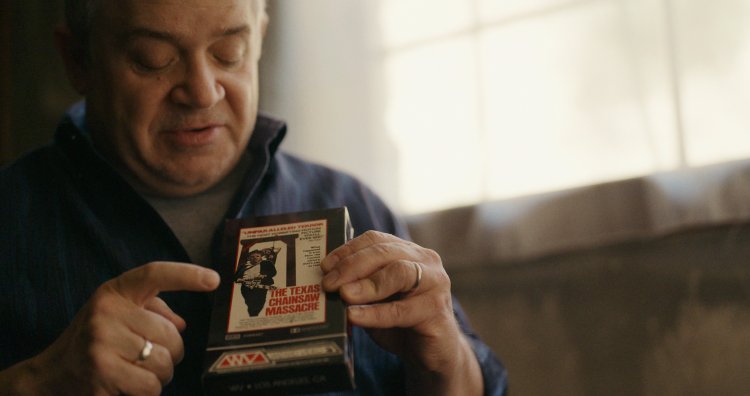
One of the most influential horror films of all time is lionized and analyzed by five different artists in "Chain Reactions."
Laura's Review: A-
Writer/director Alexandre O. Philippe has specialized in documentaries about films and filmmakers like "78/52" and "Lynch/Oz," but none have been as satisfying as his latest essay compilation on "The Texas Chainsaw Massacre," which deservedly won 2024's Venice Classics Award for Best Documentary on Cinema. Much has been written about the film in the fifty years since its release, from the travails of the inexperienced cast and crew making it in 100 degree temperatures to how its profits were siphoned away from them via shady business dealings. It is a film whose title promises blood and gore yet while hardly any is actually seen in the film, people insist they saw it. And despite its initial release into drive-ins and grindhouses, the film's artistic integrity has been recognized, having been installed in MOMA's permanent collection and finally entered into the National Film Registry last year.
Philippe divides his movie into five chapters, each given over for one individual to expound on 'the saw' for about twenty minutes in a setting designed to look like the Sawyer house. First up is Patton Oswalt, introduced with footage from one of his stand-up shows ranting about wishy washy movie titles which tell us nothing about the film, unlike "The Texas Chainsaw Massacre," which, he notes, sounds like teeth tearing through flesh while saying it. Patton will be the first to compare 'the saw' to F.W. Murnau's 'Nosferatu,' the silent he saw projected on a wall at a Halloween party at the age of five. A neighbor with a top loading VCR introduced him to "The Texas Chainsaw Massacre" in the 80's on a small color television. Oswalt makes lots of connections, like Leatherface's retrieval of Pam on the porch to Rhett Butler carrying Scarlett up the stairs. He'll note how it is used in other films as a malignant signpost, shown on a marquee in "Taxi Driver" or playing while an "American Psycho" does crunches. Oswald finds beauty and poetry in it and his enthusiasm is infectious.
Japanese director Takashi Miike tells us that his teenaged self wasn't into horror at all, instead a devotee of Bruce Lee films, then broadening out to the likes of Charlie Chaplin, but when he traveled 40 minutes to see "City Lights" and discovered it was sold out, he decided to take a chance on a film called "Devil's Sacrifice" because the woman on the poster suggested eroticism. That was Hooper's film under its Japanese title and Miike says the movie literally changed his life, doubting he would have become a film director otherwise. He describes a fascination with seeing pain expressed in cinema, focusing on the notorious meathook scene, but pain inflicted with a kind of love. If that sounds crazy, his point comes across as we see scenes from his "Ichi the Killer" and "Audition." The only other film that has affected him this deeply is Ghibli Studios' "Grave of the Fireflies." When asked if he ever did catch "City Lights," he laughs and says he has always thought something bad might happen if he did.
Australian film critic Alexandra Heller-Nicholas views the film both through her own nationality and the poor prints she originally saw it on, equating the film with heat. Having grown up 40 miles from Hanging Rock, Alexandra is not only familiar with Peter Weir's film but experienced the 1983 Ash Wednesday bushfires which took place where his film was shot. She was traumatized by the event, remembering homes burnt to the ground, only chimneys left standing, an image she always equates to the grotesque corpse cemetery monument we see early in "Massacre." Heat and fire are evident in the solar storm we see over opening credits and characters in 'the saw' always seem to be looking up at the sun, something she sees as warning of evil as opposed to terminating it as it does at the end of "Nosferatu." The fact that she first saw the film on an old VHS tape made from an old print that was basically yellow connects it to such Australian films as "Picnic at Hanging Rock" and "Wake in Fright," which she saw in an elementary school class(!) She'll note Hooper's planetary fixation, the moon and astrology also figuring into his film. She finds art references to Rembrandt and Francis Bacon in the Hitchhiker's slaughterhouse photos and Bosch's red hell mouths behind Leatherface's sliding metal door. She also laughs as she says she doesn't think enough people pay attention to Leatherface, talking about his place as an abused child looking for a place in a dysfunctional family. Rather than a monster, Leatherface could be seen sympathetically as the teenagers coming to his door seem like a home invasion from his perspective, the man blubbering in fear and confusion after looking out a window. (If there was one thing I disagreed with that Oswalt said, it was deeming this youngest brother 'evil.')
Ironically, only the fourth chapter, led by Stephen King disappoints, the horror writer failing to connect his comments on "The Huanting of Hill House" to the film being discussed, although he does a better with his Cormac McCarthy parallels. He makes the point that studio interference waters down horror and that it is the small budget independents like "The Evil Dead" which can push the envelope (unlike, say, Stanley Kubrick and all the expensive equipment he used to make a 'cold' film, "The Shining." Ahem, way to get your digs in Mr. King.). He also believes the 'real people' seen in "Night of the Living Dead" and "The Texas Chainsaw Massacre" make the films feel more realistic. But King lost me completely when he claimed that "The Texas Chainsaw Massacre" was 'not of the zeitgeist,' something the last chapter's author, director Karyn Kusama, negates with multiple examples.
She begins speaking about how the film recalls a specific day for her, August 18th the date her brother died, while also mentioning the film's focus on astrology. Maybe Philippe is being cheeky using the famous still photograph of Jack Torrance celebrating New Year's Eve in "The Shining" to illustrate her words about 'a day something horrible happens.' She delves into the subject of the zeitgeist by contemplating that the loss of the American dream, their livelihood in the slaughterhouse, has driven the Sawyer family mad, something which still reverberates today, ensuring the film's timelessness. The director also compares what she calls 'an American masterpiece' to Hooper's first, unsuccessful film "Eggshells," noting similar American themes and many specific, similar shots. She sums up the entire essay with 'most great art is a punch in our complacent faces.'
Philippe segues from one chapterinto the next with outtakes from the original film which have never been seen before, from rough shots of the cast to landscapes which are compared to Terrance Malick's work. His documentary is a must see for any fan of the film and may just convince those on the fence or who haven't yet taken the plunge of its worth.
Robin's Review: B+
Some say (I know because I live with a sayer) that “The Texas Chainsaw Massacre (1974)” is the greatest horror movie, ever. Five artists – Patton Oswalt, Takashi Miike, Alexandra Heller-Nicholas, Steven King and Karyn Kusama – speak their minds and express their opinions on the horror classic in “Chain Reactions.”
Knowing, and living with, a fanatic who thinks that TCM is the best thing since sliced bread, I have seen the film many times – we even saw it at the Medford Twin Drive-in theater over four decades ago. And, we have multiple video formats, including a vintage laserdisc the size and weight of a Greek throwing disk. With that said, I am an informed viewer of Toby Hooper’s seminal film.
Going into “Chain Reactions,” a film that highlights others pontificating on the movie, I realized that I am married to someone who could have, should have, been one of the five commentators – surprisingly, Stephen King’s analysis is the least insightful and he could have been replaced – I know someone who can do the job.
All that said, five die-hard fans of TCM show their knowledge and understanding of the film and, to varying degrees, do a decent job analyzing a well-analyzed movie. Of the five, horror film director Karyn Kusama showed the most insight into TCM, while Australian film critic Alexandra Heller-Nicholas gives us a perspective from down under and its influence on Aussie horror films.
Japanese director Takes Miike, who has directed his share of horror movies, gives a distinctly Japanese take on the phenomenon of “The Texas Chainsaw Massacre,” saying the Japanese people familiar with TCM thought it meant Texas is a dangerous place – well, for a Democrat, anyway.
Patton Oswalt, who leads off the analysis, lends his understanding of acting and compares the film to such other horror films as “Nosferatu (1922 – my favorite), “American Psycho (2000)” and in a bizarre connect, “The Quiet Man (1952),” directed by John Ford and starring John Wayne and Maureen O’Hara. Stephen King gives his views of many other horror films, including those adapted from his stories, and TCM.
I cannot imagine that anyone who has not seen “The Texas Chainsaw Massacre” at least five times would even bother with “Chain Reactions.” It is for the movie’s fans, in particular, and horror fans, in general (who have seen TCM at least five times). I appreciate the way director/writer Alexandre O. Philippe incorporates copious footage from the movie with the narration.
Part of the analyses of the classic brings up how we all saw the film way back when, on VHS tape rented from the video store that had been played a hundred times. We get to see how we saw it and how it really looks like in a pristine copy.
I know it may be hard to fathom when talking about an old horror movie but “The Texas Chainsaw Massacre” and its horror predecessor, George Romero’s “The Night of the Living Dead (1968)” are seminal movies and, I think, deserve the praise many give.
Dark Sky Films releases "Chain Reactions" in select theaters on 9/19/25, expanding on 9/26/25.

