Case 137
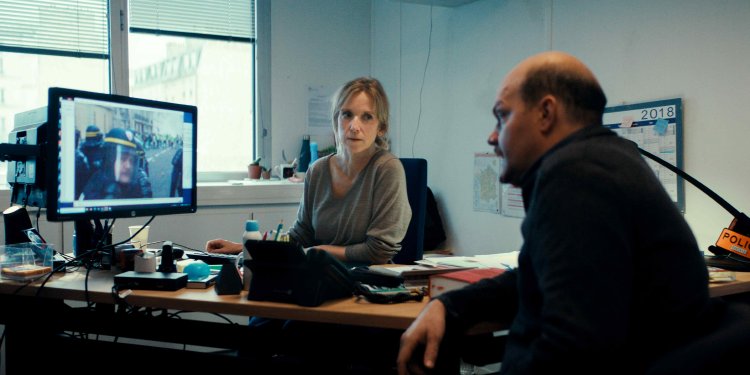
In December of 2018, the Yellow Vest protests, a movement largely made up of rural and working class French protesting rising costs and income inequality, were rocking Paris. Overwhelmed, the government deployed additional police forces untrained in crowd control, like the anti-crime BAC and anti-terrorist BRI. When young Guillaume Girard (Côme Peronnet) and his family turn attending the protest into a trip to Paris, he receives a serious head injury by a projectile from a riot gun on a side street off the Champs-Élysées and Internal Affairs officer Stéphanie Bertrand (Cesar best actress winner Léa Drucker, "Close") is assigned "Case 137."
Laura's Review: B+
Cowriter (with his "Night of the 12th" collaborator Gilles Marchand)/director Dominik Moll ("With a Friend Like Harry...") used several real life cases to present a true to life picture of what happens when untrained officers close ranks to protect their own in situations they haven't been trained for and the almost impossible position the police officers tasked with investigating them find themselves in. French police procedurals have always been among the very best and this is one of them, the film receiving 7 César Award nominations in addition to Drucker's win, including Best Picture, Director and Screenplay.
Marchand and Moll kick off highlighting just what it means for a police officer to investigate a colleague, perhaps even someone they've worked with before as IGPN officers are sourced from other areas of policing. When we meet Sandra, she is dispassionately showing riot footage on her PC screen to a riot cop (Yoann Blanc) accused of throwing rocks at protestors. She is stern in her questioning of him and he admits to having been on edge, protestors having been hurling verbal abuse. Later Sandra will defend him to IGPN superiors, noting his psychological state and prior clean record.
Things get more complicated when Joëlle Girard (Sandra Colombo, "A Woman's Life") files a report on behalf of her son. When Sandra asks why he hasn't come himself, Mme. Girard explains that he is in the hospital, so badly injured he is unable to provide testimony yet (later we see a picture of the boy's injuries and they are brutal). Then things go a step further when Sandra learns the Girards are from Saint Dizier, the home town where her parents still both live, but when she calls her mother (Geneviève Mnich) to ask if she knows them, the answer is no.
While Marchand and Moll relied on shoe-leather work in their last policier, here they assemble multiple montages illustrating a more data driven form of investigation using official correspondence, stills and video from police CCTV and private surveillance cameras. Sandra spends more time in her office than out in the field, interviewing heads and members of the various police forces, their testimony largely a defensive shield while the friend who was with Guillaume when the incident happened, Rémi Cordier (Valentin Campagne), insists that four cops assaulted them for no reason as they walked away from the protests.
Sandra's personal life becomes affected as well, her son Victor (Solán Machado-Graner) asking why people hate the police while her ex Jérémy (Stanislas Merhar) and his girlfriend Noélie (Antonia Buresi), also cops, are downright hostile, denouncing her as a traitor. A trip home to visit mother and father (Christian Sinniger) offers both comic relief (mom actually had Mme. Didier as a home health aide, but didn't remember her name) while members of the Girard family spot her in a supermarket and accuse her of spying on them. Back in Paris, when Sandra and her colleagues Benoît Guérini (Jonathan Turnbull) and Camille Delarue (Mathilde Roehrich) do go out into the field to visit the incident's location, Sandra spots something in a hotel window with a great vantage point, leading her to hotel maid Alicia Mady (Guslagie Malanda, "Saint Omer"), who both shames her with a racial perspective on events while also reluctantly providing important evidence.
Drucker is intensely focused as the investigator, alleviating the emotional strain of her job with an abandoned kitten and cat vidoes, another humorous outlet provided by Marchand and Moll. Cinematography and editing add to both the 'fog of war' of mass protests and the pinpointing of pertinent details. If initially "Case 137" might appear refreshingly democratic to American audiences, in the end, its twists and turns offer a more cynical, if realistic worldview. Many will find the film a reflection of what the U.S. faces now with I.C.E.
Robin's Review: B+
In 2018, France was rocked by the yellow-vest protests against high fuel costs, inflation and unfair tax inequity. Police used "non-lethal" weapons on the crowds, including one young man who was in the wrong place at the wrong time in "Case 137."
I have always believed that no-one does police procedurals better than the French and Dominik Moll's latest supports that belief. The Yellow Vests have taken to the streets and the police have orders to restore law and order and punish looters. The cops are not allowed to use live ammunition, so riot guns with rubber bullets are used instead.
In one such incident, a young man, Guillaume Girard (Come Peronnet), and his friend Remi (Valentin Campagne), happen to be on the street when they pass some can-throwing Yellow Vesters being chased by a group of riot cops. The cops fire on the two young men, hit Girard and put him in the hospital with severe head trauma, His mother, Joelle (Sandra Colombo) files a complaint.
IGPN (Internal Affairs) officer Stephanie Bertrand (Lea Drucker) is assigned to head the investigation and begins the arduous task of collecting all CCTV camera evidence and any other videos they can find. But, the real problem for Bertrand are the department heads of the men responsible for the shooting.
This is where this procedural runs into roadblocks. If you are investigating civilians, that is one thing, But, if you are investigating and, worse, accusing cops of using excessive force, there is going to be stonewalling about responsibility and guilt.
This is where Stephanie has her work cut out for here as she has to plow through the bullshit, lies and cover-ups at the highest levels in the police. What strikes most is she is castigated by her colleagues, ex-husband included, and shunned because of her investigation. And, she has to deal with the statement by her son, Victor (Solan Machado-Graner) that "people hate cops." With her investigation, she comes to realize that he is right – for a reason.
Lea Drucker has matured as an actress and I mean that in a good way. She gives a powerful performance as a woman balancing two worlds – as a cop and as an investigator of cops. The actor is convincing from start to finish. Supporting cast, which is huge, really flesh out their characters, especially those who are guilty, using denial as a defense.
Is justice done for young, damaged, perhaps permanently damaged, Girard? You will have to find out yourself and see "Case 137." I recommend it.
"Case 137" does not yet have a U.S. release date from its distributor, Film Movement. It is screening as part of the 30th edition of the Boston French Film Festival at the Museum of Fine Arts.

