Butthole Surfers: The Hole Truth and Nothing Butt
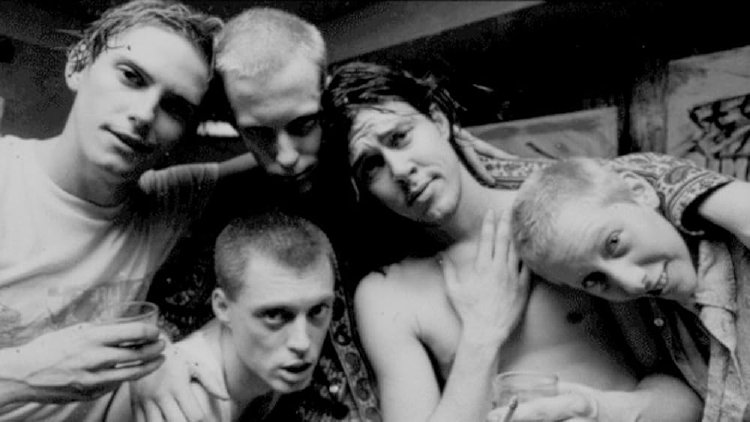
In the late 1970s at San Antonio's Trinity College, an introverted, talented guitar player brought up to be a gentleman but who thought himself weird met the very outgoing accountant student who was the star of his basketball team and definitely was weird. The two bonded over a shared love of bands like Joy Division, published 'VD Magazine,' a parody featuring horrific illustrations from a book on tropical diseases and sold t-shirts and pillowcases emblazoned with Lee Harvey Oswald. But their crowning achievement was the notorious punk band they would form, a hugely influential, ever evolving band. Their incredible story is documented with a visual flair evocative of the band's stagecraft by cowriter (with Simon Weinstein)/director Tom Stern ("Freaked") in "Butthole Surfers: The Hole Truth and Nothing Butt."
Laura's Review: A
Simply put, this is one of the best rock documentaries ever made. Not only does the band have a fascinating history, Stern isn't content to rely on the usual talking heads and archival footage, ambushing some of his unknowing interview subjects with animation sequences featuring puppets or placing them in Pythonesque cut-out animation when he isn't using stop motion. The film even begins with a hilarious disclaimer warning against all manner of things including strobing effects, nudity (including nude puppets) and regret. Stern also constructs an impressive dramatic arc, capping it all off with revelations joyful, painful and insightful.
After Red Hot Chili Peppers' bassist Flea describes the band as new and dangerous, we meet those two cofounders as they are today. The guitarist, Paul Leary, who many musicians will go on to describe as one of the best ever, calmly talks and chuckles describing his early friendship with Haynes. The man, who held his mom in high esteem, notes 'What mother wants her son to grow up to be a Butthole Surfer,' his career choice having caused a painful rift. Lead singer Gibby Haynes prances about a public park feeding squirrels, noting how his dad, famous as Mr. Peppermint back in the day, was 'the nicest guy in Dallas.'
The band that will go on to have more bass players than Spinal Tap had drummers (Jeff Pinkus being the most notable) finds fans like fellow Texan John Hawke, but it's not until they head to the West Coast and their van breaks down in front of San Francisco's Tool and Die Club does their fame begin to spread. Insisting on playing there that night, the band is seen by the Dead Kennedy's Jello Biafra who immediately offers to sign them onto his Alternative Tentacles label. Haynes will get into a physical altercation with their drummer Scott Mathews, losing he and his brother, bass player Quinn Mathews, but they gain drummer King Coffey who is still with them today. Then King finds a twin of sorts in Teresa Nervosa, the two drumming side by side and slightly out of sync, giving them a tribal, marching band effect. Ten years later they'll be signed to Capitol Records, be produced by Led Zepplin's John Paul Jones and hit Billboard's charts. Haynes, had had formed a side band with Johnny Depp, was on stage with him at the Viper Room when River Phoenix OD'ed in 1993. Three years later Capital released its last album with them, ElectricLarryLand, but despite it producing 'Pepper," a #1 single, the record deal and the band disintegrated.
When she joined the band, Teresa had asked Gibby if he could get her to Paris and Stern illustrates how the lead singer's drug and alcohol fueled behavior on tour began to get more and more outrageous, causing friction within the band but gaining European fans. Even then, Haynes is described as being both 'warm and loving' and 'an agent of chaos.' After heading to Georgia to stalk R.E.M., the city's drag venue Celebrity Club became a draw and performance artist Kathleen Lynch joined their show, most notoriously at New York's Danceteria club where she and Haynes simulated sex on stage. Stern uses footage from this notorious show as a sort of climax to his film (and the footage is indeed wild). Puppets are once again employed to illustrate the jaw-dropping episode in Lynch's post-Butthole peep show career that earned her the nickname 'Tada.' But the band began to lose some of their fans when they chose to sue Touch and Go, many seeing their old friend Corey Rusk as having been one of their biggest benefactors.
Closing in on the present day, Paul, who says he moved into producing when he saw the writing on the wall, is content in his suburban home, happily married and living a 'normal' life, although he feels distant from his old friend Gibby while laughing recalling the shame of his having worked with Kid Rock, something Haynes denies despite evidence to the contrary. Stern has an interview with Teresa in an advanced stage of lung disease due to smoking and she manages to be upbeat (closing credits reveal her death in 2023. Her spiritual twin, King Coffey, is in a state of extremes, joy in having married his partner Craig Stewart, tragedy to losing him to dementia six months after Teresa's death. We are told Haynes carries the weight of both Phoenix's death and Kurt Cobain's, having been in rehab with the latter four days before he took his own life, and yet he too has changed, now married and flourishing as a dad to their son Satchel. Then Stern asks him what his earliest memory is and Gibby's recollection from the age of four is not only shockingly distressing but psychologically illuminating.
There is so much more packed into this 106 minute documentary, from commentary from famous fans and musicians to sampling of all the Buttholes' various albums and more crazy anecdotes and episodes than one might believe possible and Stern relates it all with artistic, cinematic flair. "Butthole Surfers: The Hole Truth and Nothing Butt" is the definitive work on the band and it just may be as entertaining as one of their live shows (without the potential danger).
Robin's Review: B
Drafthouse Cinemas releases "Butthole Surfers: The Hole Truth and Nothing Butt" in their cinemas on 8/28/26.

