Blue Heron
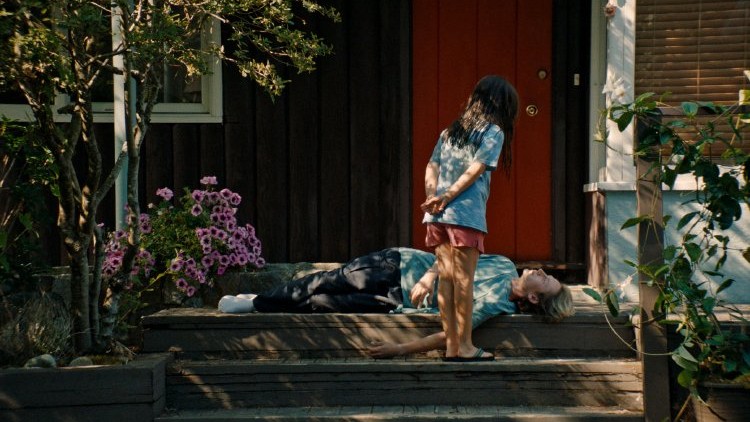
Three brothers and their sister enjoy a seemingly normal day with their mother (Iringó Réti) at a nature preserve, but after returning to their new home on Vancouver Island, the Hungarian family's father (Ádám Tompa) reports that a neighbor has called, concerned that their eldest, Jeremy (Edik Beddoes), is dead on their front steps. Jeremy's parents discuss his behavior, deciding he's merely seeking attention, but their youngest, daughter Sasha (Eylul Guven), will be haunted into adulthood (Amy Zimmer, "Stress Positions") by witnessing her brother's burgeoning mental illness that summer, reexamining his case for her collegiate social studies work in "Blue Heron."
Laura's Review: B+
Writer/director Sophy Romvari's feature debut is based on her own experience and she's created a uniquely effective device to construct her film. After a brief voice over narration setting her stage, Romvari flashes back to her 'summer of Jeremy," but at about the midway point jumps forward a couple of decades to view the events from a professional perspective, even adopting the role of the social worker who visited the family when she was eight. The film works both as a childhood memory of making new friends and spending time with mom over the summer and a depiction of how mental illness can strain a family to breaking without the proper professional support.
In the first half of the film, we experience things through an eight year-old's perspective and at first Jeremy's behavior doesn't seem that extreme, the young girl with no sisters playing with other young girls in the neighborhood, vaguely aware of parental conversations in other rooms. As her older brother's behavior becomes more aggressively disturbing, we will hear her mother trying to nudge her father into a more active role in his children's lives, mom bearing the brunt of summer activities as he works on a PC and acts as a family documentarian with both still photographs and an early camcorder. When Jeremy amuses younger brothers Henry (Liam Serg) and Felix (Preston Drabble) by sifting powdered sugar over them in the kitchen, dad takes pictures and mom comes home to a mess. And if you notice that Jeremy, the only blond in a family of brunettes, doesn't look like his siblings, it will be noted that he is isn't this father's child.
Jeremy will bounce a basketball off the wall of the house, resounding inside where his father works, ignoring his mother's pleas to get in the car. Sasha will return home after a day of water balloon fights to find Jeremy arriving in handcuffs with police in full view of the neighbors, having been caught shoplifting. Later, making potato pancakes with mom, Sasha will ask if one of her new friends can come over for dinner only to be told that it is better if she doesn't bring any friends home. Hearing an overhead thud in the middle of the night, mom will jump up, she and her husband finding Jeremy on the roof, once again ignoring their pleas. A social worker arrives, her only suggestion heartbreaking, but perhaps the only way to protect the rest of the family.
A sudden shift vaults us into the future, the now adult Sasha gathering a panel of psychologists to reevaluate her brother's old case. She struggles with her own memories, but remembers a brother who could be sweet as he was unpredictable (a flashback shows him drop a blue heron keychain in front of her eight year-old self, a present from that opening scene's gift shop). We will learn a startling, dangerous, new detail about her brother's behavior. Then she will knock on a familiar door, her father answering, but only recognizing her as a social worker as she wanders about her old home observing family dynamics, a moving scene.
Romvari captures Jeremy like a storm cloud threatening idyllic childhood days of summer, then backtracks to analyze just what went wrong and although she has no real answers, the filmmaker conveys the anguish of a decision Sasha will equate to King Solomon's dilemma when facing two mothers claiming the same baby. Her cast meshes like a natural family, young Eylul Guven quietly observant, Edik Beddoes conveying Jeremy's inner turmoil with cynical interior smiles and a clenched jaw. "Blue Heron" is a wistful reflection on a painful family event.
Robin's Review: B+
An immigrant Hungarian family of six moves to Canada and settles down on Vancouver Island. It is an idyllic family life but there are some serious cracks in the familial façade in "Blue Heron."
Writer-director Sophy Romvari tells an autobiographical tale of growing up in an immigrant family in Canada. The family – mom (Iringo Reti), dad (Adam Tompa), eldest son Jeremy (Erik Beddoes) and the youngsters, Sasha (Eylul Guven), Henry (Liam Serg) and Felix (Preston Drabble) – is entering a new chapter in their young life.
At first, everyone seems to be settling in to their new digs with dad working on his computer or playing with his camera or with the kids. Mom, though, has to take care of the kids, do the shopping, clean the house, do laundry and everything else. Responsibility in this household is lopsided. to say the least.
There is a far greater problem rising with teen Jeremy. His behavior becomes increasingly closed off from the rest of the family and he begins do strange things, like busting a window or pacing on the roof. Then, the police bring him home after arresting the boy for shoplifting. Soon, social services becomes involved and recommend him for "voluntary placement" (read, "foster home").
The family drama around Jeremy is tempered by the younger kids who get to play being children at play. The contrast between Jeremy's increasingly antisocial behavior and the kids being kids may be a statement by the director on the memory of the past and how it colors our present. Or, not.
The family story takes an odd turn at about the three-quarters mark. Sasha, who had been the family's eyes as a girl, is all grown up and is an analyst for social services. She is doing a study on her brother, Jeremy, and her family and, suddenly, grown up Sasha (Amy Zimmer) inserts herself in the family from when a girl.
It is, as I said, an odd turn, but there is a method to the filmmakers' madness. The change of direction the film takes makes an important point about mental illness in a family. For the parents it is always about "what did we do wrong?" The truth is, the sufferer will not get better and will not change no matter what mom and dad do.
Janus Films releases "Blue Heron" in NY on 4/17/26, expanding in subsequent weeks. Click here for theaters and playdates.

