April
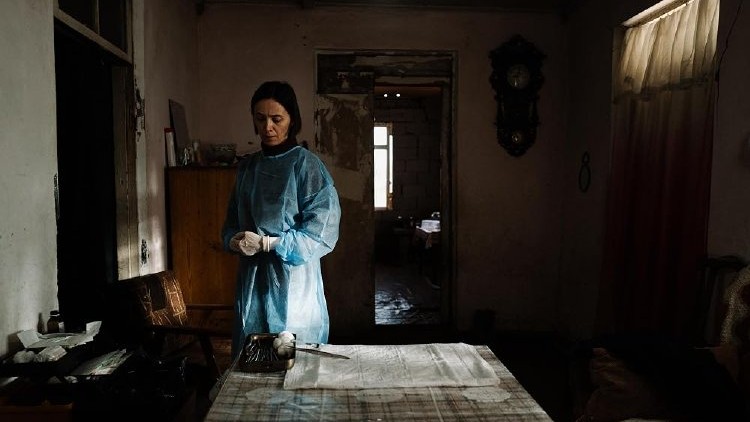
When a newborn infant dies, OB-GYN Nina's (Ia Sukhitashvili, "Beginning") life is thrown into turmoil, facing accusations while continuing to take risks providing necessary healthcare for her rural Georgian community during the toughest month, "April."
Laura's Review: A-
With just her second feature, writer/director Dea Kulumbegashvili ("Beginning") has created the most haunting film on women's healthcare, and more generally, rights in a patriarchal society, since "4 Months, 3 Weeks and 2 Days." This is not for the impatient, as cinematographer Arseni Khachaturan's long takes definitely qualify as slow cinema, nor for the faint of heart, as Kulumbegashvili presents an actual epidural and two live births, one natural, one caesarean, but it is the character study of a woman consumed by her self-appointed mission and the fate of a deaf mute girl that will haunt you well after the credits have run.
Speaking of credits, Kulumbegashvili introduces a figure from Nina's psyche, a faceless, hairless, clay-like nude that breathes heavily, like something primordial making its way through black space before the film's title appears. The figure will reappear in the dim light of Nina's home, with her former lover and again, in nature, right before the end credits.
After a long shot of heavy rain hitting the ground (April showers?), we're plunged into a graphic overhead shot of a woman giving birth surrounded by medical staff including Nina, who cuts the baby's umbilical cord. Someone notes that the baby isn't crying and we're transported to Nina sitting in the office of the hospital's Head Doctor (Merab Ninidze, "Jupiter's Moon") with the child's father and Nina's colleague David (Kakha Kintsurashvili, "Beginning"), who defends her as their best OB-GYN, having delivered thousands of babies. But the grief-stricken father is having none of it, saying if he could go back, he would keep her away from his wife and when the other two doctors leave the room, he lunges at her. 'I know you give abortions in the village. You're a murderer.'
Khachaturan's handheld camera, which seems to gently float from side to side, observes Nina in the bright white light at the end of a hospital hallway lost in thought (later he'll repeat the shot, a toddler lurching towards an adult, to eerie effect). Then we are transported to a dashcam, Nina traveling country roads in purple-blue light, picking up a man for anonymous sex which turns shockingly abusive, the first of three such interactions, the second of which equates men with beasts. Back at the hospital, Nina will ask David, who we will learn is her former, still yearning, lover, to lead the investigation into the stillbirth as otherwise they'll use it as an excuse to fire her. While David notes that she 'should have done a C-section,' Khachaturan will keep is camera close on Nina's face throughout the conversation, Nina defending her actions both in the operating theater and in the homes of village women. 'Somebody has to do it,' she says regarding the abortions which David says will cost her everything.
At Mzia's (Ana Nikolava) home in Kulumbegashvili's hometown of Lagodekhi, Khachaturan keeps his often static camera on one end of a long room, Mzia and Nina in the foreground discussing Mzia's sister sitting in the room's farthest corner. Mzia is distraught because the young woman has missed at least one period and if her husband (David Beradze) finds out about the pregnancy, they will have to 'leave this place.' She doesn't know how her sister may have 'slipped out' and who might be responsible (could he be in the house?). Nina plays devil's advocate, suggesting that Mzia's sister has the right to parenthood and that an abortion will be both physically and emotionally traumatic for her. Mzia lays out a plastic sheet on a long dining table and Nina examines the girl, who she declares further along than one month. A radio plays in the background.
This scene will be revisited later, after Nina counsels a frightened sixteen year-old in a head scarf whose mother is concerned that she is not pregnant yet after marrying, slipping her birth control and swearing her to secrecy. When she returns to Mzia's, it is to perform that abortion and once again Khachaturan frames the scene unconventionally, the girl's hips seen from a side view as Mzia runs her hands over her sister's arms to comfort her while Nina works out of frame, only her hands seen, the only sounds the young woman's whimpers and livestock bells in the distance.
Kulumbegashvili also celebrates life with the natural beauty of the area, Nina walking through a field of poppies or admiring cherry blossoms. But a stunningly captured thunderstorm moving across the landscape presages a horrific event and the filmmaker wraps with the sudden jolt of nature encountering man.
"April" isn't an easy watch, but it delivers a powerful message. It is also artfully crafted, a film that continues to build in momentum long after it's over. In addition to Khachaturan's idiosyncratic lensing, the film boasts a striking sound design. Sukhitashvili, who at times resembles a young Isabella Rossellini, gives a committed performance, albeit a somewhat mysterious one (asked by David why she wouldn't marry him, Nina replies that she has no space in her life for that).
Robin's Review: C+
After winning the Special Jury Prize at the 2024 Venice Film Festival, "April" received a very limited theatrical release by the now defunct Metrograph in 2025. Thankfully, Mubi has come to the rescue where the film will begin streaming on 7/24/26.

