After the Hunt
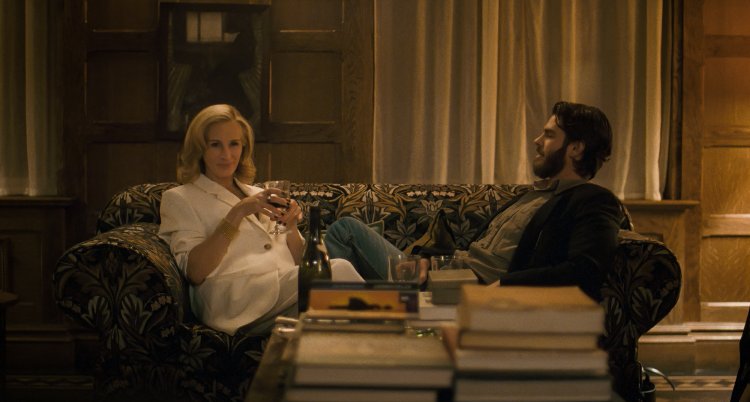
It's clear Yale philosophy professor Alma Imhoff (Julia Roberts) expects to be granted tenure despite her close colleague Hank Gibson (Andrew Garfield) also vying for the spot, the two swearing to never forgive the other should the other nab it, an affectionate display with real underlying tension during a boozy party in Alma's apartment. It will also be one of the first issues inviting the argument of diversity versus merit in an academic world about to be turned on its head when Alma's star pupil, the daughter of billionaire university donors Maggie Resnick (Ayo Edebiri), brings an accusation of sexual assault by Hank to Alma in "After the Hunt."
Laura's Review: A-
Director Luca Guadagnino ("Challengers," "Queer") worked with Nora Garrett on her first featured screenplay to make it thornier, a psychological thriller that has frustrated many with its refusal to answer Maggie's accusation. But "After the Hunt" isn't about whether or not Hank assaulted Maggie so much as it is about how these characters react, each trying to maintain a position based on assumptions of their own self perceptions on an academic chessboard. The veteran director and debuting screenwriter tackle all kinds of current issues in addition to #MeToo from identity politics to self medication to class structures and in her most complex role to date, Julia Roberts juggles them all.
Alma's party introduces us to five of the film's main players of which she is the Queen Bee, a fact her husband, psychiatrist Frederik Mendelssohn (Michael Stuhlbarg, "Call Me By Your Name"), acknowledges in its aftermath, telling her that both Hank and Maggie satisfy her need for adoration. He also makes note of her copious intake of alcohol, multiple glasses of red wine followed by tumblers of Scotch. Frederik also adores Alma, the one thing that taints his outsider status from becoming our point of view into the academic setting. And if one wonders just why Guadignino's cinematographer Malik Hassan Sayeed ("Clockers") follows Maggie after Alma directs her to use the guest bathroom, it is because while looking for toilet paper, Maggie finds an envelope taped inside a cabinet, one which holds a secret about her mentor's past. At the end of the evening, we'll be the only witness to Alma doubling over in pain, something she hides from others.
The next morning, Frederik leaves two pills by his wife's bedside, presumably to treat the hangover he knows she'll be enduring, a gesture we'll see repeated. Alma gets through the day swigging Coke, then responds to Hank's invite to meet him at Three Sheets, the local bar, leaving Frederik's text about the cassoulet he's cooking unanswered. The two find privacy outside with their additional vice, smoking, and Hank confides that he believes Maggie's plagiarized her thesis. When she arrives home (too late for dinner with Frederik), Alma is surprised to find Maggie soaking wet in her foyer, but instead of comforting the young woman who's come to confide a serious violation, Alma shuts down, asking why she's come to her as Trent Reznor and Atticus Ross' ("Challengers") score piles on the tension with violin and atonal piano. Alma will now face battle on two fronts, with both the young woman and long time friend (and perhaps more?) who feel she's failed them, Hank storming into her class after having been fired. Things escalate after she compromises her friendship with school psychologist Kim Sayers (Chloë Sevigny) by stealing blank prescription slips and lays every feeling she has about herself on Maggie in public, both actions having serious repercussions.
Garrett weaves all kinds of telling details into her script. Alma's philosophy class debates cut two ways, from the topical to its power structure. A lecture where Hank watches Alma and Maggie from afar evokes a chuckle with its subject, The Future of Judaism Is Female. Maggie herself
embodies racial and sexual identity elements (her girlfriend Alex ("Mutt's" Lío Mehiel) uses binary pronouns) in contrast to her financial privilege and the only one who seems to really see her is Frederik. Maggie doesn't even know who she is, stealing her style, from nail polish color to clothing, from Alma (costume design by "Bones and All's" Giulia Piersanti). Garrett and Guadignino leave us with a coda five years later that confirm what we'd begun to suspect about Alma and Maggie, a killer ending read between the lines.
"Queer's" production designer Stefano Baisi recreated Yale at Cambridge University and on London soundstages with astonishing results, Sayeed portraying it as a place of shadows and dark wood, only Alma's pied-à-terre brightly lit, disclosing secrets. The ensemble shines, but "After the Hunt" belongs to Roberts whose portrait of a complex, ambitious woman haunted by a youthful transgression is the best work of her career. Guadagnino's film may not provide easy answers, but is sure to inspire endless debates.
Amazon/MGM releases "After the Hunt" in select theaters on 10/10/25, expanding on 10/17/25.

