A Magnificent Life
As the curtain closes on a Parisian stage in 1956, there are calls for the play's author, Marcel Pagnol (voice of Matthew Gravelle), to take a bow. When he looks out into 'Fabien's' half full audience, he feels his time has passed, but a request for his serialized memoirs from Elle magazine sees the English teacher turned playwright turned filmmaker embarking on yet another new chapter of "A Magnificent Life."
Laura's Review: B+
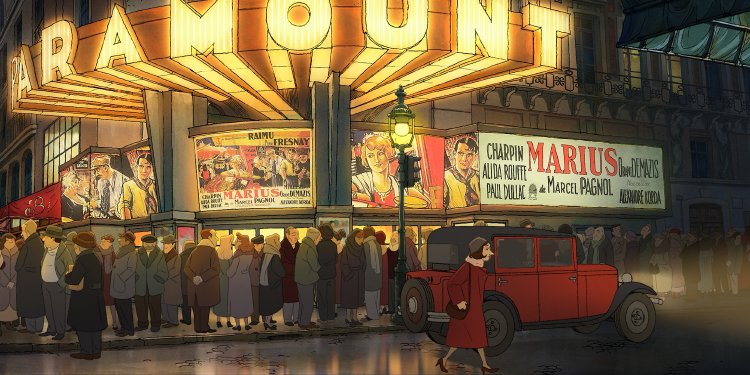
"The Triplets of Belleville" writer/director Sylvain Chomet employs his distinct animation style of hand drawn, exaggerated characterizations cast in autumnal nostalgia to bring decades of one of France's most prolific literary figures to life. When a messenger arrives for his first chapter. the sixty-one year old author Pagnol, who says his memory is like a tape that's been half erased, is guided by Marcel, his childhood self, as he begins to write. Luckily that messenger has a flat tire on his bicycle which Pagnol believes will take the young man a few hours to fix. Pagnol is probably best known in the U.S. for the Claude Berri films adapted from his two volume 'The Water of the Hills,' "Jean de Florette" and "Manon of the Spring," although a recent retrospective of his Marseilles trilogy ("Marius," Fanny" and "Cesar"), the first two of which have also been remade by Berri's films' star Daniel Auteuil, has raised his profile with cinephiles.
His Marseilles childhood sees the young boy writing poems for him beloved mother, who adores them, spreading them in a circular pattern on her bed, the poems turning into flowers and whirling into her funeral wreath. Marcel doesn't take too well to the stepmother chosen by his coolly practical father, who tells his boy that poetry is not a profession. We next find him as a young schoolteacher married to Simone who gives piano lessons in their apartment and is devastated when her husband exults in a transfer to Paris. Writing a vaudeville routine, 'Castro & Jojo,' with a friend at a drunken party launches Pagnol into his next career, but while his early dramas get good reviews, they don't match the financial success of the bawdier work. Simone has left him and Marcel has taken up with the actress Orane Demazis, who suggests he should set one in Marseilles. Not only does he do that, but he insists on maintaining the distinctive Marseilles accents many Parisians claim not to understand (differentiated in the English language dub) as well as casting his friend Raimu, an Alsatian who proves the naysayers wrong. In Hollywood, where Hungarian director Alexander Korda will adapt 'Marius,' the first of his Marseilles trilogy, Pagnol is told to 'never make a sequel.'
Chomet depicts Pagnol as a man who adored his mother, but continually sought the approval of his father, perhaps the reason for his interest in engineering (we see him trying to build a perpetual motional model). He loves many women and his home in Marseilles, where he will eventually build his own film studio. One of the animator's most effective devices is embedding actual film footage into animated screens, celebrating two forms of filmmaking in one frame (Salvador Simo used both in another animation about a filmmaker, "Buñuel in the Labyrinth of the Turtles," without melding the two). Chomet's use of animal characters comes into play not only in the form of that old, overweight dog from "Triplets" but in Bullock, the lamb that ate film and everything else at Pagnol's Marseilles studio. When the Nazis want him back in Paris to 'rebuild' French cinema, he destroys his latest film rather than let it fall into German hands. He also objected to a post-war trade agreement with the U.S., believing France would be flooded with Hollywood films.
Chomet circles back to his beginning, Pagnol at his writing desk, the man struggling to begin his memoirs now seated with multiple completed volumes on the shelves behind him. Following the ghost of his own younger self and the mother whose voice would continue to guide him, the brother who remained in Marseilles as a goatherd arrives to lead him into the afterlife. "A Magnificent Life" is so beautifully constructed and lovely to look at, it doesn't matter if you know nothing about Pagnol. Chomet celebrates an artistic life with charming artistry.
Robin's Review: A
Marcel Paul Pagnol, born in 1895 and died in 1974, was a French auteur, novelist, playwright and filmmaker whose career spanned decades. Animation master Sylvain Chomet brings us the man’s long and colorful career and his story in “A Magnificent Life.”
If anyone is lucky enough to have seen Sylvain Chomet’s wonderful 2003 animation classic, “The Triplets of Belleville,” it gives you an idea of what you are in store for with his latest – the biography of the icon of French culture, Pagnol.
The director uses the author’s own works to tell his unique story. Pagnol was born near Marseilles in southern France. His father was a schoolteacher and his mother a seamstress so the young Marcel was destined to middle-class life following in his father’s footsteps.
Chomet tells of Pagnol’s simple beginnings as a teacher, but his inner creativity drives him to leave the provincial life and move to Paris and become a playwright. This is where the story is told in the stages of Marcel Pagnol’s long creative life.
He became the toast of the Paris stage with his hit plays, the first being “The Glory Merchants” in 1925. He had a succession of hits through the decade. Then, in 1931, he discovered the power of talking film for storytelling and embraced that medium to great success. Then, Hitler and the Nazis place a boot on the neck of Europe and, particularly, France.
Once Hitler was defeated, Pagnol continued to make films and became the only filmmaker invited to join the French Academy of the Arts. In 1952, he turned to writing, including his memoirs, and achieved even more fame as a novelist.
While I “knew” about Marcel Pagnol before watching “A Magnificent Life,” sitting through it proved to be a real education about, as I said, the auteur, novelist, playwright and filmmaker. One device Chomet uses to push forward Marcel’s story and his decisions is Pagnol, himself, as the young Marcel who visits himself over the years as his alter ego. Others that he lost, like his beloved mother and older brother Paul, also “visit” him throughout his life.
“A Magnificent Life” is, indeed, about a magnificent life and I feel that I really got to know the man and his art in a way I did not expect – except I had the privilege of seeing “The Triplets of Belleville.”
After a 2025 awards qualifying run, Sony Pictures Classics releases "A Magnificent Life" in theaters on 3/27/26.

