Never After Dark
Spiritualist Airi (Moeka Hoshi, TV's 'Shogun') chats with what appears to be her younger sister Miku (Kurumi Inagaki, Netflix's 'House of Ninjas') in her rearview mirror as she drives through forest toward a country estate, but Miku isn't really there, having already ventured 'beyond the veil.' To Airi's horror, the ghost she's been hired to drive out of that estate, a former hotel, by Teiko (Tae Kimura, Netflix's 'House of Ninjas'), may not have taken that step yet in "Never After Dark."
Laura's Review: B+
Writer/director Dave Boyle (Netflix's 'House of Ninjas') raises plenty of gooseflesh with practical effects using mirrors, body doubles and lighting techniques combined with ancient folklore, creepy make-up, exaggerated sound and inventive props. As our guide into the mystery, Hoshi guards one of her own, Miku's demise tied to her character's fears which will be challenged once again.
'I thought there were two of you,' asks Gunji Nakasawa (producer Kento Kaku), Teiko's son who instructs Airi to assure his mother that there is nothing scary in their house. But Teiko tells her that a grandfather clock at the top of the stairs only tells time when it wants to, that a door at the end of the hall opens and shuts by itself and that there is a man who 'visits' her. After Airi observes the clock suddenly running backward and a strange man (Mutsuo Yoshioka, "Chime," "Cloud") plodding down the hall, both mother and son are taken aback when Airi tells them that they must leave and let her do her work alone, Gunji thinking she's a charlatan, Teiko wishing to watch Airi's ritual. But Airi is insistent, warning of danger, the reason, she tells them, she never works after dark when the veil is thin and the undead have more power.
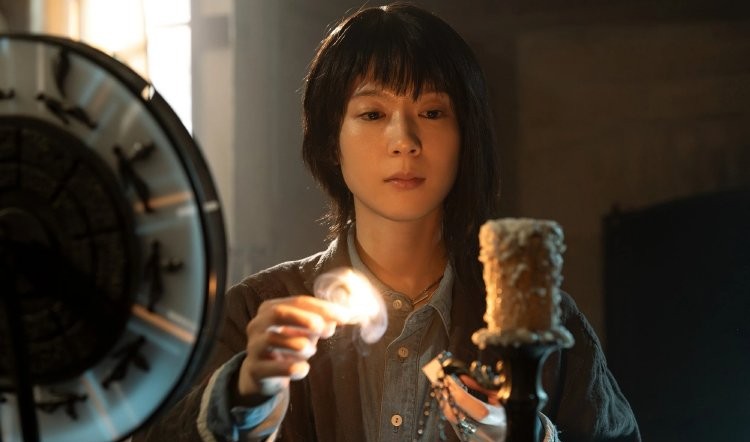
With Miku having warned Airi 'this one is different,' Airi begins her ritual (note there is a strobing effect), sitting in front of a mirror encircled with a zoetrope illustrating a soul leaving a body (production design by "Shin Godzilla's" Yuji Hayashida). She lights a candle, cuts off a piece of her hair and burns it and suddenly she is 'inside' the mirror, behind the veil in a parallel world of dim blue light. She sees the man and follows him quietly, observing as he scratches against a wall panel, but when he senses her presence, he begins a hair-raising chase, Airi making it back to her ritual site just in time to blow out the candle and return to the world of the living. Now she has an idea what her 'ghost' is looking for, and, sure enough, when she removes that wall panel, she finds something very disturbing - a tin box full of teeth, each one she picks up sending her a visual shockwave, one terrified individual after another having teeth violently extracted, a nightmarish montage. Airi will also make another disturbing discovery - Teiko never left the house, having watched her perform her ritual ('you never left your chair').
Airi blows off some steam that evening, getting drunk and dancing around to a pop record she finds (a catchy original song, 'Silhouette,' by the film's composer Jonathan Snipes with lyrics by Sharon Udoh) when suddenly Gunji appears, offering apologies for his earlier behavior. The two bond over beers. The next day Airi will meet a man who says he was a salesman in the area who used to stay in the home when it was a hotel, expressing a strong interest in seeing the inside, but Airi is not comfortable letting a stranger into a property she does not own. He appears to understand, but when Officer Inokoshi (Bokuzō Masana, HBO's 'Tokyo Vice') gets involved, his identity - and ill will - become apparent.
Boyle has not only redefined the ghost story but structured it atop a sisterly bond that is integral to its outcome. Hoshi readily shoulders the film with her mixture of confidence and eventual fear, the actress's work with costar Inagaki creating a true sisterly push/pull dynammic with the revelation that although she died at a younger age than Airi is now, Miku is actually the elder sister, another complicating factor. The use of teeth in horror has always been disturbing (see "The Texas Chainsaw Massacre," "The Tenant") and Boyle's use of ancient beliefs that a person's teeth, as the last part of the body to disappear, hold their soul, may be the reason why. Yoshioka, seen both with and without them, is suitably 'normal' on one side of the veil, physically eerie on the other. Director of Photography Patrick Ouziel makes an impressive feature debut tackling mirror images and lighting which immediately lets us know which side of the veil Airi is on. The location supports the story perfectly.
"Never Before Dark" is an inventive reimagining of what a ghost story can be, its sisterly bond providing an emotionally moving finale.
Magnolia Pictures releases "Never After Dark" in select theaters on 9/25/26, expanding on 10/2/26.

