Once Upon a Time in Harlem
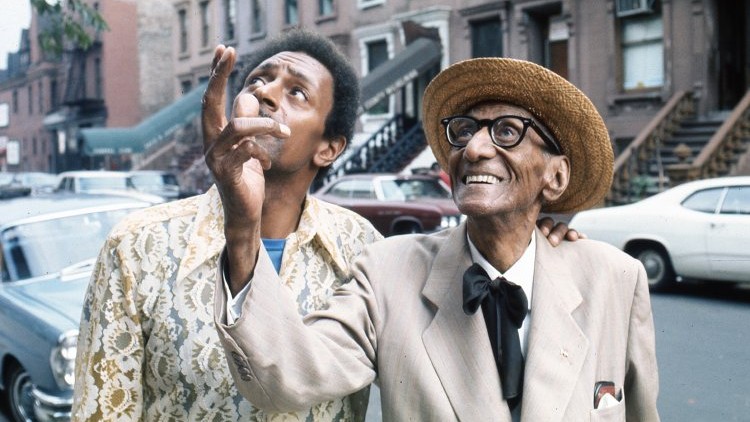
In August of 1972, documentarian William Greaves invited over two dozen seminal figures of the Harlem Renaissance to a cocktail party at Duke Ellington's brownstone. Musicians, actors, writers, painters, librarians, bookshop owners, journalists, historians and political activists would engage in debate about the significance of the Harlem Renaissance and the community which lived "Once Upon a Time in Harlem."
Laura's Review: A-
William Greaves continued to work on this film, which contains multiple one-on-one interviews conducted the day after the party and in intervening years, until his death in 2014. Now his son, David Greaves, has completed a film that is like being invited to an illuminating and entertaining cocktail party celebrating black excellence in the arts and the time's burgeoning political activism and, as with many such parties, debate gets more lively as punch bowl levels drop.
After a brief intro featuring the written invitation to Duke Ellington's house (he was not able to attend himself due to illness), we see people out on the street arriving and being greeted at the door, folks making their way in greeting friends they hadn't seen in years. The filmmakers use split screen effectively, sometimes showcasing a current subject with a still photograph of them at the time of the Renaissance (which is stated as the 1930's, although poet Countee Cullen's widow, Ida Cullen Cooper, corrects that to the 1920's) or showing two different perspectives of the party. Best of all, they are generous with subtitling who all these folks are, repeating the information throughout the film.
As James Van Der Zee's photos of the time are shown, the man himself sits and plays piano, entertaining guests. Jazz great Eubie Blake corrects a media story about refusing to shake the hand of a white man, stating that he always held back, waiting for the other person to offer it. (He's also quite endearing, stating that he's afraid to open his mouth in front of 'all this intelligentsia.') Blake's collaborator, Noble Sissle, sings 'If you've never been vamped by a brown skin' and 96 year-old Leigh Whipper, who founded the Negro Actors' Guild (and there will be a heated discussion about the terms Negro vs. Black vs. African American when the conversation turns to politics), is thrilled to hear 'Eubie's here.'
Others, like queer painter Richard Bruce Nugent, try to dominate the conversation and, the later it gets, are sometimes spoken over. He recalls writer Zora Neale Hurston after others remember sculptor Augusta Savage and salonnière A'Lelia Walker with memorable anecdotes.
Librarian Regina Andrews knew writers like Langston Hughes when they was just starting out, and tells of one New Year's Eve when they and a few others went to multiple restaurants in Chinatown, the fledgling authors picking up various pieces of dinnerware to trick out her undersupplied kitchen.
Richard B. Moore, an activist and founder of the Frederick Douglass Book Center, turns the talk to politics, noting the importance of street corner orator Hubert Harrison and pulling conservative writer George Schuyler into the conversation. Different perspectives are offered on responses to racial oppression, activist Marcus Garvey making a case against poet Claude McKay's 'If We Must Die.' Yet all recall feeling perfectly safe in Harlem. Then, as the afternoon is beginning to come to a close, we hear all about 'The Black Eagle,' the pilot Hubert Fauntleroy Julian who parachuted over Harlem multiple times, underlining what a fascinating and vibrant place this New York neighborhood was once upon a time.
"Once Upon a Time in Harlem" will receive a limited theatrical release from Neon on 10/23/26, expanding on 10/30/26. It is the opening night film of the New Hampshire Film Festival on 10/15/26.

