The Samurai and the Prisoner
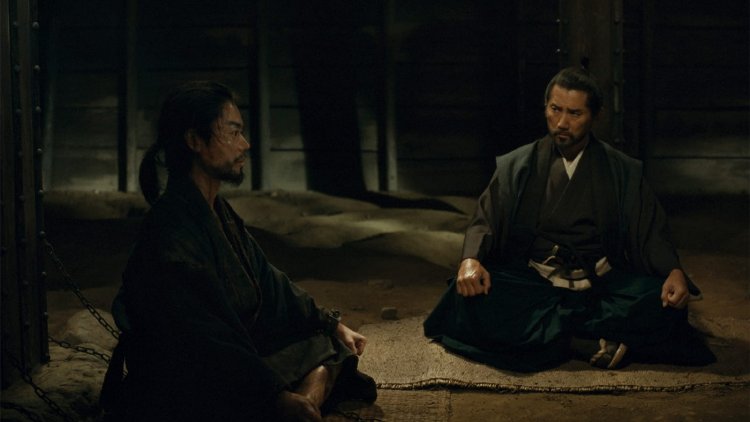
In the Feudal Japan of 1598, Lord Murashige (Masahiro Motoki, "Departures") rebels against Lord Oda's (Bando Shingo) sweep to the West, but when expected alliances fail to materialize he must secure himself and his generals within the walls of his Arioka Castle. When Oda's envoy, savvy strategist Kanbei Kuroda (Masaki Suda, "Cloud"), arrives, he advises Murashige on his position, but Murashige ignores Samurai tradition about sending envoys back, chaining the man in his dungeon. As the seasons progress and Oda advances, murders and mysteries dog Murashige who relies on Kanbei to help him solve them in "The Samurai and the Prisoner."
Laura's Review: A-
Writer/director Kiyoshi Kurosawa's ("Cure") first film set before the 20th century, an adaptation of Honobu Yonezawa's historical fiction novel, features layers upon layers of complexity, from Feudal power struggles to court intrigue and earthly mysteries to Buddhist and Christian philosophies, all centered on one man willing to flout Samurai tradition. Murashige is a fascinating historical figure, a man whose modern way of thinking eschews killing as meaningless, his perspective formed by the brutal cruelty he participated in under Oda (a late breaking flashback is recalled by Murashige with shamed regret and viewed by us with horror).
Kanbei isn't at all pleased to have his life spared, though, his failure to return likely to be seen by Oda as his having defected to Murashige when Oda has Kanbei's young son. Murashige also has the young son of a Lord who has turned against him and although most would kill the boy, even Murashige's wife Chiyoho (Yuriko Yoshitaka) urging him to give Jinen a sword, he is intent on sparing him. But in this first season, winter, Jinen will be found dead in a pool of blood and Murashige begins both forensic tests with his loyal guard Jūemon Kōri (Joe Odagiri, "Bright Future") while interviewing all the men who were guarding the boy and that part of the castle. But it will be a poem recited by Kanbei when Murashige presents the case to him that will solve the mystery, one of Murashige's men having done the deed in the name of 'divine intervention' to save his master's face. Murashige once again refuses to execute the man, instead ordering him to the front lines.
Spring will see Murashige attack Oda's men, his Christian Tataksuki and Buddhist Saika clans both returning with the heads of slain warriors, setting up another mystery when one of the heads becomes 'distorted,' its face twisted into an awful grimace. When they learn a young general was killed, both clans wish to claim the honor, but Kanbei opens Murashige's eyes reminding him of the man's carelessness. Summer sees Murashige, his options dwindling, willing to give up one of his greatest treasures, the Tora-Sura, a yellow tea urn more priceless than his castle, to Lord Akioka in a trick surrender bid, but the priest he sends to relay the treasure and the man meant to receive it are both murdered and his treasure disappears. Again, Kanbei proves invaluable and when the perpetrator is seemingly killed by lightning, 'divine intervention,' Murashige knows better. The joy he expresses upon the Tora-Sura's return is as revelatory as his distaste for bloodshed, the Lord having deeply mourned the loss of one of his most faithful during their earlier battle.
The final season, Autumn, puts much in perspective, many men's belief that they should 'advance to paradise, retreat into hell,' a battle cry resulting in the slaughter of thousands, the motivating factor behind everything. Shakespearean references and personal loyalties all come into play as Murashige leaves us with a final mystery, yet such a satisfying conclusion, it may bring a smile.
Kurosawa, known most for modern horror, takes a classical approach here, weaving a fascinating tale. Motoki fascinates throughout, a compassionate leader with everything stacked against him while Suda remains ambiguous, his true aims yet another mystery. Both performances are riveting. Cinematographer Yasuyuki Sasaki ("Cloud") uses a gray green and brown gold palette to suggest seasonal changes.
"The Samurai and the Prisoner" requires concentration to follow all its intricate plot lines, but it will reward you generously. At the age of seventy, Kurosawa is expanding his range.
Robin's Review: A-
Lord Murashiga (Masahiro Motoki) has turned on his leader, Oda (Bando Shingo), and barricaded himself inside Arioka Castle. Under siege, he turns to the man he just imprisoned, Kanbei (Masaki Suda), to solve a murder and uncover the truth in "The Samurai and the Prisoner."
Do not let the title fool you. This historically set drama of rebellion, retaliation and war, by director Kiyoshi Kurasawa (no relation to Akira), is not a non-stop battle epic. Instead, it is a more thoughtful examination of a turbulent time in Japanese history circa 16th century.
Adapted from the novel by Honobu Yonezawa, the filmmaker gives us a lesson in Japanese history that is right up my alley as an avid student of all history. While war and armed siege are going on all around, it is the conversations between Murashega and Kanbei where the latter goes from being prisoner to the Lord's trusted advisor.
So, if this is not your usual historical action flick, what is it? It is a film that tells the story of political intrigue and war in feudal Japan. The filmmaker builds the story based on the historical accuracy of the rebellion against Oda.
As I watched "the Samurai and the Prisoner," I kept being reminded of the other Kurosawa's classic samurai stories. Though the maestro's later films, "Kagemusha (1980)" and "Ran (1985)," hold more akin to "The Samurai..." than to, say, "The Seven Samurai (1954)." Acting though, here, is on a par with the best.
Janus Films releases "The Samurai and the Prisoner" in NY on 7/31/26, expanding in subsequent weeks. Click here for playdates.

