Remake
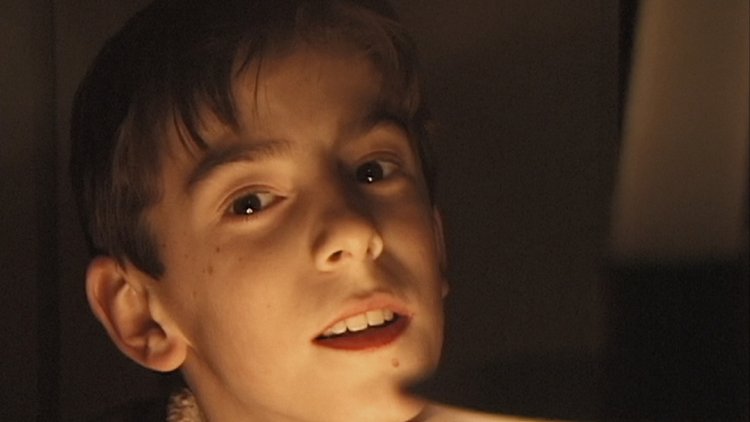
'I used to call myself a filmmaker, a documentary filmmaker,' writer/director Ross McElwee tells us forty years after "Sherman's March," his account of Union General Sherman's military march to end the Civil War which turned into his own personal quest to replace the girlfriend he'd just broken up with, put him on the cinematic map. Now the man who used his family life as the lens he used to make sense of the world around him finds himself on his own, going through his old films to preserve the memory of Adrian, the son who died of a fentanyl overdose at the age of 27 in "Remake."
Laura's Review: A-
McElwee has crafted an intricate exploration of memory, much of his own collected on film and digital, in a work brimming with questions, his grief and love for his son so palpable we feel his reluctance to let go as his film begins to run long. And yet this is no self indulgent exercise, as it is so thoughtfully put together, McElwee's themes flowing from one to the next with a natural rhythm. The title is both literal and not, "Daddy Day Care" filmmaker Steve Carr having optioned the rights to "Sherman's March" to turn it into a feature film, a project McElwee thought could become a bonding experience with his son, a budding filmmaker, but ends up having its own twists and turns.
The film begins with McElwee talking to his son as he shows us footage of a curious, happy little boy engaged in what was once one of his favorite pastimes - fishing, both by net and rod and reel. 'I filmed you spontaneously, randomly,' McElwee says, noting that he only shot a few minutes here and there but that it has all added up to an incredible archive. As he goes through the years he realizes he is 'moving closer to the day you died,' then reverses back to footage from his 2008 documentary "In Paraguay," where Adrian builds a play restaurant and invites his mother Marilyn and dad to visit his establishment (a 'salad' of leaves and pine twigs is served). The family was there to adopt a baby girl, Mariah, after Adrian had expressed the desire for a sibling and the film, like many of McElwee's, premiered at the Venice Film Festival, film festivals something Adrian grew up attending. McElwee realizes that it was this time in his life that was his 'golden period,' because after this family life started to become strained, his wife Marilyn telling him she didn't want to be filmed anymore. Unmoored, McElwee begins to consider Carr's proposal passing it by his sister and brother (who amusingly asks 'Can a film bomb twice?'). Amy Adams is tossed out for the part of his mother. McElwee signs the contract, including his own right to make a documentary about the making of the film based on his documentary, the act shot by Adrian who insists he can find a more interesting shot than the one his dad has set up.
It is this project that gets McElwee on the road again, visiting friends who appeared in "Sherman's March." Charleen Swansea, who made us laugh in that film and subsequent ones, is suffering from some form of dementia and doesn't even remember being in her old friend's movies nor that she was a teacher, yet does remember him. Later, another friend from "Sherman's March," Winnie Wood, remembers the experience so strongly, she tells him it's like the film has become her memory. Adrian is out shooting with progressively larger cameras, looking for his path forward creating websites to sell t-shirts and for a marketing business.
Then, McElwee, who has been shooting his two disinterested teens in his home, tells us he is divorcing and moves into his own space in Boston (while he tells us it is painful he offers no explanation). Adrian is in college in Vermont and it is here that we learn McElwee's son has been having problems with drugs and alcohol, the subject of his 2011 documentary "Photographic Memory." Adrian accompanies his dad to Venice once again, but his appearance at a press conference is uncomfortable, insinuating that life in front of his father's camera has been a factor in his troubles. McElwee revisits 1993's "Time Indefinite," featuring his marriage to Marilyn and the birth of his son. He'll also go through brain surgery when a large mass is found, the doctors amazed it hasn't affected his nervous system. He'll also find a new partner in Hyun, another woman who prefers not to be photographed but whose loving presence McElwee finds ways to incorporate.
The latter part of the film finds McElwee contemplating all the things his son might have become, one music video Adrian created offering two wildly different possibilities. The young man who often berated his father for not cashing in commercially could come off as entitled, but as he moves into his later twenties, he seems on an even keel, a drug designed to curb opioid cravings seemingly working for him. Then McElwee's world caves in, Adrian found dead from an overdose on his and Hyun's bathroom floor on Christmas Eve. 'I used to call myself a filmmaker. I used to call myself your father.'
And that remake deal? After morphing into a television series, then a half hour sitcom, the rights lapse. That project may have never come to fruition, but it gave Ross McElwee one of the last shared experiences with his son and it gave us this incredibly moving and introspective film.
Robin's Review: B
40 years ago, documentarian Ross McElwee set out to document General Sherman's famous march to the sea but went in an entirely different direction. Now, he deals with adapting his '85 work to fiction and losing his son in "Remake."
I remember, way back in the 80s, watching "Sherman's March" because I, like many, expected a historical documentary about "Uncle Billie" Sherman and his war of destruction against the South. It was not. It WAS a personal reflection on the women in his life and the love and loss he experienced as each relationship blossomed and died.
Here McElwee divides his attention between the titular task of adapting "Sherman's March" and the life of his son Adrian, who died of a fentanyl overdose at age 27. While the remake is part of the story, it is McElwee's reflections on his son's short life that is first and foremost in the director's story.
The actual discussion of the remake of "Sherman's March" starts with the possibility of creating a feature length fictionalizing of the original work. That falls through and the talk changed to making it a TV miniseries. That changed to a single 30 minute episode.
The meat of "Remake," though. is about McElwee and his ever-present camera as he chronicled Adrian's life from infant to troubled teen who reached a breaking point with his father and his constantly intruding camera. But, it also shows how Ross McElwee obsession with documenting all aspects of his son's life. I get the impression that Adrian, used drugs to get away from his camera-obsessed father.
Something else that comes across in "Remake" is how Ross made his son into a selfish, spoiled young man who was entitled by his father and pushed to be a filmmaker like his dad. The footage of Adrian's filmmaking attempts did not show an upcoming star director in the making. What I saw, as Adrian grew up, was he grew away from his doting father, eventually moving far away and to what seemed an inevitable end.
I do not know if "Remake" is a continuation of the filmmaker's intrusive camera or an apology to a son whose life ended too soon, I hope for that latter.
Music Box Films released "Remake" at NY's Film Forum on 7/10/26, platforming in subsequent weeks. Click here for theaters and playdates.

