Fiume O Morte!
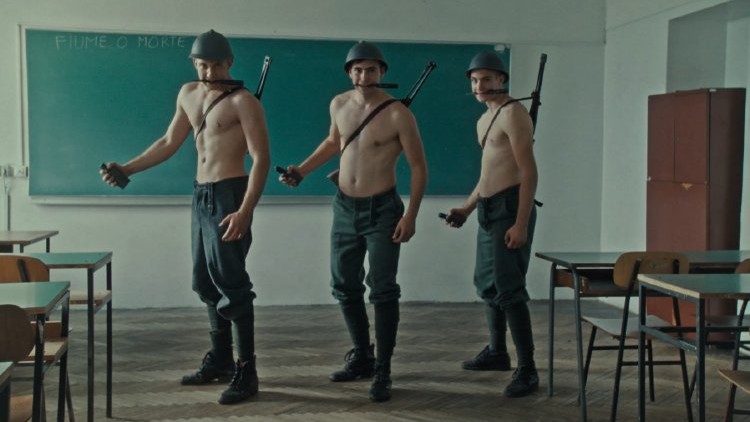
If you've never heard of Italian poet Gabriele D'Annunzio, neither have most of the residents of Rijeka, Croatia, the city he occupied for over a year in 1919, establishing an army and declaring "Fiume O Morte!"
Laura's Review: A
Writer/director Igor Bezinović engages the citizens of Rijeka, which was once Fiume, to recreate a strange footnote of history in the most humorously engaging way possible. Flipping the device of reenactment on its head by using anachronistic modern day staging, then contrasting his present day footage with archival film and stills, he often evokes a laugh with the absurdity of his modern day scenarios, D'Annunzio's triumph in front of cheering crowds now locals dressed in period costume on largely empty streets. When Bezinović's on-the-street interviews finally find some locals familiar with D'Annunzio, he good-naturedly cautions over their frequent use of the word 'fascist,' so as not to provoke their Italian neighbors who erected a statue in Trieste to the man they consider a patriot. This is the type of tongue-in-cheek treatment you might expect from Romanian filmmaker Radu Jude.
First, a quick recap of the history Bezinović relates, which may be familiar to those who've seen Joe Wright's Mubi series 'Mussolini: The Son of a Century.' After the Treaty of Versailles ended WWI, some in the Italian speaking city of Fiume, which sported its own Italian dialect but was under Austro-Hungarian control, wanted it to become part of Yugoslavia while others wanted it to become an independent city state. Fresh from having fought in the way, 56 year-old Gabriele D'Annunzio left his home on a Venetian Canal and traveled to Fiume to occupy the city. He defied Italian General Pittaluga, who tried to halt his advance. His arrival in Fiume was greeted by cheering crowds. The short, bald man who had been the lover of Italian actress Eleonora Duse among many others, installed his 26 year-old pianist Luisa Baccara in Fiume as his paramour. He decreed that all men between the ages of 18 and 22 join his army or spend those years in jail. Two of his young soldiers destroyed the city's two-headed eagle, symbolic of a city looking towards both Hungary and Italy. He ordered the city's bridges to the Croatian island of Susak destroyed (Bezinović holds up pictures of how they looked at the time in front of how they appear today) and declared Fiume was now the Italian Regency of Carnaro. But when both Italy and Hungary declared it the Free State of Fiume, D'Annunzio took over two Croatian islands and declared war on his home country, his followers destroying local Italian businesses. His friend, radio inventor Guglielmo Marconi, was sent by Italy to dissuade him, but ended up supporting him during a radio broadcast. Over a holiday season known as Bloody Christmas, twenty-five young men and several civilians lost their lives against the Italian Army. The rest returned to Italy, as did D'Annunzio, who died in 1939, never learning that Fiume became part of Yugoslavia after all. Mussolini, a friend, said D'Annunzio was 'like a rotten tooth - you either pull it out or cover it in gold.' In 1924, under Mussolini, D'Annunzio was given a princeship.
You will be surprised how entertaining reenacting this will be. While the filmmaker interviews the locals, he slowly begins asking various people to assume roles in his film (one large gentleman laughingly objects to playing D'Annuzio because he was a 'little guy'). He'll end up with about eight different men portraying his lead character, one of whom, shown stopping at an inn on his way to Fiume, ends up breaking character, cracking up with the woman portraying the innkeeper. Another, a local musician, will join the band playing by the side of the road after speaking his lines. Scores of D'Annunzio's rules and regulations for his legionnaires are read ('an expert in running, throwing stones, climbing over walls or gates, passing safely through flames, coiling up to fit the tightest of hiding places in ambush') in a Pythonesque montage. Narration is handled like a relay race, one person introducing the next as each takes over their segment. Passing time isn't relayed by title cards, but by the establishing year laid in tiles on multiple city thresholds. When we get to the election which D'Annunzio rigged in his favor, declaring it void because of 'irregularities' caused by his own soldiers, Bezinović sarcastically notes no photos of that day still exist, so he and his cast of locals create their own dramatic b&w stills. A local nail salon is converted into The Golden Stag tavern which D'Annunzio once frequented at that very location (it was renamed back then to The Platypus when a soldier stole one from the national history museum and presented it to him, an illustration of historical absurdity). One of the film's funniest moments comes when we see three young men craning towards the camera on a Rijeka street, juxtaposed with their period counterparts popping up like Zelig in front of a military parade. Giovanni Maier and Hrvoje Niksic's jazzy score is reminiscent of a European 60's road movie.
Not everything is funny in Bezinović's recreation, though, the destruction of Italian businesses illustrated by furniture being thrown through plate glass adorning current day businesses. The tragedy of Bloody Christmas is emphasized with close-ups of the dead, make-up effects distressingly realistic. "Fiume O Morte!," which won Best Documentary at the 2026 European Film Awards, is evidence of what America's late night hosts have known about 45/47, that humor is a strong anti-authoritarian tool. The past always informs the present.
Robin's Review: A-
The story begins, after WWI, with a photographic montage of the bridges between Rijeka and the town of Fiume in what is now Croatia. They are all destroyed in an effort, after the war, to isolate the Italian loyalist town in "Fiume O Morte!"
I have said it many times before – a good documentary should be educational, enlightening and entertaining. In the case of documaker Igor Bezinovic, you can also add a lot of fun to the list. I have been a fan of documentary feature films for many, many years and this is a totally unique and imaginative way of teaching history – especially a little known piece of it.
Bezinovic draws on the story of the close of World War One and the collapse of the Austro-Hungarian Empire. Soon to be Yugoslavia, the divided city of Fiume-Rijeka is in a flux between the Kingdom of Italy and newly-formed Yugoslavia. In 1919, famed Italian poet, playwright, journalist, orator and war hero Gabriele D'Annunzio decided the fate of the divided city. D'Annunzio led an invasion force of Italian irregulars and seized the city, declaring the Regency of Carnaro under his control.
This is where Bezinovic's documentary takes off. The filmmakers located a rich treasure of archival footage from the time of the invasion and takeover of Fiume-Rijeka. The clever use of the local population in the modern day Croatian city as re-creators of D'Annunzio's short-lived reign is an amusing and colorful contrast to the black and white footage.
Seven different local men, resembling the bald-pated D'Annunzio, were enlisted to portray the man in the recreations. Bezinovic studied his source material fully and, with other locals too, recreates the moments of the invasion and occupation. I appreciated the contrast between the actual events under D'Annunzio and the filmmaker's accurate, though very simply done, historic recreations.
I sat and watched this entertaining documentary with two minds – the history student who gobbles this stuff up and the guy that loves movies, especially documentaries. Both were very satisfied with "Fiume o Morte!"
Icarus Films released "Fiume O Morte!" on 4/10/26 in New York. It becomes available on digital on 6/30/26 and on DVD on 7/7/26.

