Blue Film
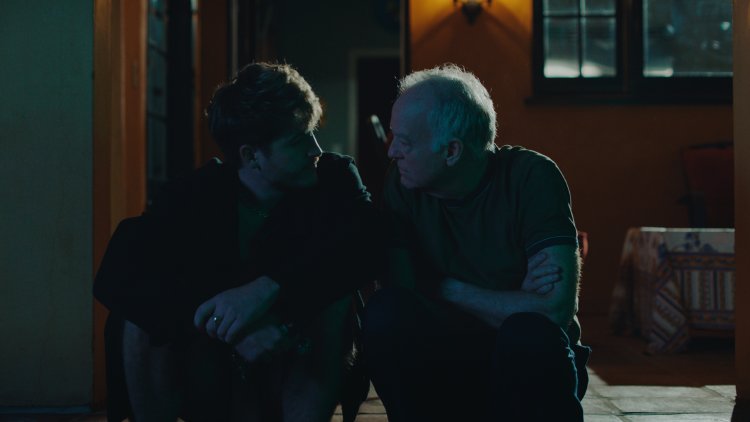
Aaron Eagle (Kieron Moore, TV's 'Vampire Academy,' 'Boots') taunts his male clientele via webcam, flexing his muscles, describing his sweat and teasing more reveals as long as his tip jar keeps filling up, but when he arrives at a private L.A. home and is greeted by a man in a ski mask (Reed Birney, "Mass," "The Menu") with an envelope containing $25K, the man's probing questions hint of prior knowledge and Aaron's facade drops along with his mystery man’s in "Blue Film."
Laura's Review: B+
Writer/director Elliot Tuttle has crafted a provocative two hander between a gay sex worker into dominance over his clients and a convicted pedophile wrestling with his demons. This isn't what anyone would call a pleasant watch, but it is a brutally honest look at what fuels perversions and how people rationalize them driven by two performers unafraid to go there. While there is no male full frontal nudity depicted, there are several sex scenes the actors make explicit nonetheless.
The man in the mask has a video camera set up and asks Aaron to get comfortable, then begins asking him questions about his background, but when he asks about the 'diablo' tattoo over Aaron's right eyebrow, he hits a nerve. Aaron gets up and is ready to leave, the man telling he's not being honest with him, that he isn't from Miami and when Aaron says he knows nothing about him, the man replies that he indeed does and that Aaron's real name is Alex. Alex snatches the man's ski mask off, stumbling back in surprise. 'Mr. Grant?' he asks, recognizing his old English teacher from Maine.
What follows are a series of in depth conversations, more like confessions, as these two men grapple with their pasts while navigating their present. Asked about how he became Aaron, Alex recounts moving to Hollywood and being picked up by two men at a party, then realizing one of them wanted to be humiliated while the other watched. He not only indulged them but the experience made him feel powerful, a feeling he describes as somewhat spiritual. He then probes Mr. Grant about what happened back in Maine. 'Wasn't he twelve?' he asks. And when Alex asks Hank just why he traveled from Maine for this encounter, he shocks Alex with 'I wanted to see if I still loved you.' But while Hank was drawn to that other twelve year-old boy, the one he took into a school bathroom, then let go when the kid began to cry, he says he didn't love him. Describing his joy watching Alex overcome his fear to sing a song at a school event almost makes the man sympathetic if it weren't for the way his handling of Aaron/Alex now carries the whiff of grooming, at least until Alex reverses the power dynamic.
Birney creates a very complicated character, one we both recoil from and yet see glimmers of good in, a man clearly tormented by his own makeup. His final admission as Hank is chilling, yet its disclosure also tells us a lot about the man. And "Blue Film" should be a breakout vehicle for English actor Moore, who wavers between the cocksure camboy persona he presents to the world and the twelve-year-old boy Hank still sees in him, at times the change washing across his face within a scene. Tuttle increases our discomfort interjecting old home movies of a young boy, a toddler, implying Hank's obsession with this young man went further back than their school days. Cinematographer Ryan Jackson-Healy ("Mass") tackles that format along with Aaron and Hank's video footage all the while keeping Tuttle's single set visually interesting, the penultimate scene shot with the blue filter that gives the film its double (or is that triple?) entendre title.
Robin's Review: C
"Blue Film" was released in select theaters on 5/7/26 by Obscured Releasing. It will be available on VOD on 6/12/26.

