Jinsei
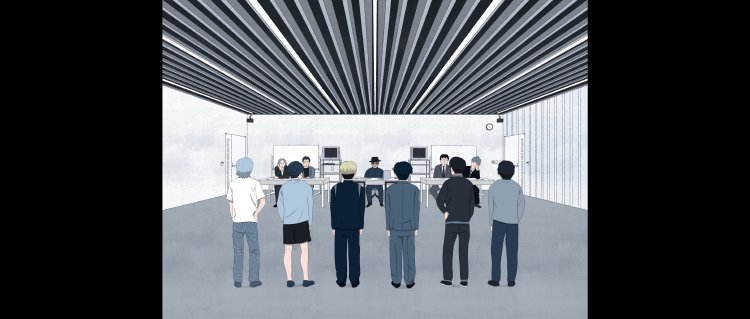
1994, a female taxi driver met and was courted by a young man, Eito Aiko, who had walked away from J-Pop Idol fame. They married and had a child who would be orphaned by the time he was in his early teens, his mother calling out his name in her last moments, his father left in a coma. The young man who barely spoke would be called 'The Grim Reaper' by his peers, but a friendship with a new boy in school, Kin (voice of Taketo Tanaka), would find him following in his father's footsteps in "Jinsei."
Laura's Review: B+
If Wes Anderson was Japanese, more minimalist and into hand drawn animation, his work might look a lot like writer/director/editor/animator Ryuya Suzuki's impressive debut, a mind boggling journey through 100 years of one man's life (Jinsei is the Japanese word for 'life'). Broken into 10 chapters from 1994 through 2095, Suzuki's tale becomes difficult to follow if you are not aware that Se-chan, The Grim Reaper, Kuro, Zen, and God are all the same person, the character reflecting different eras of Japanese history, real and imagined.
Suzuki's style is unique. Until he jumps into the future, his animation is presented in a square box within a black frame, his color palette limited to neutral grays and beiges which occasionally suggest slate blues and earthen pinks. There is more movement in his editing than his actual animation, a kind of visual 'deadpan,' occasional forays into J-Pop dancing, especially when viewing the well worn video tape of Eito which is a constant touchstone, the exception. Death will be another frequent subject, Se-Chan visiting a crematorium more than once, earning him that classroom nickname. But Se-Chan connects with a new student, Kin-Cha, whose big dream is becoming an idol. Amusingly the boys make their stage debut in their school's production of Swan Lake - as trees.
By 2010, though, Kin has big news - he's gotten a contract from Swan Productions, or Swa Pro as most call it, but if he's going to be an idol, he wants to do it with Se-Chan. Surprisingly, they are both chosen, even t hough Se-Chan doesn't move during their audition. Shiratori, who made his father a star, recognizes the boy and is sure the talent is there, but his controlling management puts the five boys into a gilded cage, a vertical montage of the boy band places them in frames like paper dolls. Kin expresses the desire to be an idol who helps people and makes them smile, but Se-Chan revolts, attacking Shiratori and declaring his freedom.
That rolling vertical frame presages Suzuki's change of aspect ratio, that square box becoming a letterboxed widescreen as Se-Chan reemerge as Zen, a major film star being breathlessly interviewed on a television set by Sakura. Bright colors are introduced before this world grows darker, an earthquake followed by an apocalyptic war illustrated in a montage of contrasting imagery. A brighter looking future follows, humans assisted by robots, with the boy we've followed into adulthood achieving the elevated status of an oracle, aka God.
Suzuki, who was born the year he begins his tale, has achieved something quite spectacular his first time out, an animation of unique style whose narrative ambition perhaps overreaches in the film's second half, but should keep rewarding with repeat viewings. The film is accompanied by a synth pop score that complements both the animation's visuals and storyline. "Jinsei" announces an impressive new talent.
Robin's Review: B
Greenwich Entertainment releases "Jinsei" in select theaters on 6/5/26, expanding on 6/12/26.

