Two Seasons, Two Strangers
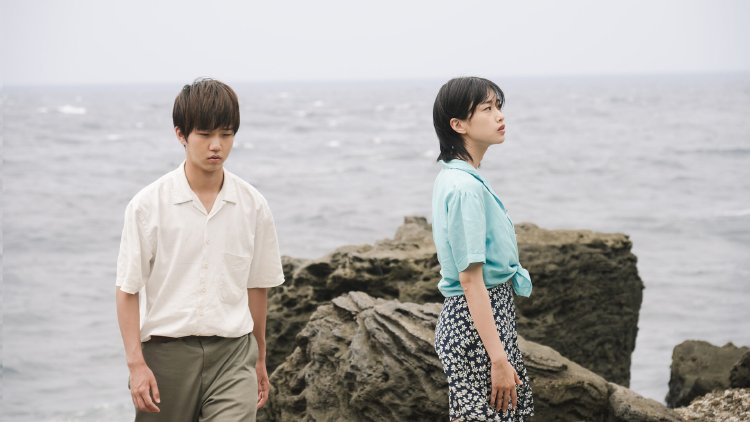
After watching Li (South Korea's Shim Eun-kyung) at her desk tentatively begin a screenplay in which a young woman wakes up in the back seat of a car beside a beach, we will suddenly be with that young woman, Nagisa (Yuumi Kawai, "Plan 75"), a tourist who will have a profound meeting with a young man, Natsuo (Mansaku Takada), visiting relatives that summer in what used to be his hometown. Later, after losing the professor, Uonuma (Shirô Sano, "Happyend"), who mentored her, Li will take his camera on an adventure at a mountain inn in winter in "Two Seasons, Two Strangers."
Laura's Review: A-
He may not be well known in the U.S., but manga author Yoshiharu Tsuge is highly revered in Japan and writer/director Sho Miyake has melded two of his stories, 'A View of the Seaside' and 'Mr. Ben and his Igloo,' into one expanded tale with parallel themes, 'A View of the Seaside' cleverly worked in as the film produced from Li's screenplay. This is the type of quiet film that sneaks up on you, evoking a strong emotional response. It can also be quite funny, Benzo (Shinichi Tsutsumi), the innkeeper who takes Li on an adventure, telling her that he prefers 'drama with comedy.'
A camera makes an appearance in the first tale as well, Natsuo being asked by an Italian tourist if she can take his picture, the attention making him uncomfortable enough to leave the beach. We'll watch him wander the beach town's narrow streets, stopping for an ice cream, while Nagisa visits a fishing museum, later wandering out by the coast against the very scenery she'd just been viewing in black and white stills. She'll find Natsu on the beach and the two begin a tentative conversation, Nagisa expressing jealousy that he has people to visit in this lovely place, him regaling her with an eerie early memory of a woman holding a child found dead in a fisherman's net off this coast. They'll note a headless fish in the shallows, a possible omen, another parallel to the winter tale and the possible reason they begin to talk about depression. They plan to meet on the beach the next, but a typhoon comes in, giving us the amusing sight of Natsu sitting alone under a small wooden shelter in a torrential downpour, but Nagisa does arrive, wearing a flirty bikini, and just when a swim looks like it might become a tragedy, we find ourselves watching it on a screen, Li and her director beginning a Q&A with a film class.
That class instigates the next part of the tale when Li's mentor collapses on the stairs. At a memorial reception, his brother (also Sano) will gift Li with the professor's old camera and, believing she needs to escape words, decides to take the camera on a trip for some visual inspiration. A train will emerge from a darkened tunnel into a snowy landscape and once at her destination, Li will wander about, but when she looks for a room for the night, all the hotels are booked and a desk clerk suggests she try an inn up in the mountains that may have room. Hers is an arduous trek and nightfall has arrived by the time she finds the old inn, its owner, Benzo, suspicious until he realizes she's a customer. After a brief conversation, he tells her 'sleep wherever you like,' the inn consisting of one large communal room where Benzo also sleeps, snoring loudly. The next day Li begins to ask the man questions, noting things that suggest a family once lived here. She'll take a picture of ornamental carp Benzo caught and has in a bucket, suggesting that he could raise them as an additional source of income. Her suggestion ignites something in Benzo, who insists he follow her, at night, across the snowy landscape, to a destination that will fill in the man's background, give Li fodder for another screenplay and end with whimsical irony, a 'drama with comedy.'
If you crossed Japan's Yasujiro Ozu with a little of South Korea's Hong Sang-soo, you might come up with something like this winner of Locarno's Golden Leopard. Mikayi's ingenious adaptation featuring a screenwriter who feels trapped by words is beautifully shot by cinematographer Yûta Tsukinaga ("Two Mothers") who places his characters in stunning natural landscapes with a hint of danger. Music by Hi'Spec features a different instrument for each setting, the strings of the seashore replaced by a French horn for the segue, then piano in the mountain. Happenstance encounters reverberate in this lyrical mood piece.
Robin's Review: B+
Several Features released "Two Seasons, Two Strangers" in NY on 4/24/26. It is also part of Boston's Museum of Fine Arts' UNIQLO Festival of Films from Japan.

