2026 Oscar Nominated Documentary Shorts
The five documentary shorts nominated for the 2026 Oscar are a reflection of today's world and, with the exception of one outlier, the effect is the opposite of uplifting. The difficult and dangerous work involved at an Atlanta health care facility for women and the childish bedrooms left behind by the victims of school shootings are a disturbing window into today's America while Palestinian activists in Israel and a tribute to a slain documentarian from Arkansas chronicle global tragedies.
Laura's Review: B+
But first is that outlier. Alison McAlpine's "Perfectly a Stranger" explores the La Silla Observatory in Chile's Atacama Desert through the eyes of three donkeys who clip clop up the road just as the observatory captures that 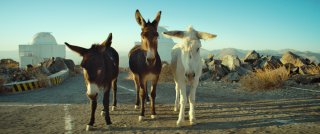 moment when a star filled sky slowly gives way to a glorious sunrise. White, brown and black, Palaye, Ruperto, and Palomo are reflected in a convex traffic mirror as they make their approach, the three exploring the site with its white observatory domes, McAlpine's cinematographer Nicolas Canniccioni frequently using a POV shot from behind a donkey's upraised ears, editor Carolina Siraqyan juxtaposing a closeup of a donkey's eye with a round, silver radio telescope. A fox wanders is but appears uncomfortable with the presence of the filmmakers, backing up as a camera centers it in its frame. The low hum of Ben Grossman's score turns bell-like as the filmmakers enter the facility to observe the machinery looking out into the stars. The fifteen minute film is a lovely rumination on three creatures amidst the vastness of the universe. B+
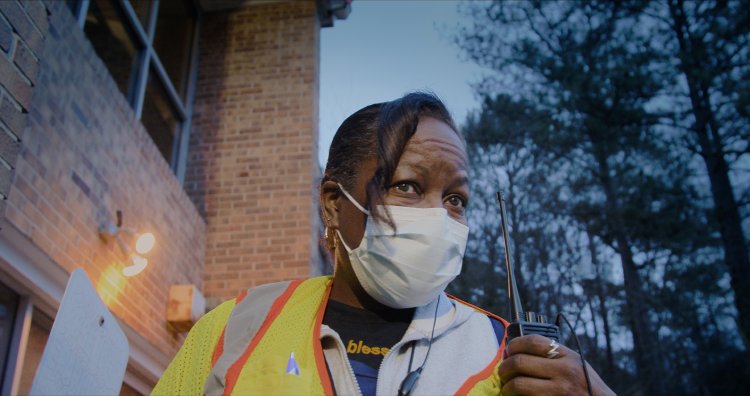
"The Devil Is Busy" focuses on the Everyday hero that is Tracii, the head of security who arrives at an Atlanta women's healthcare clinic before 6 a.m. to ensure the women who travel there, some from great distances, are treated with compassion and kept safe. Christalyn Hampton and Geeta Gandbhir's camera follows her as she turns on lights and inspects the building, always on the lookout for someone who may have hidden the night before, itching to do harm. She questions someone sitting in a car in the parking lot outside, and, once convinced the driver is a client, assures them they are welcome to wait until the doors open. She also expresses her frustration with the men who protest daily at the gates of the clinic, asking just who they are to judge (one is a former convict), before revealing the sorrow in her own past. Tracii shows us the numbers given to clients on wristbands, the better to protect their privacy. The filmmakers also visit with other staff members, the call center tech regretting just how many scared young women she has to point towards other states, the sonogram tech stating 'I never thought I would have more rights 25 years ago than my daughter does today while the doctor muses on the possibility of jail time, all of them frustrated by the six week restriction they must operate under. B+
Craig Renaud's loving portrait of the older brother whose footsteps he followed, "Armed With Only a Camera: The Life and Death of Brent Renaud," spans a multi-decade career covering global events, beginning with Brent's coverage of the war in Ukraine, where he was targeted by Russian troops, shot in the head (the colleague who was with him when he died, Juan Arredondo, was also shot, but survived, and tells Craig about his final moments). As Craig retrieves his brother's body, he videotapes him in his coffin, stating that is what Brent would have wanted him to do. Brent's mother and sister are on the airfield to receive his coffin and as Craig builds to his moving memorial service, he segues into and out of his brother's coverage of a Honduran teen crossing a river into the U.S. to avoid gang violence; Ukrainians sifting through the wreckage that was their homes after a missile strike; the Arkansas National Guard interacting with civilians in Iraq; Hondurans recycling trash from a massive garbage dump, a Haitian woman caring for two orphaned boys in a flimsy tent after the earthquake and the aftermath of the largest car bombing in Somalia. We'll also see Brent, who is also given a directorial credit here, enjoying time with his therapy dog Chai, and learn he had autism, something that didn't appear to hold him back from connecting with people all over the world. In addition to honoring his brother, Craig Renaud emphasizes the sacrifices journalists make every day in a career that is becoming one of the most dangerous. B+
After finding himself using the same words over and over when reporting on U.S. school shootings which America seemed to move on from them faster and faster, CBS News correspondent Steve Hartman wanted to do something different and so he took photographer Lou Bopp on a country-wide mission to document the bedrooms of the children who no longer returned to them. The resulting "All the Empty Rooms" forces us to reconsider their loss by turning statistics into individuals. Hartman will visit the family of 8 year old Hailee Scruggs, who was killed at the Covenant School in Nashville, her older brothers, still awfully young, 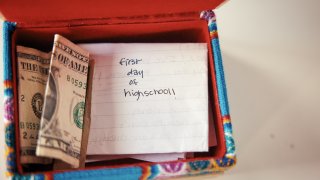 remembering how she tried to keep up with them. Jackie Cazares was 9 when she was shot at Robb Elementary, a girl who loved teddy bears and the pink lights adorning her ceiling. Bopp crawls around with his camera, documenting things like a bunch of colored hair ties wrapped around a doorknob, the type of discoveries that could make a grieving parent choke up. Fifteen year-old Gracie Muelberger left for her school in Saugus one day planning on buying a ticket to the school dance, then getting a dress for it the next day. She would do neither. Even more heartbreaking are the notes she left behind for her 'future self,' a woman who would never be. Watching Hartman's documentary reminded me of a stunning scene in "The Silence of the Lambs," where Clarice visits the bedroom of a victim and she and we discover the girl who once slept there by looking at the things which were important to her. The CBS News veteran used to be the guy they'd bring out to 'restore faith in humanity' at the end of a broadcast. He's up to something much more hard-hitting here. B+
Hilla Medalia's "Children No More: Were and Are Gone" is not only a document of protestors in Tel Aviv highlighting the thousands of children being killed in Gaza, it is a tutorial on effective activism. A small group of women begin standing in a square holding enlarged photos of children with their names, their age and the phrase 'was and is no more' accompanying their date of death. Slowly, more and more volunteers join the protest and the organizers discuss where they can make the most impact, straddling the fine line between provocation and preaching to the converted, and how to avoid inflaming the police. 'I can give a child dimensional space,' explains one of the organizational leaders. Cinematographer Avner Shahaf adds poetry to the movement, slowing down his picture so those honoring the dead appear to float down a sidewalk. And while dozens stand in silence condemning the Israeli goverment's actions, we witness other Israelis shouting verbal abuse, as if killing tens of thousands of children can ever be justified. This short's only drawback is that it continues on well after making its point. B
My money is on either of the two HBO documentaries, "Armed With Only a Camera: The Life and Death of Brent Renaud," and, my personal favorite, "The Devil Is Busy."
Robin's Review: B+
“Perfectly a Strangeness”
Three donkeys wander through a stark desert landscape, the home of an unmanned observatory of telescopes and radio antennae. Nothing happens and the only action is the clomping of hooves and the sound of the wind.
Director Alison McAlpine creates a lyrical slice of cinema verite that does not tell or explain anything. It does, though, provide a meditative look at both nature and technology in vivid contrast . B
“The Devil Is Busy”
Atlanta, GA, 2024. Tracii is the head of security at a women’s health care clinic that also, sometimes, perform abortions and, always, protects the identities of their vulnerable clients. Outside the center are protesters on bullhorns declaring that all within are child murderers.
Directors Geeta Gandbhir and Christalyn Hampton, utilizing a roving camera style to show us the life, over the course of the day, in a women’s health care center under siege by ignorance and hate.
The camera follows Tracii at the start of her and the clinic’s day, show her daily routine of inspecting the facility for intruders, checking in the clients by number not name and safeguarding and protecting both the workers and the clients.
The filmmakers have something to say about the state of women healthcare following the catastrophic overturning of Roe v. Wade. They say this through, mainly, Tracii’s eyes as she constantly fights against the system that puts women’s lives in unnecessary danger – mainly because of the actions of white men, and one black man; the Supreme Court. B+
“Armed Only with a Camera: The Life and Death of Brent Renaud”
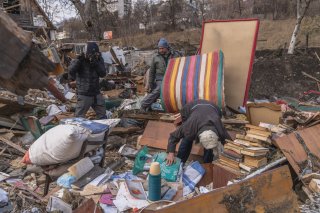 Photojournalist Brent Renaud, camera in hand, covered the world’s most violent hotspots. In 2022, while shooting the war in Ukraine, he was questioned and killed by Russian soldiers. His sibling and long-time collaborator, Craig, took his brother’s body on the long journey home.
Craig tells the story of his brother’s eventful and sometimes harrowing life using Brent’s and his own photography to tell his brother’s story. That story, shown in cinema verite style, spans the world, from the war in Iraq to the tragedy of the conflict in Somalia to the aftermath of the 2010 Haitian earthquake to Honduras and the migration to the US to the Ukraine war.
Brent Renaud is a microcosm, in his life and his death, for all of the journalists who have sacrificed their lives to cover the story and show, unabashed, the suffering in the world. There is a lot of brotherly pride and love in Craig’s telling of Brent’s story. A-
“All the Empty Rooms”
School shootings, once the subject for the news channels for weeks, have become a commonplace occurrence in America. Correspondent Steve Hartman and photographer Lou Bopp visit the homes of four of the victims in“All the Empty Rooms.”
What is most heartbreaking about this thoughtful documentary about the tragic loss of a child – something a parent should never have to bear – is how lovingly they keep their shrines to their children intact, with wall posters, books, clothes and everything else in the room untouched and honored.
If anything, director Joshua Seftel does not go deeply enough into the case for getting rid of guns, not just assault rifles, but all guns. It could have had more impact on voicing the outrage we should all have every time we see yet another school shooting and hear about how “our hearts and minds are with the victims.” Enough already. B
“Children No More”
In Tel Aviv, a silent vigil for the children lost to Israeli military attacks in Gaza is held weekly and the numbers of children killed steadily increases. It is a heartfelt protest against the unjustified murder of innocent children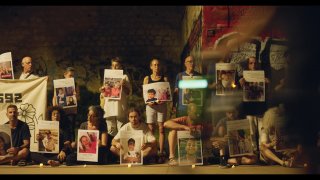 because they live in Gaza.
The humanity of those standing vigil is honest as they try to give faces to the thousands of Palestinian children killed in the pogrom of the full-on assault on Gaza and its civilians by the Israeli army.
Director Hilla Medalia tries to be even handed and shows the protesters against those standing vigil with “what about the children who died in the 7 October Hamas attack?” My response is that comparison is a false equivalency. Yes, it is terrible and tragic what Hamas had done. But, the scale of difference between Israeli deaths and Palestinian deaths is totally unbalanced. Children should not die this way – or any way except old age. B
Roadside Attractions releases the 2026 Oscar Nominated Short Documentaries in theaters on 2/20/26. Click here for theaters and playdates.

