Sound of Falling
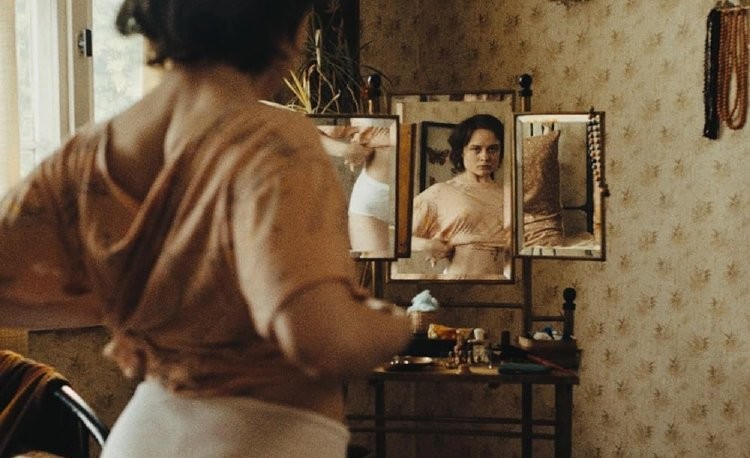
A German farmhouse holds the secrets of four generations of women whose fates repeat themselves in a patriarchal society in "Sound of Falling."
Laura's Review: A
Cowriter (with Louise Peter)/director Mascha Schilinski's generational family trauma reverberates through one German farmhouse, cinematographer Fabian Gamper's camera the ghostly presence that glides around it as editor Evelyn Rack seamlessly weaves back and forth among different eras, connecting these women through abandonment, sexual abuse, suicide and death. Only in the modern day segment, which finds Lenka (Laeni Geiseler) befriending motherless teen Kaya (Ninel Geiger) as her mother Christa (Luise Heyer) renovates the old farmhouse, do we find some hope, but even there Lenka's younger sister Nelly (Zoë Baier) imagines her own "Mouchette" style suicide when she's left feeling abandoned, trailing behind her mother and sister after a day by the river.
The film opens in the second generation, Erika (Lea Drinda) obsessed by the uncle, Fritz (Martin Rother), who lies in an upstairs bedroom, a sheet draped over his genitals in the summer heat. She ties up her leg to mimic his missing one, gone below the knee, hobbling down a hallway on his crutches as she's called from outside to put the pigs in the barn. After tracing her finger from Fritz's navel to his groin, she leaves, receiving a slap across the face for not responding sooner, turning with a lascivious smirk toward Fritz, now peering down from his upstairs window.
We then skip back a generation, observing the life of Erika's aunt Alma (Hanna Heckt) at the age of seven, playing a prank on housemaid Berta (Bärbel Schwarz) with two of her sisters. Their horseplay is a brief respite as the family gathers to commemorate All Souls' Day, Alma watching her mother Emma (Susanne Wuest, "Goodnight, Mommy") arrange photos of the dead on a mantle through a keyhole. The little girl is thrilled to find a new, black frock laid out for her to wear, the camera giving us her POV as she looks down, adjusting a bow and smoothing her skirt, but she will see the same dress in a photograph being warn by a dead girl about her age, a sister she had no knowledge of who even shared her name, her mother double exposed, 'two-faced,' standing above the child. As the extended family gathers around the dining table, all dressed in black, the sound of a buzzing fly floats above the Lynchian, droning sound design. When we revisit Alma later, she and her sisters will watch as a fly enters the mouth of a younger brother's corpse lying in the barn prepared for burial.
Christa will provide a transition between eras, playfully pulling her daughters through the house on a sheet, a magic carpet ride, then making love to her husband as once again the camera rises, entering an upstairs bedroom window to find Erika paying Fritz a nighttime visit. Then we skip to the 1980's where Erika's niece Angelika (Lena Urzendowsky), the film's most potent, sexually charged character and the film's narrator, has just gotten new glasses which her mother, Irm (Claudia Geisler-Bading, "Jerichow") says are chic. Another family gathering is taking place and Angelika flirts with her cousin Rainer (Florian Geißelmann) as she gets ready, dancing provocatively in front of her mirror as Anna von Hausswolff's ethereal 'Stranger' plays on the soundtrack for the first of three times. Fun and games ensue in the courtyard, where Uncle Uwe (Konstantin Lindhorst) will successfully grab a freshwater eel out of a tub on a table as he rides by on a bicycle, a feat his sister Irm cannot repeat. We've seen those eels lurking in the silty river water in cutaways, a menacing symbol of manhood, their presence a constant. Later Angelika will humiliate Rainer when the younger family members sneak schnapps in the barn, pointing out the erection he is desperate to hide, an embarrassment he will revisit on Angelika later when he tells her everyone knows that she has sex with his father, Uwe. Angelika walks away fully aware of her sexual power, hips swaying, to find her mother cleaning up in the kitchen, pleased with how the day has gone, but Angelika will tell us that her mother never laughs at anything funny, something we witness when her husband Albat (Andreas Anke), who never gives up on the idea, pranks her on her birthday, jamming her car between two trees. If Urzendowsky is the film's most compelling presence, Geisler-Bading is perhaps the most heart-breaking, the actress portraying Irm as a skittish woman always on the outside, never fitting in, always trying to please. Angelika tells us that Irm always regretted not having 'gone all the way' when she and her sister Erika sank to the bottom of the river after the war, Irm resurfacing, her sister, such a forerunner of her daughter, not.
Another visit to the present day finds Christa feeding Kaya, the girl brought home by Lenka also asking if she can stay. After speaking with Kaya's father to approve an overnight, the teenager surprises Christa by asking for a lullaby before we segue back to Alma with her grandmother in the kitchen as her parents chase her brother Fritz (Filip Schnack as the younger version) with an ax outside, maiming their own son to keep him out of a war. As he screams in pain in the ensuing days, Alma remarks on his phantom limb 'Funny how things can hurt that are no longer there,' the camera resting on her mother, the double entendre clear. Later Emma will lose the ability to use her own legs, even though the doctor declares her in perfect health. The ordinarily stern woman laughs when she drops to the floor.
Alma will lose her grandmother, another occasion for some strange, Teutonic humor, but also her elder sister, Lia (Greta Krämer), who falls from a wagon heaped with hay as she's being taken away to work on another farm. Angelika guides her father's thresher through the fields, pointing out obstacles, but when she finds a dead doe, she lies down beside it, imagining her own death. She'll disappear one day, her image in a family photo blurred, Rainer briefly assuming voice over narration. And then there is the family's younger maid, Trudi (Luzia Oppermann), sterilized for the menfolk's pleasure, her face an emotionless mask. But Trudi offers comfort, curing Alma of the fever she develops when left in a tree into the night, a prank her siblings play while playing hide and seek. It is Trudi who gives Emma the use of her legs once more and, as Alma tells it, 'calms' Fritz while bathing him, recognizing another wasted life. Nelly will observe a friend of her father's paying undue attention to her after she sheds her top playing under a sprinkler.
Schilinski's marvel of a film ends on a note of magical realism, perhaps Fritz's version of his female relatives' imagined deaths. Her large ensemble is beautifully cast, faces portraying different eras. The film stays within the same location, the farmhouse interior redone to reflect the times, the nearby riverbank unchanging. Costume and hairstyles also help us locate our place on the filmmaker's timeline. Gamper's contributions cannot be overstated, his camera more of a haunting observer and even more agile than Soderbergh's ghostly "Presence" POV. The film, which was submitted as Germany's pick for the International Oscar (shortlisted, but unfortunately not nominated), wields an utterly German aesthetic.
"Sound of Falling" is, simply put, a masterpiece that continues to reveal its mysteries with repeated viewings.
Robin's Review: B+
After an awards qualifying run in 2025, Mubi released "Sound of Falling" in New York on 1/16/26. It will have a limited engagement at Cambridge's Brattle Theater beginning on 4/16/26 before it begins streaming on Mubi on 4/24/26.

