Nouvelle Vague
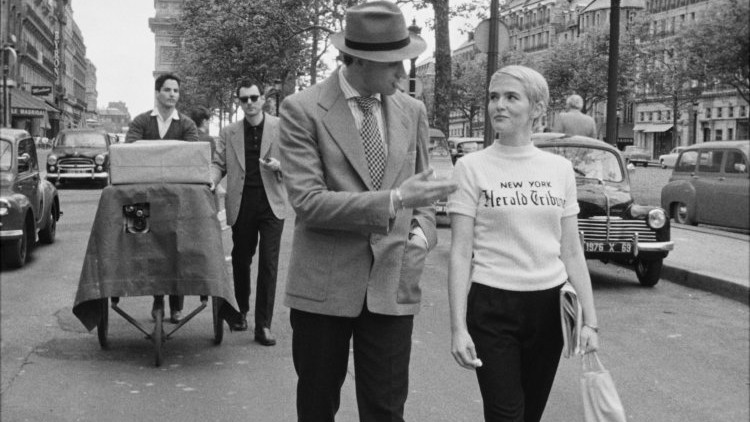
Of all the writers at Cahiers du cinema, Jean-Luc Godard (Guillaume Marbeck) was becoming anxious as the only one without a feature film to his credit. Taking advice from an idol, Roberto Rossellini (Laurent Mothe), he broke cinematic rules and his first film, "Breathless," became the most influential of the "Nouvelle Vague."
Laura's Review: A-
Director Richard Linklater ("Before Midnight," "Blue Moon") has his second film released in as many weeks, his first not in the English language, "Where'd You Go, Bernadette?" writers Holly Gent and Vincent Palmo Jr.'s screenplay adapted into French by Michèle Halberstadt and Laetitia Masson. In the film, Godard has Rossellini address a crowd of up-and-comers in French cinema at the Cahiers offices and he calls them 'cinemaniacs,' which is exactly the audience this film is for. Those who don't know the seven directors of the French New Wave or the movie "Breathless" may not find much to latch onto here, let alone all the various characters surrounding them, but for those who do, "Nouvelle Vague" is sheer delight, a breezy, playful look at Godard's process and the amusement and frustration it caused his cast and crew.
Godard is introduced at, of all things, a film premiere, the Cahier critic declaring "La Passe du Diable" shit to François Truffaut (Adrien Rouyard), Claude Chabrol (Antoine Besson) and screenwriter Suzanne Schiffman (Jodie Ruth Forest) at the after party. Later, left alone in the office with Jacques Rivette (Jonas Marmy) and Eric Rohmer (Côme Thieulin), Jean-Luc moans about not being at Cannes, where Trufaut's "400 Blows" is premiering. Encouraged to go, he steals cash from the office till and is there to applaud his friend's film, its rapturous reception lighting a fire under him. He wrangles with producer Georges de Beauregard (Bruno Dreyfürst), first suggesting his 'Odile' script could be retitled "A Woman Is a Woman" and be part musical, then pushing "Prenatal," but Beauregard wants to ride Truffaut's wave, insisting on the true crime script Godard collaborated with his friend on. Godard relents, stating this was his desired outcome all along.
The filmmaker taps Pierre Rissient (Benjamin Clery) to be 'the youngest first assistant director ever' and secures the services of Raoul Coutard (Matthieu Penchinat) as his cinematographer, the man's war photography experience making him ideal for Godard's gorilla style of filmmaking. Visiting the set of Jean-Pierre Melville's (Tom Novembre) latest film, he'll be given advice, then told to ignore it. He finds his friend Jean-Paul Belmondo (Aubry Dullin), the star of his short, at the boxing gym, quickly locking down his leading man, but his choice for Michel Poiccard's American girlfriend, Jean Seberg (Zoey Deutch), proves a lot more difficult to convince, her French husband, aspiring director Francois Moreuil (Paolo Luka-Noé) helping to seal the deal. Then Day One of shooting arrives and it is not what anyone expected.
The script girl, Suzon Faye (Pauline Belle), not only doesn't have a script, but gets told off by the director when she attempts to remove a coffee cup from a scene for continuity. Seberg not only bemoans the lack of a script, but Godard's refusal to use makeup on his film. Belmondo is amused by it all. Godard calls it a day after two hours, stating that he is out of ideas. By the film's second week of this, Beauregard is apoplectic.
Linklater's film is just stuffed full of amusing tidbits, like Godard deciding the use of a stuntman for a car accident is too literal, substituting sound alone for the crash with Jacque Rivette asked to lie in the road to portray its aftermath. Belmondo and Seberg have silly conversations while shooting as Godard isn't shooting with sync sound. The cast and crew are delighted to discover Robert Bresson (Aurélien Lorgnier) shooting in the metro. Godard's love of quotes is sprinkled throughout, Seberg amused when he throws out a quote about a quote, the director citing DaVinci at the end of shooting 'Art is never finished, only abandoned.' Seberg's last scene, where she refuses Godard's direction, is shot by Linklater from behind, her imitation of her co-star's Bogie impression revealed over the movie's closing credits, where Linklater also has fun with the jump cuts the director instructed his editors to embrace.
Cinematographer David Chambille shot the film in black and white 35mm in the boxy Academy ratio like "Breathless," complemented by Jérôme Lateur's referential jazz score. Both Linklater's direction and the well researched script are light on their feet, the movie evoking smiles throughout. The ensemble is simply wonderful, Linklater introducing characters in ones and twos in captioned portrait shots, an endless who's of the French New Wave, but Zoey Deutch as the lone American in the bunch is sure to see her stock rise for her playful portrayal of Seberg. Casting has done an impressive job matching actors to their real life counterparts, Dullin a great stand-in for Belmondo, Marbeck evoking Godard with the aid of dark shades and an ever-present cigarette. If the film has one sad moment, it is no fault of the filmmakers, the friendship shown between Godard and Agnès Varda (Roxane Rivière) reminding of her heartbreak in her last feature documentary, "Faces Places," when her old friend slighted her.
With "Nouvelle Vague," Richard Linklater is two for two in 2025 paying homage to creative artists who have inspired him. If "Blue Moon" leaves one feeling sad, "Nouvelle Vague" uplifts like champagne bubbles.
Robin's Review: B+
In the late 1950s, the French New Wave film movement revolutionized movies. Jean-Luc Godard (Guillaume Marbeck), a movie critic for Cahiers du Cinema, is the last of the new directors to break out and does it in grand style with his debut creation in “Nouvelle Vague.”
Any film nut worth his salt knows Godard’s classic crime drama, his debut film, and its stars Jean Paul Belmond on Jean Seberg as Michel and Patricia, respectively. Director Richard Linklater, who is on a roll with his terrific “Blue Moon,” also out in theaters, creates a fun look at a small, but important, piece of cinema history.
Godard is envious of his friends and their success in creating New Wave film, particularly Francois Truffaut (Andre Rouyard) and his debut, “The 400 Blows (1959).” The critic and wannabe director goes to his friend and money-guy Georges de Beauregard (Bruno Dreyfurst) to secure financing. Then, he needs to have a script (by Truffaut) and his stars.
Michel is played by first-timer to the big screen Aubry Dullin and, besides looking like the late actor, Belmondo, also exudes his sassy charm. The only “name” in the film, Zooey Deutch, puts the perfect spin on playing Jean Seberg, the sole American in a story about the New Wave players – besides Truffaut, Linklater rolls out the likes of Claude Chabrol (Antoine Besson), Agnes Varda (Roxane Riviere), Jean Cocteau (Jean-Jacques Le Vessier), Eric Rohmer (Come Thieulin), Roberto Rossellini (Laurent Mothe), Jacques Rivette (Jonas Marmy) and many others.
Linklater uses “les jours” as chapters in this play about prima donnas, egos and making a movie guerrilla-style. Set with a 20 day shooting schedule, as imposed by producer Beauregard, Godard the “artiste,” though, travels to a different production tune, making his internal “inspiration” dictate the actual shoot.
As the jours tick by, we see the auteur in action, declaring his “visions” of filmmaking, like only two takes, using only natural light and improvisation over script. Some days no film rolls in the camera or just one shot in a day or cancelling a day because of “bad pizza.” For the producer, it is like dealing with a spoiled child. But, the film eventually wraps – in 20 days.
Linklater’s homage to the New Wave is obvious, as is his love of film and filmmaking. There is obvious pride in telling the story of the making of a movie, and a classic one at that. The whole of “Nouvelle Vague” is a labor of love, not just for the director but all the players, too. And, for us film buffs.
The subject – the making of “Breathless” – is handled in a way that puts you there, like fly on the wall, watching the creative process in guerrilla filmmaking. Godard can be maddening as the young, uncompromising intellectual who wants his vision on the screen. Linklater creates that vision quite well, indeed.
Netflix releases "Nouvelle Vague" in theaters on 10/31/25. It begins streaming on 11/14/25.

