Blue Moon
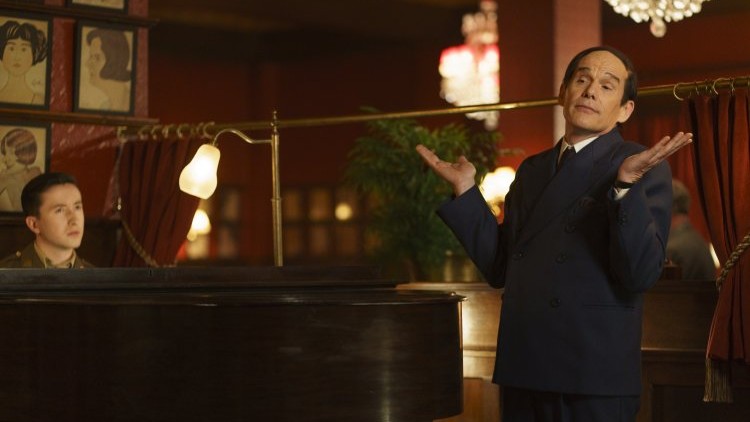
March 31, 1943 was the beginning of the end for lyricist Lorenz Hart (Ethan Hawke) as he watched his former partner Richard Rodgers (Andrew Scott) enjoy the resounding success of the Broadway premiere of 'Oklahoma!,' Rodgers' first collaboration with his new lyricist Oscar Hammerstein II (Simon Delaney), from the bar at Sardi's in "Blue Moon."
Laura's Review: A-
Director Richard Linklater ("Before Sunrise," "Hit Man") sat on screenwriter Robert Kaplow's ("Me and Orson Welles") witty and moving script for ten years in order for Ethan Hawke to be the right age to play Hart and his gambit has resulted in his best work since 2014's "Boyhood." Staging the entire film in one room with Hart frequently breaking into song himself, accompanied by the soldier he dubs 'Knuckles' (Jonah Lees) on piano, turns the movie into musical theater of a sort, fitting given its subject.
Before Rodgers and Hammerstein became the most successful Broadway musical collaborators of all time, Rodgers and Hart were the toast of the Great White Way, composing such songs together as 'My Funny Valentine,' 'The Lady Is a Tramp,' 'Isn't It Romantic' and, of course, 'Blue Moon,' but when we meet 'Larry' Hart, he's drinking seltzer, signaling a man on the wagon and there for a reason. He does ask his old friend, Eddie the bartender (Bobby Cannavale), to pour him a shot of whisky so he can admire it and to leave the bottle on the bar as 'a visual poem.'
Hawke is amazing in the role, a charmer whose wit lets him get away with sly vulgarity, the actor delivering reams of rapidly paced dialogue. Besides his putdowns of his old partner's new musical (Rodgers is still 'a genius,' but beginning with the title's exclamation point, everything else is sentimental hogwash), Hart is telling everyone, Eddie, Knuckles and a man sitting drinking he will learn is the writer E.B. White (Patrick Kennedy), about Elizabeth, a twenty year-old Yale student he is obsessed with who he believes may become his lover that very evening. Eddie is surprised, stating that he didn't think Larry was interested in women, but Larry disagrees stating 'women appeal to me because of their lack of penises.' 'Me too!' Eddie retorts. Larry also declares himself 'ambisexual,' 'able to jerk off with either hand.'
Linklater keeps things visually interesting by giving Hawke a rondelay of supporting characters to bounce off of, spaced around Sardi's lounge almost in a circle. His first (and last) will be Eddie, the two reenacting scenes from "Casablanca," Larry declaring the six word line, 'Nobody ever loved me that much,' the film's best, his own mantra. He'll engage with Knuckles, across the room at the piano, the young man hoping to be introduced to Rodgers. Later, after Hart begins to drink, the young man will leave him talking to himself in the bathroom, the curtained door closing behind him like the end of an act. Hart engages White in a leather banquette, the two admiring each other's writing, Larry telling a story about a mouse which E.B., in the process of writing a children's book, quickly jots down, the inspiration for Stuart Little. Elizabeth (Margaret Qualley) will breeze in to much adulation, before reminding Larry that she wants to be introduced to Rodgers, then hurrying upstairs to help her mother, an industry vet, prepare for the after party.
Then the evening's stars are swept in amidst a crowd of admirers, Hart generous with his praise, even to Hammerstein, but while Rodgers suggests reviving their "Connecticut Yankee" with new songs, he has trouble disengaging, his admiration for his old mentor tainted by Hart's unreliable behavior during their past working relationship. Elizabeth hovers in the background waiting for that intro. Larry will be in seventh heaven when he's afforded privacy with the young beauty in the cloakroom, Elizabeth baring her soul about her bad experiences with men, but Larry's own hopes are crushed by four little words. And, after having invited her to a soiree in his apartment, Elizabeth will instead leave with Rodgers. Seven months later, Hart will be found on a NYC street and taken to the hospital, where he will die of pneumonia at the age of 47.
Hawke's been given a high forehead and severe, slicked down side part, Hart's small stature mostly suggested with camera angles. The actor embodies the man who is described at the onset by competing quotes from Hammerstein, describing him as 'alert and dynamic and fun to be around,' and Mabel Mercer, calling him 'the saddest man I know.' Cannavale is a great foil, like Captain Renault to Hawke's Rick Blaine whereas Qualley and Hawke conjure the intimacy of friendship verging on lovers. Kaplow's script, which imagines the Elizabeth relationship based on letters between the two, is one of the year's strongest, bursting with Broadway history, the passing of torches, love, poignancy and great writing (Hart on Yale's female students - Bohemian goddesses in gray smocks mixing paint in the morning light').
Lorenz Hart's time may have passed him by in 1943, but Linklater, Kaplow and Hawke have brought him back to life for a new generation.
Robin's Review: A-
March 31, 1943. It is opening night for Rodgers and Hammerstein’s soon to be a big hit musical, “Oklahoma!” Nearby, at Sardi’s, Rogers’s former creative partner Lorenz Hart (Ethan Hawke) gets drunk and complains about his ex-partner’s new play and his success in “Blue Moon.”
Director Richard Linklater, with scripter Robert Kaplow, tells a funny and sad story of one of the last days in the life of songwriter, and former collaborative partner with Richard Rodgers, Lorenz Hart. “Larry,” in a fit of pique and jealousy of Rogers’s success, leaves the theater during the premier performance and ensconces himself at the bar at Sardi’s. The bartender, Eddie (Bobby Cannavale), does his best to keep his favorite customer from drinking too much but it is a losing battle.
Hart has invited his “protégé,” Elizabeth (Margaret Qualley), to join him with the promise that he will introduce her to Rodgers. In fact, though, he harbors a hidden love for the much younger woman and showers her with attention, knowing that she cannot love him “in that kind of way.”
After the play, Rogers and Oscar Hammerstein, the new wunderkind of Broadway musicals, show up at the bar with their entourage in tow. Larry, almost like a stalker, ingratiates himself to the new dynamic duo, but it is half-hearted praise at best. You can sense the loads of baggage that exist between Hart and Rodgers.
At one point during the after party, Rodgers offers his ex-partner to collaborate on a revival of “A Connecticut Yankee” – but not the “way you used to,” complaining about Hart’s “unconventional” work habits. It seems like more of giving a bone than sincere offer. Rodgers has been burned by his friend more than once.
The dialogue, with its pith and witty delivery, is the draw to “Blue Moon” with its rapid fire, droll monologues by Ethan Hawke – who loses himself in the role completely. Lorenz is the epitome of insecurity and confidence who uses his wit to shield himself from others – a necessity for a semi-closeted man in Manhattan in 1943.
While Hawke is the heart (no pun intended) of the story, Linklater has also assembled a fine supporting cast. Bobby Cannavale’s Eddie is the bartender you would want to have when you need to get something off of your chest. Margaret Qualley, who I like better every time I see her, completely fills out her Elizabeth as a beautiful, smart and intelligent young woman who loves Hart, “but not in that way.” Andrew Scott, as Richard Rodgers, plays the composer as someone both used to and tired of Hart’s unique and peculiar ways.
In several ways, “Blue Moon” reminds me of “My Dinner with Andre (1981)” with its singular setting, limited number of characters and sharp and funny dialog. Mostly, though, I am blown away by Ethan Hawke’s assured and, dare I say, brilliant performance as the sad and tragic songster who died too young.
Sony Pictures Classics releases "Blue Moon" in theaters on 10/24/25.

