Harvest
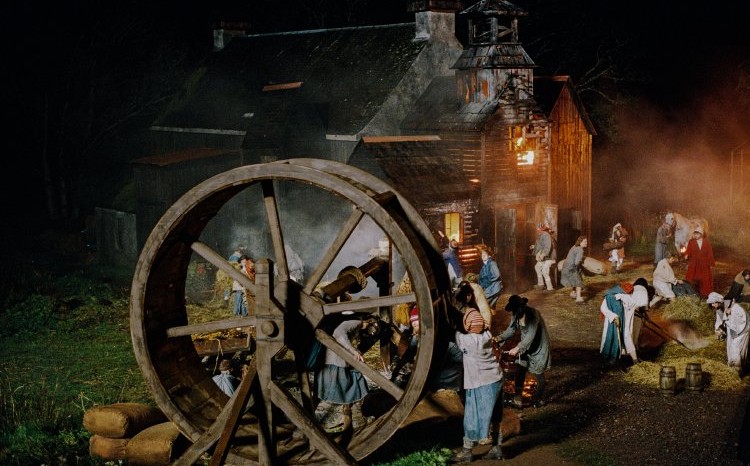
Fifty people live off the land in a remote Scottish village presided over by kindly lord of the manor Master Kent (Harry Melling, "The Ballad of Buster Scruggs"), but the arrival of a mapmaker, Quill (Arinze Kene, "Tuesday"), and three outsiders the villagers call Beldams suspected of setting fire to Master Kent's dove cote begin the breakdown of their society in "Harvest."
Laura's Review: B+
Cowriter (with "Nickel Boys'" Joslyn Barnes)/director Athina Rachel Tsangari's ("Chevalier") adaptation of Jim Crace's book is a fable about how man's desire to take ownership of land perverts the natural order. Cinematographer Sean Price Williams captures it all beautifully, from Malickesque close-ups to peasants working with animals and in the fields, landscapes which recall the work of Pieter Bruegel the Elder. The story is threaded together with occasional poetic narration by Caleb Landry Jones ("Nitram") who plays Walter Thirsk, first seen reveling in nature, then revealed to have come from the city as Kent's manservant. Walt, who left the big house for the village after marrying a local, serves as both a conduit from the people to Kent and our point of view.
After a nude dip in the nearby loch, Walt returns to a village in chaos, its inhabitants racing about trying to put out the flames rising through a steepled wooden structure. He immediately heads into a barn and leads Willowjack, Kent's white horse, away from the flames, before cradling a burning dove and gently tamping it out with green grass, severely burning his hand. Although he demands 'What sparked this fire?,' Kent appears ready to accept it as an act of God, until, that is, the villagers spy a fire on the shores of the loch. They all march down and find three strangers there, capturing the two men (Gary Maitland, "The Angel's Share" and Noor Dillan-Night, "Fantastic Beasts: The Secrets of Dumbledore") who are promptly put into the village pillory where Kent says they must stay for a week as punishment for arson, a sentence most find too lenient. Mistress Beldam (Thalissa Teixeira, "Fast & Furious Presents: Hobbs & Shaw"), the exotic dark haired beauty who was with the men, runs off into the night, but the compassionate Kent sends Walt out to look for her, offering shelter.
It will become apparent that the village was actually owned by Kent's wife, Lucy, and that both he and Walt are widowers, their wives buried on a hill marked by an elaborate cairn. Walt has taken up with Kitty, the widow Gosse (Rosy McEwen, "Blue Jean"), although it will be she who shears the long hair off Mistress Beldam when the woman is finally found, the lustful male villagers scooping up locks as keepsakes. Walt tries to offer aid to the Beldam men but gets nothing in return but their hilariously profane insults. He'll draw further suspicion from the village when Kent asks him to guide Quill, his black chart maker, through the lands and, to Walt's surprise, he makes a fast friend of another nature lover. After their harvest celebration, where Kent announces focusing on rearing sheep to produce cloth for the nobility, the villagers are further incensed when Kent grants Quill the honor of choosing their Gleaning Queen, even though he makes the charming choice of the youngest hopeful Lizzie Carr (Maya Bonniwell), the daughter of Walt's good friend Lizzie Carr (Maya Bonniwell).
Tsangari teases out bits of information which slowly add up to the arrival of Lucy's cousin Master Jordan (Frank Dillane, TV's 'Fear the Walking Dead'), who is the actual inheritor of the property and the reason behind the hiring of the chart maker. Suddenly Kent's gentle ways are exposed for weakness, the man unable to protect the women of his village, and Walt, now regarded as more an outsider by his fellow villagers, is left in charge until their return. His defiance is ironic, poetic justice, yet the tale is tragic. What have we lost as we have evolved?
Tsangari immerses us in the countryside (the film was shot on the western coast of Scotland) and makes her characters part of it, costume designer Kirsty Halliday fashioning clothing from woven, naturally dyed cloth, the villagers cast with locals experienced in farming and sheep sheering. Yet the film also tackles such modern subjects as sustainability and labor shortages. Landry Jones, an actor of unique talent, seems one with this land, his embrace of the surroundings found in the dirt under his fingernails and the sky in his eyes. Also compelling is Kene as the mild mannered artist defiled by the commerce of his talent.
"Harvest" takes us back to another place and time while asking us to contemplate our own future.
Robin's Review: B+
A man walks the fields around a nameless village at an undefined time. Life goes on, as usual, until outside forces arrive that will remove the inhabitants in a seven day period and make the village disappear without a trace in “Harvest.”
This is an obscure concept of a film to say the least. At its core are the Enclosure Acts in England that, over the course of centuries, took common land – land belonging to all – and allowed the “lord of the manor” to decide the fate of the land. They often divided and parceled out land enclosures to their favored vassals.
We see the nameless place, initially, through the eyes of Walter (Caleb Landry Jones), a man of the land. He is the best old friend of the lord of the manor, Charles Kent (Harry Melling), and his adviser on the land and its crops. The entire village helps till and plant the common land and their fortunes rise and fall with price of the grain they sell.
But, there is a law that demands that the lord of the manor be blood-related, if possible, to the ownership of the land, including common property. Charles does not have blood right but his cousin, Edmond Jordon (Frank Dillane), does and takes over the property. Joining him is a cartographer, Quill (Arinze Kene), who is brought in to map out every detail of the land and define where each asset is, including the villagers.
This is where the village disappearing act begins and Master Jordan begins the process of changing the land from farmland to pasture, which does not require tilling and all the other human labor involved in farming. Sheep require fewer people than do crops.
While steeped in English history, this is a decidedly modern parable about greed (for money) and neglect (of people). The arc of the film starts with Walter and Master Kent discussing the wheat crop and its varying yield. They plan on how to make things better and more prosperous.
Life in the village, while not exactly idyllic, is one of community with all working together for the good and prosperity of all. Then, without actually stating it, the Enclosure Act is invoked and the people of the land are doomed. It is impossible not to compare this to what Israel is doing in Gaza, except now it is at a far greater magnitude.
Director/co-writer Athina Racel Tsangari (with Joslyn Barnes and Jim Crake), while telling a historical parable, makes it very modern and identifiable to the now. The cast, though led by Caleb Landry Jones, is really an ensemble as their village life, once representing stability, is abruptly brought to an end – all because of greed.
The production, from acting to costume (everyone is suitably grungy) to set and location, puts us in that timeless place that mirrors our modern times all too well.
Mubi releases "Harvest" in theaters on 8/1/25 and on its streaming platform on 8/8/25.

