Shall We Dance?
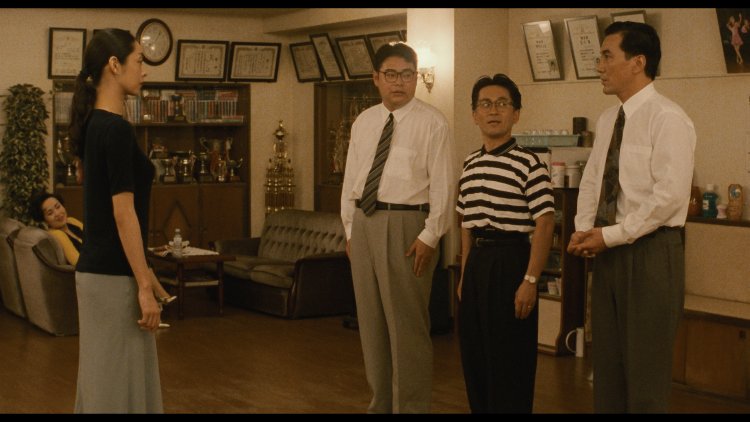
Ballroom dancing is regarded with suspicion in Japan, a country where even married couples do not touch in public. Shohei Sugiyama (Koji Yakusho, "Ran," "Tampopo") is a middle aged accountant who has just completely tethered himself to his humdrum job by purchasing a house for his wife, Masako (Hideko Hara) and teenage daughter Chikage (Ayano Nakamura). During his evening train commutes, Sugiyama becomes captivated by a beautiful woman gazing sadly out the window of The Kishikawa Dance Studio. He gathers up the courage to investigate and continues to admire Mai (Tamiyo Kusakari) from within the group lessons he signs up for when private lessons prove too expensive in "Shall We Dance?"
Laura's Review: A
This perfect Japanese comedy, originally released in 1996 followed by a 2004 American remake starring Richard Gere, has been given a 4K restoration and is being rereleased with seventeen additional minutes never before seen in North America. We reviewed the original way back on Reeling #0159 and it was an absolute joy to revisit it. The ensemble cast is delightful, expertly led by writer/director Masayuki Suô who brilliantly mixes complex character and cultural behaviors with physical movement both beautiful and hilarious. "Shall We Dance?" won all thirteen Japanese Academy awards in its day while also making Koji Yakusho, recently seen in "Perfect Days," a global star. (The opening narrative, explaining Japan's outlook on ballroom dancing and intimacy in general, was added for Western audiences.)
When Mr. Sugiyama returns home, the salaryman is so tired he heads straight to bed, rejecting his wife's offer of dinner. Masako is cheerful about returning to work, wanting to help with the new mortgage, but tells Chikage she's worried about Shohei, thinking he might be depressed. When he suddenly seems much happier and begins to come home late on Wednesday nights and occasionally go out on weekends, Masako begins to fret, assuming the worst, and goes to see a private investigator. In a scene which parallels her husband's shock at the cost of private dance lessons and the special shoes that go with them, Masako is stunned at the amount of an investigation. Taking pity, Detective Miwa (Akira Emoto), offers her a budget plan to follow her husband for three days.
Meanwhile, we watch as the kind and supremely patient Tamako Tamura (Raiko Kusamura, "The Twilight Samurai") leads Mr. Sugiyama's group of three. The tall, elegant Sugiyama struggles learning the steps while the pudgy, sweaty (and endearing) Masahiro Tanaka (Hiromasa Taguchi) has them mastered in minutes. As short as Sugiymama is tall, Tōkichi Hattori (Yu Tokui) is the mouthy group know-it-all who considers himself an expert because his wife dances. Sugiyama is amazed to discover a bewigged Tomio Aoki (Naoto Takenaka), the oddball office analyst who is almost bald and walks with military precision by taking every turn at a severe right angle, dancing flamboyantly, his shirt unbuttoned to his waist, in the persona of the wavy haired Donnie Burns, the Scottish Latin dance champ (it's a great parody - see for yourself here). The two keep each other's secret in the office.
Mai, the woman who has entranced Sugiyama, remains haughty, teaching a single client she clearly has no use for. Sugiyama becomes friendly with the other students, but when he waits for Mai one evening and asks her out to dinner, she coolly turns him down, informing him that she doesn't engage with students outside of class and that if she is the reason for his presence, he should quit. This proves a surprising turn for Sugiyama who refocuses and discovers he has a true passion for dancing and he accepts Aoki's invitation to join him at a dance hall. When he discovers Tamako working there part time, he asks his older mentor to dance and when the titular song comes on, they gracefully spin around the floor, his teacher telling him to feel the music and enjoy himself. Tamako encourages him further by suggesting he pair up with Toyoko Takahashi (Eriko Watanabe), the school's brash, brassy student, who is looking for a partner for a local competition. It is here where everything will come to a head, as Detective Miwa, having become a dance fan himself by being on the case, encourages Masako to surprise her husband by attending.
Masayuki Suô keeps us entertained throughout with such sight gags as Sugiyama's feet performing steps beneath his office desk or his moving in concert across the floor with Tanaka and Hattori, three mismatched men in sync. Every supporting player here has a story, from the widowed Toyoko trying to stem her loneliness to Aoki's zeal turning off the younger women he pursues as partners (those two, who are combatants at the school, will end up as well suited partners, gently nudged by Tamako). The screenplay connects Mai and Sugiyama psychologically, Sugiyama's treading on his partner's dress during the local competition connected to Mai's self-absorption during the world competition in Blackpool, the reason her father has insisted she instruct instead of compete, a mistake she blamed her partner for before seeing herself in Sugiyama. Most of all he uses the repressed reticence of Japanese culture throughout, not only for comedy but for the problems created because a husband cannot open himself up to his wife. When Chikage, who was impressed by her father at the competition, pushes him towards her mother in their backyard, the married couple's connection through dance is powerfully moving.
Koji Yakusho is tremendously appealing, his awkward shyness blossoming into grace on the dance floor, his newfound confidence powered by sheer joy. But while he's setting hearts aflutter, it is Raiko Kusamura who is the heart of the film, an aura of gentle kindness making her this film's fairy godmother. Naoto Takenaka is a comic highlight in his two very different personae, yet the actor lets the hurt hiding below the surface seep through. Hideko Hara is sweet as the quiet housewife who dares to say 'I love you.' But there isn't a false performance to be found here, the large and varied ensemble clicking like a well oiled machine. Production design takes us from Tokyo offices and businesses to suburban homes and dance floors of all types. Costume, makeup and hair design ranges from tasteful and elegant to loud and garish, reflecting the dancers' personalities. In addition to the Rogers & Hammerstein classic from "The King and I" which gives the movie its name, the soundtrack features The Drifters' 'Save the Last Dance for Me' with Yoshikazu Suo's score providing various dance beats.
The rerelease of "Shall We Dance?" is cause for celebration. It is a real treat whether one is revisiting it or discovering it for the first time.
Robin's Review: A-
Film Movement released "Shall We Dance?" in NYC on 5/30/25 followed by a national rollout. Click here for theaters and play dates.

